The POWERSTHETICS Manifesto
The philosophy of the complete athlete: why form and function are not opposites, and why the Big Three are the non-negotiable foundation of everything you build in the gym.
By Dhiren Dunraj MSc
Key Insight
“Before you choose a programme, before you pick a side, before you decide what kind of athlete you want to be — ask yourself one question: what is strength actually for?”
The First Question
Before you touch a barbell, before you choose a programme, before you decide what kind of athlete you want to be, ask yourself one question:
What is strength actually for?
A lifter who can move weight but cannot move well is not strong. An athlete who looks powerful but crumbles under real pressure is not powerful. The gym is a laboratory for building something real, and most people are running the wrong experiment.
Powersthetics is the answer to that question. It is a philosophy of physical completeness rather than a programme, the conviction that how you perform and how you are built are two expressions of the same underlying quality.
The Incomplete Athlete on Both Sides
There are two dominant approaches in modern training, and each one, taken alone, leaves something essential on the table.
The aesthetics-only approach can produce athletes who look extraordinary and perform ordinarily. When training is organised entirely around the mirror (pump work, isolation splits, no progressive overload on compound lifts) the result is a physique optimised for appearance rather than output. This is not a judgement of bodybuilding as a discipline; bodybuilding demands extraordinary commitment (and Why Bodybuilding Is Anything But 'Non-Functional' makes the case for that respect). But when aesthetics become the only goal, the athlete loses something. There is a gap between looking capable and being capable, and training exclusively for one side of that equation does not close it.
The strength-only approach can produce athletes who are genuinely powerful but who have accepted a false trade-off. The argument goes: I do not train to look good; I train to perform. The discipline behind that statement is real. But the premise is incomplete. Carrying excess body fat beyond the performance-optimal range does not add force production. Adipose tissue does not contract (Haff & Triplett, 2016). It does not improve rate of force development, work capacity, or durability. You can be remarkably strong and still be leaving performance on the table by ignoring body composition as a variable.
Neither approach is wrong. Both contain hard-won wisdom. But each one, taken as the entire picture, is incomplete.
The complete picture is Powersthetics.
Key Insight
“Aesthetics without capability is a costume. Strength without composition awareness is an incomplete equation. Powersthetics refuses to accept either trade-off.”
Your Time Is Finite. Train Like It.
You do not have unlimited time in the gym. Most people training seriously get somewhere between three and five hours a week under a barbell. Some get less. Life, work, family, and recovery all take their share first, and the gym gets what remains.
This is a constraint rather than a tragedy, and constraints, when taken seriously, are clarifying.
If you have three hours a week to build the strongest, leanest, most capable version of yourself, the question becomes ruthlessly simple: what gives the most return on that investment? What moves the needle furthest per hour spent?
The answer has been the same for decades. It is the squat. The bench press. The deadlift.
These three movements are the most efficient training stimulus in the history of physical development. That is because of anatomy, not tradition or tribalism. A heavy squat recruits quads, hamstrings, glutes, adductors, spinal erectors, core, and upper back simultaneously. A deadlift does the same from a different vector. A heavy bench press drives chest, shoulders, triceps, and stabilisers in one coordinated effort. No isolation exercise touches this. No machine circuit comes close. Suchomel, Nimphius, and Stone (2016) conducted a comprehensive review confirming that maximal strength, developed through multi-joint compound movements, underpins virtually every other physical quality, from sprint speed to change of direction to vertical jump.
This is the bang-for-your-buck argument, and it is not subtle. If you only have a few hours a week to train, spending forty minutes of them on bicep curls is a choice with consequences. You have voluntarily traded your most valuable resource, time, for one of the lowest-return investments available. Powerlifting Makes You Jacked lays out the hypertrophy science in detail, but the summary is straightforward: compound movements build more muscle, in more places, in less time.
Do the big work first, while you are fresh, while your nervous system is sharp, while you have something to give. Then, if time and energy remain, add the isolation work. It has its place. But it does not come before the foundation.
Compound movements first. Always.
Why the Big Three Are the Foundation of Everything
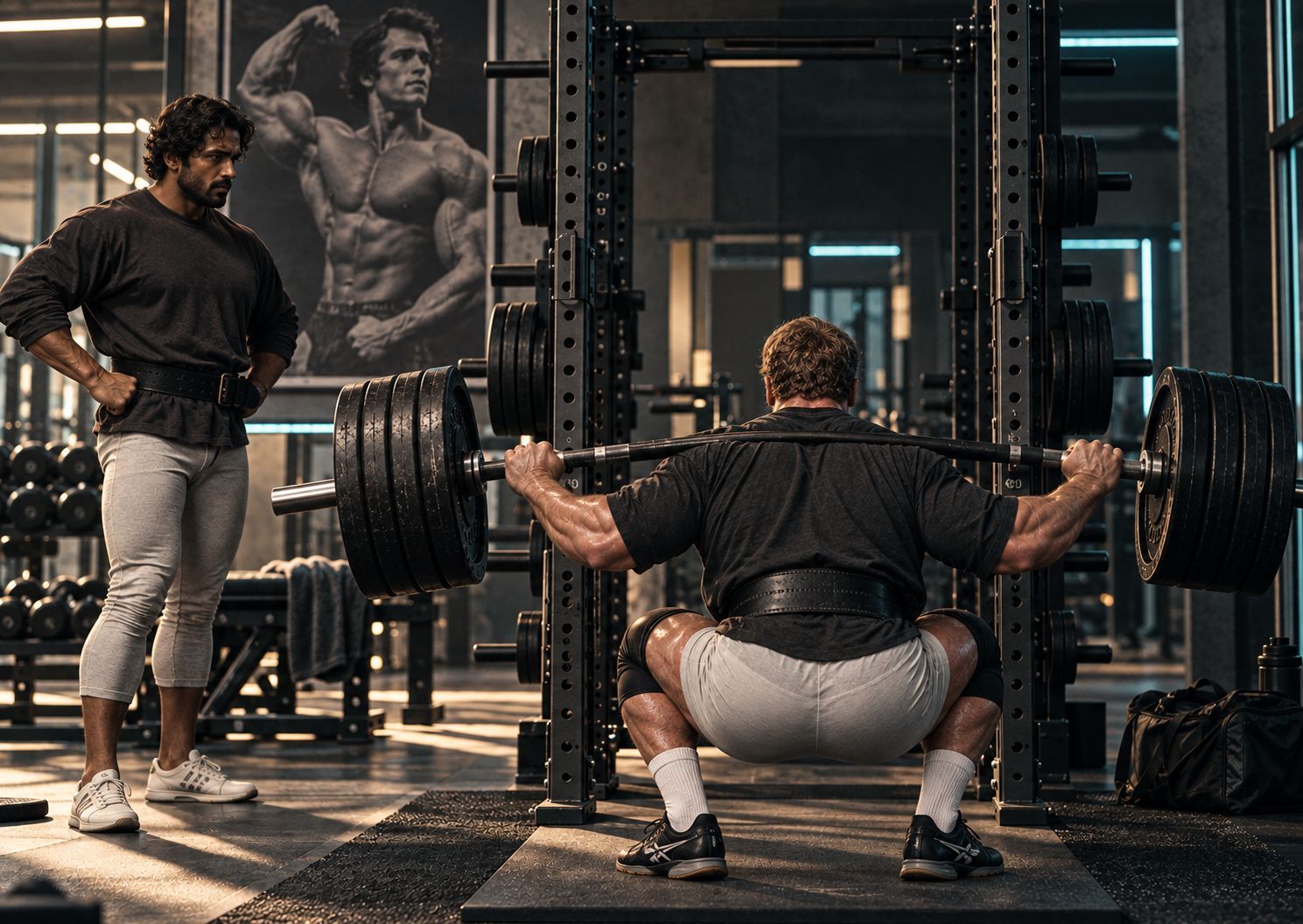
Most people walk into a gym and start decorating before they have built the house. Curls before squats. Cable flyes before bench press. Lateral raises before deadlifts. They are optimising the finish before laying the foundation, and wondering why they do not look or perform the way they want.
The squat, bench press, and deadlift are the most efficient, most proven, most physiologically complete training stimulus ever developed (Haff & Triplett, 2016). No isolation programme comes close.
This is a physics argument, not a powerlifting one.
Athletes who build their foundation on heavy compound movements carry a different kind of physicality. A footballer with a 180 kg squat moves differently on the pitch than one who only does leg press. A basketball player who deadlifts heavy has hip power and posterior chain resilience that no amount of band work produces. A combat athlete who presses heavy iron has a frame density that absorbs punishment differently. The Supremacy of Strength and Conditioning Over Functional Training for Sports makes this case across multiple sports, drawing on decades of strength and conditioning research.
The Big Three make you better at everything else. They are the foundation. Everything else is the decoration.
Build the house first. Then decorate the rooms. The foundation is the Big Three. The decoration is everything else. Most people are choosing wallpaper before they have poured the concrete.
It Is Not Easy. Nothing Worth Having Is.
Squatting heavy is hard. Deadlifting heavy is uncomfortable in ways that curl variations simply are not. The Big Three demand technique, patience, and a willingness to sit with difficulty over a long period of time before the results become obvious. There is no shortcut through a heavy squat. You cannot fake a 200 kg deadlift. The bar either moves or it does not, and if it does not, you know exactly where you stand.
That is the feature, not a flaw in the philosophy.
Nothing in life that is genuinely worth having comes easily. The career you respect, the relationships that sustain you, the character you want to build, all of it is forged through sustained effort against resistance. The gym is just the most honest version of that equation. The weight does not lie. The process does not flatter you. You show up, you do the work, and over time, the body changes.
The people who embrace this rather than resist it get something the shortcut-seekers never find: a deep confidence that comes from what they know they are capable of, not from how they look in a photo. They have been tested, repeatedly, under load, and they have not quit. That knowledge transfers. It has to.
Powersthetics is the complete path, not the easy one.
Muscle Quality: What Heavy Compounds Actually Build
Not all training produces the same kind of adaptation.
Heavy compound work (squats, deadlifts, presses performed at high loads through full ranges of motion) primarily drives hypertrophy through mechanical tension, which Schoenfeld (2010) identified as the dominant driver of muscle protein synthesis and structural adaptation. When muscle fibres are loaded heavily and repeatedly over months and years, the resulting growth is dense, contractile, and force-producing. The muscle does not disappear when the pump fades. It is structurally there.
You may encounter an older framework that divides hypertrophy into "myofibrillar" (dense, contractile protein) and "sarcoplasmic" (fluid volume within the cell) categories, suggesting they are entirely separate and trainably distinct pathways. The reality is more nuanced. Recent work, including Taber et al. (2019), confirms that myofibrillar hypertrophy, the addition of contractile proteins, is a genuine and primary contributor to strength gains, but the sharp binary between "dense functional muscle" and "puffy non-functional muscle" overstates the degree to which training can selectively target one mechanism in complete isolation from the other.
The evidence does clearly support this: heavy compound training produces capable, force-producing muscle adaptations that are visible and palpable even outside the gym. The athlete who has spent years squatting heavy carries a different density than the athlete who has only ever chased the pump. That density is the accumulated effect of sustained mechanical tension on contractile tissue (Schoenfeld & Grgic, 2020; Counts et al., 2016).
Powersthetics trains for both strength and volume. But it trains them in the right order. Build the heavy-compound foundation first (dense, capable, force-producing tissue), then layer the higher-rep accessory work on top. The result is a physique that looks as hard as it performs.
Key Insight
“Build the strength foundation first. True aesthetics are earned through progressive overload, not inflated by a pump.”
The Performance Physiology of Body Composition
Muscle tissue generates force. Adipose tissue does not.
When you optimise body composition, you maximise contractile tissue per kilogram of bodyweight, improve neuromuscular recruitment efficiency, reduce inflammatory markers that impair recovery, and enhance insulin sensitivity for better nutrient partitioning. Huovinen et al. (2015) demonstrated that male athletes who reduced body fat through a structured protocol improved power output while maintaining hormonal balance, evidence that intelligent body composition management enhances rather than compromises performance.
Kraemer and Ratamess (2005) established that resistance training produces a hormonal environment (elevated testosterone, growth hormone, and insulin-like growth factor) that simultaneously supports muscle retention and fat metabolism. This environment is maximised when training revolves around heavy, multi-joint compound movements. The Big Three are also the most potent hormonal stimulus available in the weight room.
Body Fat Percentage: The Nexus of Health, Performance, and Longevity examines the evidence on target composition ranges across health and performance contexts. The short version: there is a physiological sweet spot where hormone production, joint health, and energy reserves are preserved while lean mass relative to total bodyweight is maximised. Training to reach and maintain that range is performance optimisation, not vanity.
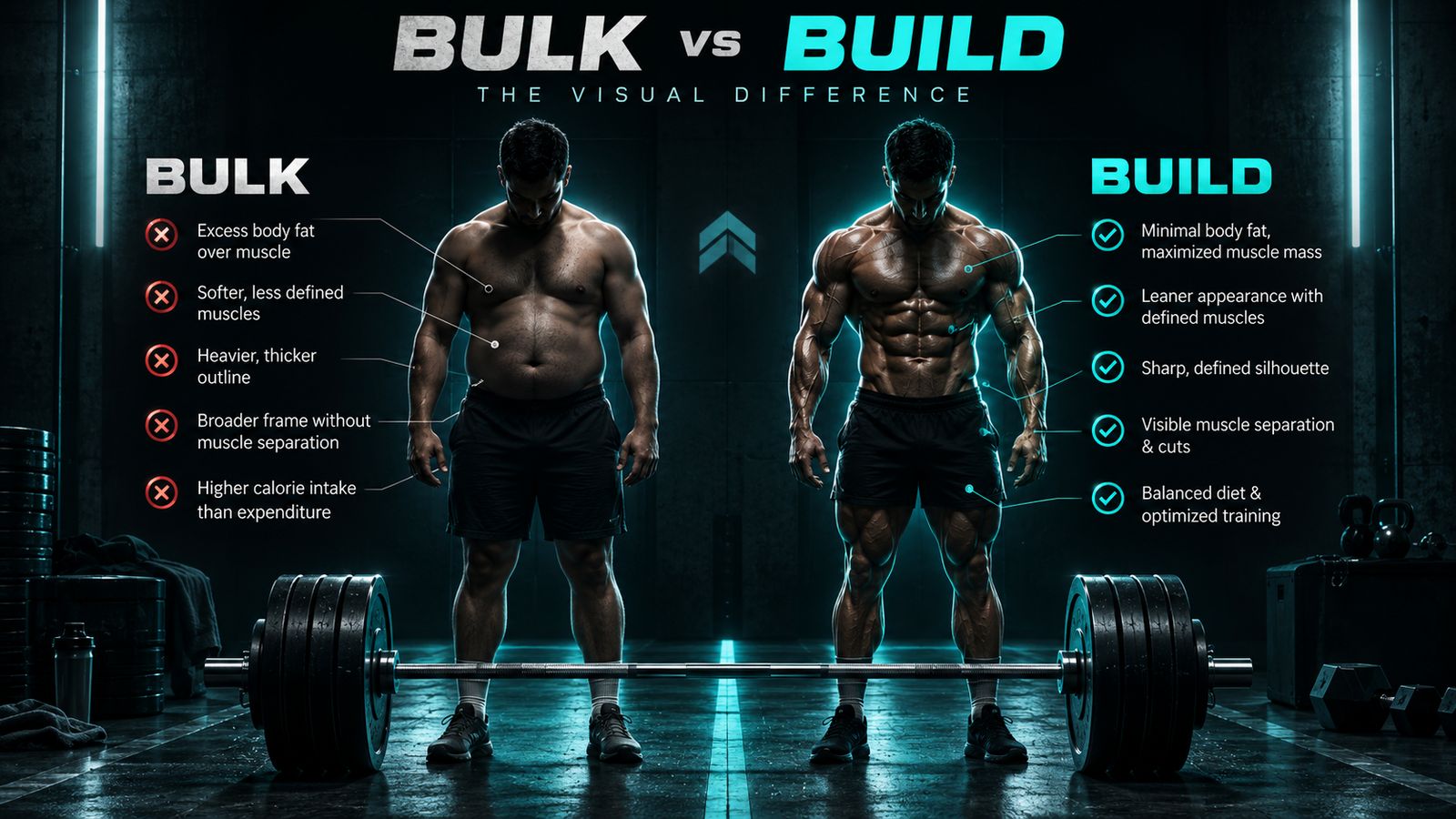
The strongest, most complete athletes in the world are not bulked up. They are built up. There is a difference, and it is visible in every aspect of how they move, how they perform, and how they carry themselves.
Key Insight
“The strongest athletes are not bulked up; they are built up. Optimising your power-to-weight ratio is the ultimate athletic advantage.”
The Forgotten Strength: The Psychology of Capability
There's a tale from Eastern mythology that gets at something most sports psychology misses.
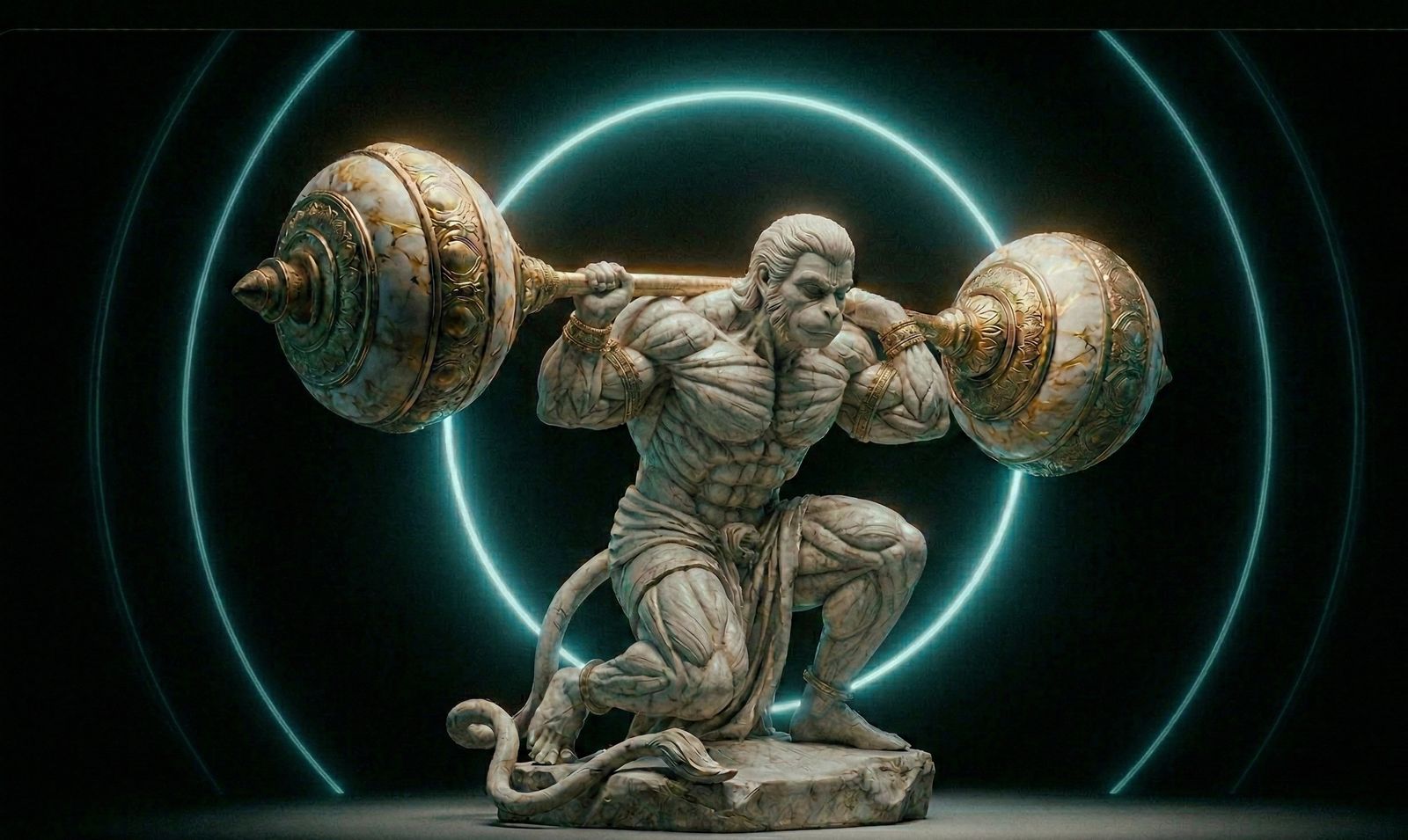
The ancient warrior, Hanuman, was born with strength so vast, and so careless with it as a child, that the sages cursed him to forget it. Not to lose it. To forget it. The power stayed exactly where it had always been, coiled in his frame, while his reflection showed him someone ordinary. He spent years as a fraction of himself, a devoted subordinate with no idea that the body he saw each day was built for something enormous.
The curse held until a mission demanded everything: an ocean nobody could cross, an army stalled on the shore. An elder pulled him aside and gave him one speech. No new skill, no new weapon. Just a reminder of what he already was. 'You are capable of this. Remember your nature.' In that moment, the curse shattered, and his latent capability finally matched his physical aesthetic. What he did next was what he had always been capable of.
The frame tells the truth before the mind believes it. Strength is written into the body long before anyone gets to see it, invisible in the mirror, waiting on structure and intent. You can carry the muscle and the wiring to pull a heavy deadlift for years without ever meeting it, because potential is quiet. It waits for something worth remembering yourself for. And a body that can move real weight looks like a body that can.
Powersthetics is built on that. The heavy barbell is the modern version of the elder's speech. Load it, and the body remembers what it was built for, then starts to look like it.
For the Athlete: Why This Applies to Your Sport
If you play sport at any level — football, rugby, basketball, combat sports, athletics, anything — Powersthetics is your training, not something adjacent to it.
Power transfers. The hip drive developed in a heavy deadlift is the same hip drive used to explode off a defensive line, to drive through a tackle, to accelerate in the first three steps of a sprint. Suchomel et al. (2016) found that stronger athletes consistently outperformed weaker athletes in sprint speed, change of direction, and vertical jump, regardless of sport. There is no athletic context where being stronger in the fundamental movement patterns makes you worse.
Body composition is athletic currency. Every kilogram of lean muscle generates force, absorbs impact, and sustains effort. Every kilogram of excess fat contributes nothing to any of those functions. In field sports, combat sports, and court sports, your power-to-weight ratio is the performance multiplier that sits underneath every other quality. Powersthetics optimises that ratio as its primary goal.
Durability. Athletes who build their frames on heavy compounds develop structural resilience. Dense posterior chains, strong hips, and a powerful trunk are nature's best joint stabilisers. The Powersthetics athlete is more powerful and harder to break.
Longevity. The athlete who chases aesthetics without function burns out or breaks down. The athlete who chases function without optimising body composition leaves performance on the table. Powersthetics plays the long game: building a body that performs and looks the part, for decades. Mattocks et al. (2017) showed that consistently practising heavy lifts produced strength gains that rivalled a far higher-volume programme over eight weeks, which supports the time-efficient Powersthetics approach.
Key Insight
“An athlete who chases aesthetics without function burns out, while one who ignores body composition leaves performance on the table. Complete athleticism demands both.”
What Powersthetics Demands of You
This philosophy offers no shortcuts, only something rarer: a complete picture of what you could be.
It demands that you train the Big Three with seriousness, consistency, and progressive intent, as the non-negotiable spine of everything you do in the gym rather than one option among many.
It demands that you take body composition seriously as a performance metric, as honest accounting of what your body is actually optimised for rather than as vanity.
It demands that you reject both incomplete extremes: the aesthetics-only approach that produces appearance without output, and the strength-only approach that accepts unnecessary limitations in the name of not caring how you look.
It demands that you be honest with yourself about where you are and what you are working toward.
And it offers, in return, something neither approach can fully deliver on its own: a body that is powerful and looks powerful. A physique that performs under real pressure. An athlete who is complete.
The Manifesto in Three Lines
Build the foundation with the Big Three. Optimise body composition as a performance metric. Let the aesthetic be the honest expression of the work.
This is Powersthetics. Welcome.
Key Takeaways
- Powersthetics is the philosophy that strength and aesthetics are not opposing goals — they are two expressions of the same underlying quality: complete physical development.
- The squat, bench press, and deadlift are the most time-efficient training stimulus available and underpin every other physical quality (Suchomel et al., 2016).
- Neither the aesthetics-only nor the strength-only approach builds the complete athlete; each one, taken as the entire picture, is incomplete.
- Heavy compound training produces dense, force-producing muscle adaptations that persist beyond the training session — the result of sustained mechanical tension on contractile tissue (Schoenfeld, 2010).
- Optimising body composition is a performance variable, not a vanity metric — leaner athletes at the same lean mass produce more force per kilogram of bodyweight (Huovinen et al., 2015).
- Time in the gym is finite. Compound movements first, accessory work second. Build the house before you decorate the rooms.
Put It Into Practice
This week: Audit your current training split. Count how many minutes per session you spend on compound barbell movements versus isolation work. If compound work is not taking up at least 60% of your training time, restructure your next session to prioritise the Big Three. Move squats, bench, and deadlifts to the front of the session when your nervous system is freshest.
This training block: Set a body composition baseline. Use The Final Form Physical Form Analysis to get your current measurements, or take waist circumference, bodyweight, and progress photos under consistent conditions. You cannot manage what you do not measure. Simultaneously, add one working set per week to your primary compound lifts over the next four weeks — this is the progressive overload that drives adaptation.
Long term: Commit to the complete picture. Plan your training year around progressive overload on the Big Three as the non-negotiable foundation, with body composition targets set alongside strength targets — not instead of them. Review both metrics every training block. The athlete who tracks force production and body composition is the athlete who reaches their potential.
References
- Schoenfeld, B. J. (2010). The mechanisms of muscle hypertrophy and their application to resistance training. Journal of Strength and Conditioning Research, 24(10), 2857-2872.
- Suchomel, T. J., Nimphius, S., & Stone, M. H. (2016). The importance of muscular strength in athletic performance. Sports Medicine, 46(10), 1419-1449.
- Huovinen, H. T., et al. (2015). Body composition and power performance improved after weight reduction in male athletes without hampering hormonal balance. Journal of Strength and Conditioning Research, 29(1), 29-36.
- Haff, G. G., & Triplett, N. T. (Eds.). (2016). Essentials of Strength Training and Conditioning (4th ed.). Human Kinetics.
- Kraemer, W. J., & Ratamess, N. A. (2005). Hormonal responses and adaptations to resistance exercise and training. Sports Medicine, 35(4), 339-361.
- Schoenfeld, B. J., & Grgic, J. (2020). Effects of range of motion on muscle development during resistance training interventions: a systematic review. SAGE Open Medicine, 8, 2050312120901559.
- Counts, B. R., et al. (2016). The acute and chronic effects of "NO LOAD" resistance training. Physiology & Behavior, 164, 345-352.
- Mattocks, K. T., et al. (2017). Practicing the test produces strength equivalent to higher volume training. Medicine and Science in Sports and Exercise, 49(9), 1945-1954.
- Taber, C. B., Vigotsky, A., Nuckols, G., & Haun, C. T. (2019). Exercise-induced myofibrillar hypertrophy is a contributory cause of gains in muscle strength. Sports Medicine, 49(7), 993-997.
*Use The Final Form Physical Form Analysis to establish your body composition baseline — then track it alongside your strength. Build the house properly, and let the decoration follow. Start your analysis here.*
Analysed by FINAL FORM AI. Your form, perfected.