Body Fat Percentage: The Nexus of Health, Performance, and Longevity
What your body fat percentage actually signals about your long-term health — beyond the aesthetics conversation.
By Dhiren Dunraj MSc
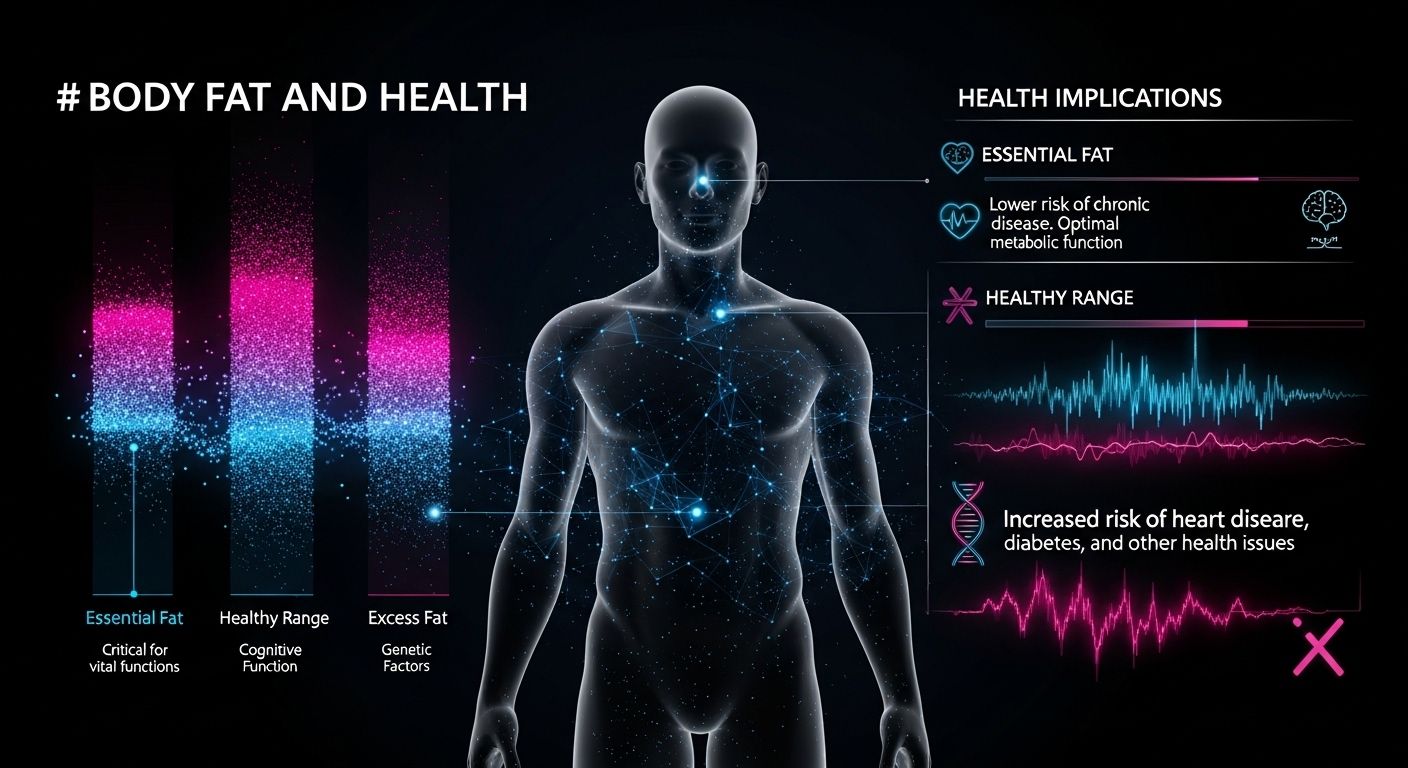
Key Insight
“The weight on the bar reveals your strength. The composition of your body determines how long you get to pursue it.”
In the iron game, body composition obsession tends to centre on performance metrics: strength-to-bodyweight ratio, relative strength, leverages. These are legitimate concerns. But they represent only one dimension of why body fat percentage matters. The larger story is the relationship between your body composition and your survival: your biological capacity for a long, capable, disease-free life, well beyond this season's performance.
Your body fat percentage is one of the most powerful modifiable risk factors for all-cause mortality. For athletes it is the central premise of intelligent, long-term physical development: the body composition that optimises your strength performance largely overlaps with the body composition that protects your longevity. Understanding why, and the mechanisms that make this true, is essential knowledge for anyone who trains seriously.
Visceral vs Subcutaneous Fat: The Fat You Cannot Pinch
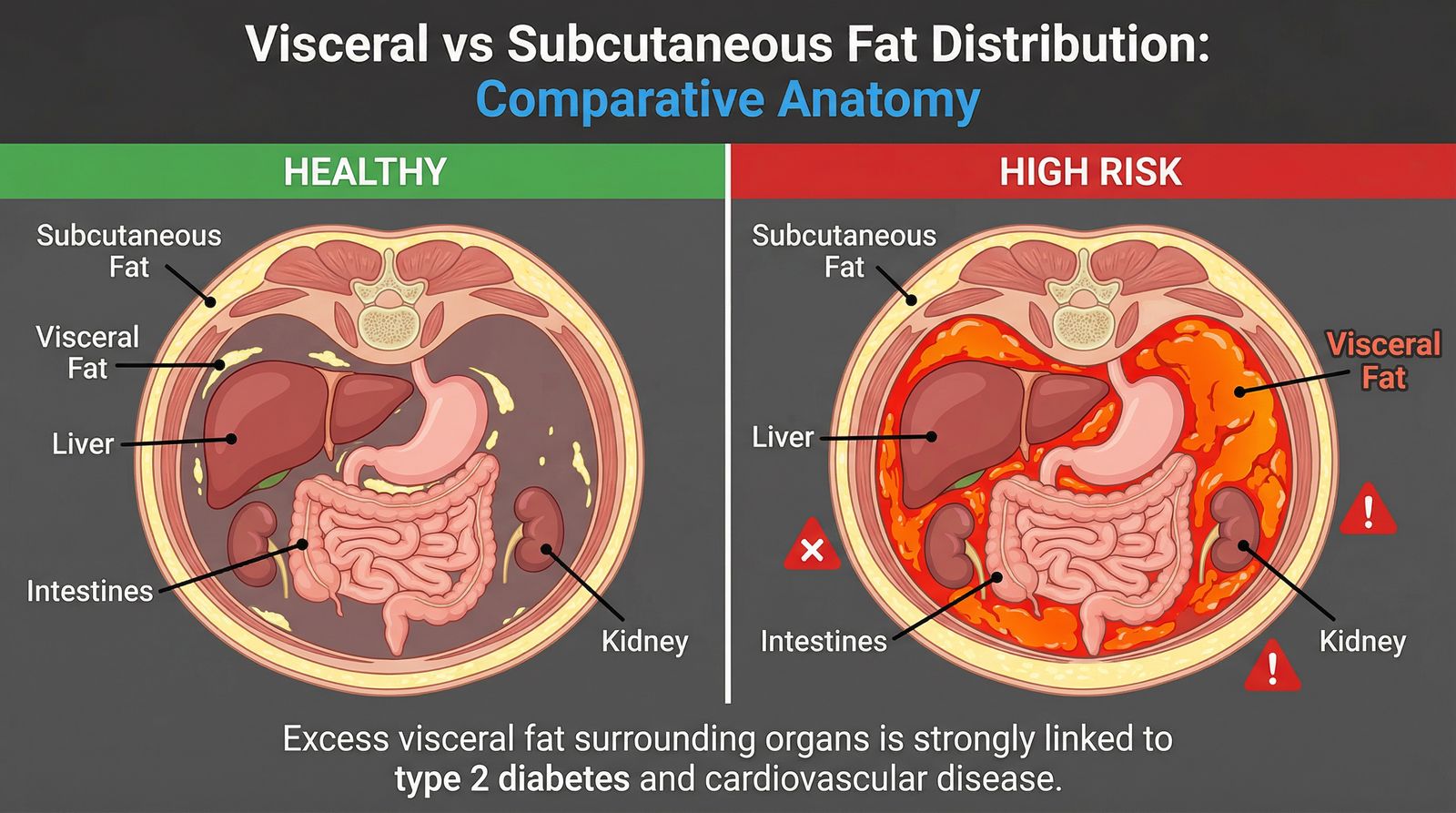
The first distinction, one most body fat discussions skip, is between subcutaneous adipose tissue and visceral adipose tissue. They are metabolically distinct tissues with radically different implications for health.
Subcutaneous fat, the fat that sits directly beneath the skin and can be grasped between the fingers, is largely metabolically benign. It serves as an energy reserve, provides thermal insulation, and functions as a mechanical cushion for underlying tissues. Moderate amounts of subcutaneous fat carry little pathological risk, and some evidence suggests that femoral-gluteal subcutaneous fat (the fat stored in the hips and thighs) may even be protective against cardiovascular disease.
Visceral adipose tissue (VAT) is the fat stored deep within the abdominal cavity, surrounding the liver, pancreas, and intestines. This is the dangerous fat. Tchernof & Despres (2013) conducted an extensive review of visceral fat pathophysiology and established that VAT is a metabolically active endocrine tissue that secretes adipokines (signalling molecules including resistin, interleukin-6, and tumour necrosis factor-alpha) that drive systemic inflammation, promote insulin resistance, disrupt lipid metabolism, and accelerate atherosclerotic processes.
High visceral fat burden is independently associated with type 2 diabetes, cardiovascular disease, non-alcoholic fatty liver disease, and several cancers, even in individuals whose total body weight appears normal (Neeland et al., 2019).
The "Skinny Fat" Problem: Normal Weight, Abnormal Risk
Researchers term one of the least discussed phenomena in metabolic health "metabolically unhealthy normal weight", colloquially the "skinny fat" phenotype. Stefan, Schick & Haring (2017) examined the epidemiology and pathophysiology of this condition and found that a non-trivial proportion of individuals with normal BMI carry high visceral fat burden and demonstrate the metabolic characteristics associated with obesity: insulin resistance, dyslipidaemia, elevated inflammatory markers, and elevated cardiovascular risk.
For the fitness community, the implication is that body weight and BMI are inadequate proxies for metabolic health. You can be lean by scale weight but carry dangerous levels of visceral fat if that weight is composed of low muscle mass and disproportionate adiposity in the abdominal compartment. Conversely, a heavily muscled powerlifter may have an elevated BMI while carrying minimal visceral fat and maintaining excellent metabolic health.
The most practical accessible proxy for visceral fat is waist circumference, specifically in relation to height. Jayedi et al. (2020) analysed data from 72 prospective cohort studies and found a clear, dose-response relationship between central adiposity (measured by waist circumference, waist-to-hip ratio, and waist-to-height ratio) and all-cause mortality. The waist-to-height ratio exceeding 0.5 (i.e., waist circumference greater than half your height) consistently identified elevated mortality risk across populations, regardless of total body weight.
Measure your waist at its narrowest point. Divide by your height in the same units. If the result exceeds 0.5, visceral fat reduction should be a primary health priority, aesthetics aside, because the data on mortality risk at this level of central adiposity is unambiguous.
Cardiorespiratory Fitness: The Variable That Overrides Body Fat
The most frequently ignored finding in the body composition and longevity literature is that cardiorespiratory fitness, measured by VO2 max, is a stronger predictor of all-cause mortality than body fat percentage.
Mandsager et al. (2018), in a study published in JAMA Network Open, followed 122,007 patients who underwent exercise treadmill testing and tracked survival over a median of 8.4 years. Individuals in the elite cardiorespiratory fitness category (top 2.3% for age and sex) showed an 80% reduction in all-cause mortality risk compared to those with the lowest fitness. The authors noted that the risk carried by low fitness was comparable to or greater than the risk carried by smoking.
The study detected no upper limit. Every incremental improvement in cardiorespiratory fitness was associated with additional mortality benefit, with no plateau at any measured fitness level.
For the strength athlete, body fat percentage and cardiorespiratory fitness are both important, but they are not redundant. An athlete who maintains low body fat through diet restriction alone, without developing cardiovascular fitness, does not achieve the mortality benefit of a fitter athlete at a slightly higher body fat percentage. The engine of your aerobic system (your VO2 max, your cardiac output, your mitochondrial density) matters independently of what the body fat calipers say.
VO2 Max for Strength Athletes: The Engine of Recovery covers this in full detail, including Zone 2 training methodology for building aerobic capacity without interfering with strength gains. Strength Training for Longevity: The Most Powerful Medicine examines the grip strength and muscle mass side of the longevity picture.
Leong et al. (2015), in the PURE study of 140,000 adults, found that grip strength, a proxy for overall musculoskeletal strength and lean mass, predicted all-cause mortality more powerfully than systolic blood pressure. Across this evidence, body fat percentage, cardiorespiratory fitness, and musculoskeletal strength are three independent contributions to longevity, and optimal health requires attending to all three.
Optimal Body Fat Ranges: Performance, Health, and Longevity Overlap
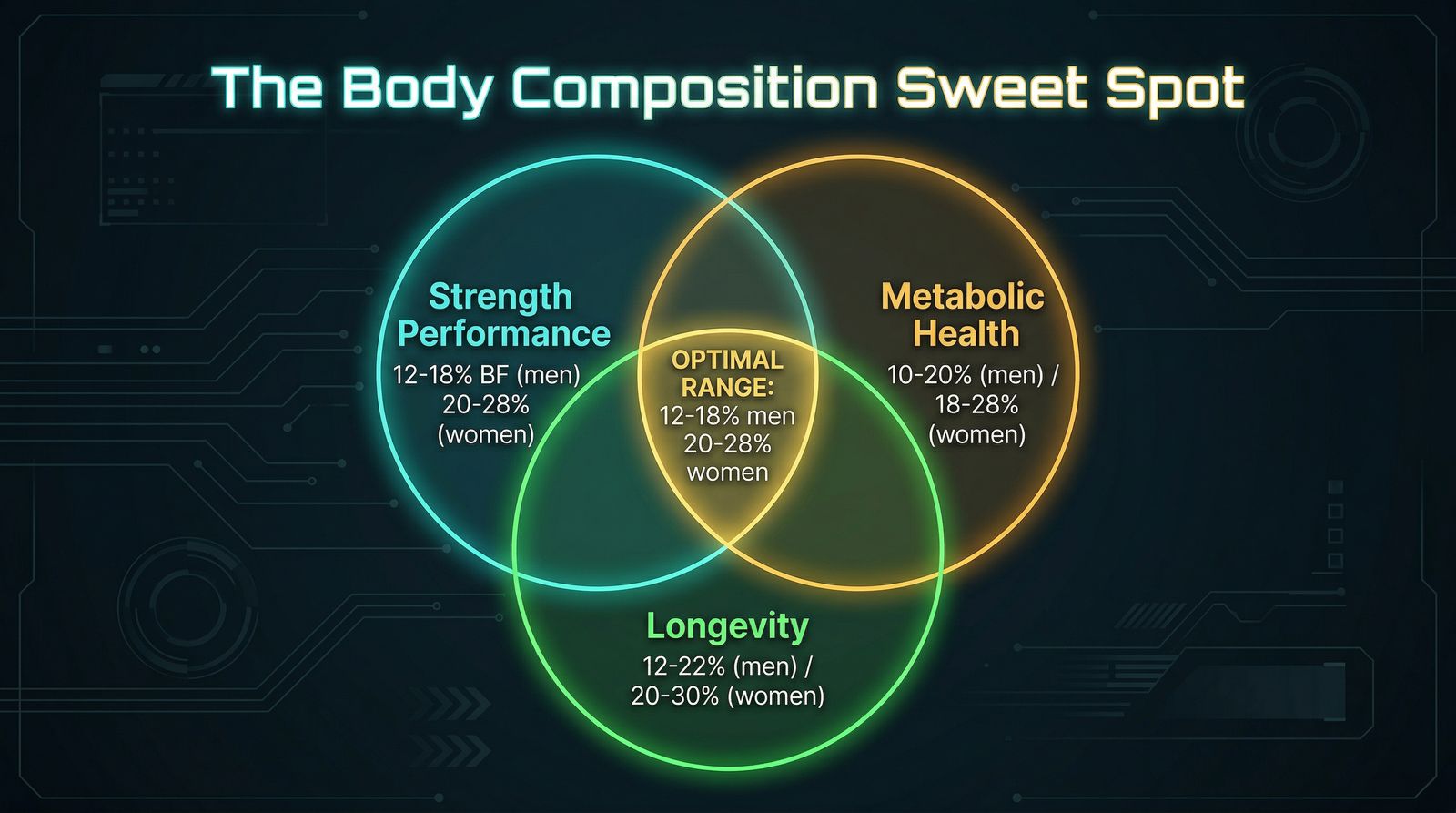
The evidence-based optimal ranges for body fat differ across these three domains.
For metabolic health (specifically, the avoidance of visceral fat-driven insulin resistance and cardiovascular risk), the general guidance for men is to stay below 20-25% body fat, with the risk inflection becoming steeper above this range. For women, the range extends to approximately 30-35% before metabolic risk becomes substantially elevated. However, these are population-level upper bounds. The metabolic health benefits of lower body fat are progressive, with no clearly defined "optimal" floor above essential fat levels.
For strength performance (maximising relative strength, keeping your lifts while managing bodyweight, and maintaining the mechanical leverages that enable maximal force production), the competitive performance range for men is approximately 8-14% body fat, and for women approximately 16-24%. These are the ranges where most elite powerlifters and weightlifters compete, balancing the strength advantages of lower body fat against the hormonal and recovery costs of extreme leanness.
For longevity (minimising all-cause mortality risk while maintaining the physical capacity required for independent function across decades), the overlap with performance ranges is substantial. The body composition that allows elite strength performance is largely the same body composition associated with the best long-term health outcomes, provided cardiorespiratory fitness is also maintained.
This convergence is the central argument for the POWERSTHETICS model. You are pursuing an integrated physical development approach where each goal reinforces the others, rather than choosing between aesthetics, performance, and health. The leanness that improves your Wilks score also reduces your visceral fat burden. The strength that improves your total also deposits into your longevity account. The Zone 2 cardio that improves your VO2 max also reduces your all-cause mortality risk by a magnitude that exceeds most medical interventions.
Measuring and Managing Body Composition
The practical challenge is measurement. Body fat percentage cannot be measured directly in a non-laboratory setting. Every accessible method is an estimation with meaningful error margins.
Skinfold callipers, when performed by a skilled practitioner using a validated protocol (Jackson and Pollock seven-site or three-site), provide reasonable precision for tracking relative changes in subcutaneous fat over time. They are less accurate for establishing absolute body fat percentage.
DEXA (dual-energy X-ray absorptiometry) scans are the most accurate clinically accessible tool, distinguishing fat, lean mass, and bone mineral density with a margin of error of approximately 1-2%. Annual DEXA scans are available at most private health clinics and provide far more actionable data than any home-based estimation.
Bioelectrical impedance (BIA) devices, including smart scales and handheld units, are highly variable in accuracy and influenced by hydration state, food intake, and electrode placement. Use them for trend tracking, not absolute measurement.
Waist circumference as described above is the most practically useful metabolic health proxy. It does not require specialist equipment, it directly reflects the visceral fat accumulation that carries the highest health risk, and it is free.
Track body composition over time. The goal is a trajectory, not a static number. A lifter who maintains 13% body fat across a decade of training while building 10 kg of lean mass has achieved something that most gym-goers never accomplish. That trajectory, building muscle while managing body fat, is the POWERSTHETICS ideal, and it serves your performance, your health, and your longevity at once.
Key Takeaways
- Visceral adipose tissue (VAT) — not subcutaneous fat — drives the metabolic disease risk associated with elevated body fat; VAT secretes inflammatory adipokines that promote insulin resistance, cardiovascular disease, and systemic inflammation (Tchernof & Despres, 2013).
- The "skinny fat" phenotype demonstrates that normal body weight does not guarantee metabolic health; waist-to-height ratio above 0.5 identifies elevated mortality risk regardless of scale weight (Jayedi et al., 2020).
- Cardiorespiratory fitness (VO2 max) is a stronger predictor of all-cause mortality than body fat percentage; elite fitness was associated with an 80% mortality reduction in the Mandsager et al. (2018) JAMA study, with no upper benefit limit detected.
- The body fat ranges optimal for strength performance (8-14% men, 16-24% women) substantially overlap with the ranges associated with the best metabolic and longevity outcomes.
- Body composition should be tracked as a trajectory over time — ideally via annual DEXA and consistent waist circumference monitoring — not as a fixed number measured by imprecise tools.
Put It Into Practice
This week: Measure your waist circumference at its narrowest point, between the lower ribs and iliac crest, first thing in the morning before eating. Divide by your height in the same units. If the ratio exceeds 0.5, make visceral fat reduction a primary health goal for your next training block, not an aesthetic afterthought.
This training block: Incorporate 150 minutes of Zone 2 cardio per week. Keep intensity conversational — you should be able to speak in full sentences comfortably. This volume is sufficient to drive meaningful improvements in VO2 max and visceral fat without compromising strength training adaptation when separated from lifting sessions.
Long term: Shift your body composition framing from short-term aesthetic targets to a multi-decade trajectory. Set an annual DEXA scan as a health investment. Track your waist-to-height ratio alongside your body fat and lean mass. Build a training and nutrition system that you can maintain consistently — not one that gets you to your leanest for a window, then rebounds.
Analysed by FINAL FORM AI. Your form, perfected.
References
- Mandsager, K., Harb, S., Cremer, P., Phelan, D., Nissen, S. E., & Jaber, W. (2018). Association of cardiorespiratory fitness with long-term mortality among adults undergoing exercise treadmill testing. JAMA Network Open, 1(6), e183605.
- Jayedi, A., Soltani, S., Zeraattalab-Motlagh, S., & Shab-Bidar, S. (2020). Central fatness and risk of all cause mortality: systematic review and dose-response meta-analysis of 72 prospective cohort studies. BMJ, 370, m3324.
- Tchernof, A., & Despres, J. P. (2013). Pathophysiology of human visceral obesity: an update. Physiological Reviews, 93(1), 359-404.
- Neeland, I. J., et al. (2019). Visceral and ectopic fat, atherosclerosis, and cardiometabolic disease: a position statement. The Lancet Diabetes & Endocrinology, 7(9), 715-725.
- Stefan, N., Schick, F., & Haring, H. U. (2017). Causes, characteristics, and consequences of metabolically unhealthy normal weight in humans. Cell Metabolism, 26(2), 292-300.
- Leong, D. P., et al. (2015). Prognostic value of grip strength: findings from the Prospective Urban Rural Epidemiology (PURE) study. The Lancet, 386(9990), 266-273. PMID: 25982160
- Després, J. P. (2012). Body fat distribution and risk of cardiovascular disease: an update. Circulation, 126(10), 1301-1313. PMID: 22949540
- Ross, R., Neeland, I. J., Yamashita, S., et al. (2020). Waist circumference as a vital sign in clinical practice: a Consensus Statement from the IAS and ICCR Working Group on Visceral Obesity. Nature Reviews Endocrinology, 16(3), 177-189. PMID: 32020062
- Kodama, S., Saito, K., Tanaka, S., et al. (2009). Cardiorespiratory fitness as a quantitative predictor of all-cause mortality and cardiovascular events in healthy men and women: a meta-analysis. JAMA, 301(19), 2024-2035. PMID: 19454641