Why Bodybuilding Is Anything But 'Non-Functional'
The critique is not of bodybuilders — it is of the marketing category that dismisses their methods. Isolation work builds the engine of every movement.
By Dhiren Dunraj MSc

Key Insight
“Before you can be "functional," you must first be strong. Strength is built one muscle fibre at a time. That is precisely what bodybuilding does.”
The term "functional training" has become one of the most commercially successful and scientifically confused concepts in the fitness industry. Marketed through BOSU balls, suspension trainers, resistance bands, and movement-mimicry drills, it carries with it a pervasive implication: that traditional resistance training (and specifically, bodybuilding-style isolation work) is somehow "non-functional," detached from real-world performance, and therefore inferior.
This implication is wrong, and it misrepresents both the science of biomechanics and the nature of the discipline being dismissed.
Competitive bodybuilding is one of the most demanding pursuits in all of sport. The level of dietary precision required to reach sub-5% body fat on a competitive stage, while maintaining muscle mass built through years of systematic hypertrophy training, demands nutritional science, disciplined programming, and psychological fortitude of the highest order. The aesthetic result is the product of structured, intelligent effort over years or decades. Competitive bodybuilders deserve nothing but respect for what they achieve.
The critique in this article is aimed at the marketing category of "functional training" and the flawed logic that underpins it, not at bodybuilders or bodybuilding methods.
What "Functional" Actually Means in Biomechanics
In biomechanics and sports science, the word "functional" has a precise meaning that the fitness industry has entirely distorted. A movement or training method is functional to the extent that it transfers to a target activity, meaning it improves the performance capacity in the context for which training is being conducted.
This is governed by the SAID principle: Specific Adaptation to Imposed Demands. Your body adapts with specificity to the stresses you place on it. A squat is functional for a strength athlete because it directly trains the movement pattern and energy system used under a heavy bar. A triple extension pattern (power clean, broad jump, sprint) is functional for a rugby player because it builds the explosive force production that underpins their performance. A seated leg press performed in a chronic low-back pain patient is functional if it rebuilds their capacity to stand up from a chair.
The problem with "functional training" as a marketing category is that it has redefined "functional" to mean "looks like a sport movement." The assumption is that mimicking a sporting action under light resistance in the gym will improve that action in competition. This assumption is physiologically fragile.

Isolation Builds the Muscular Hardware of Every Movement
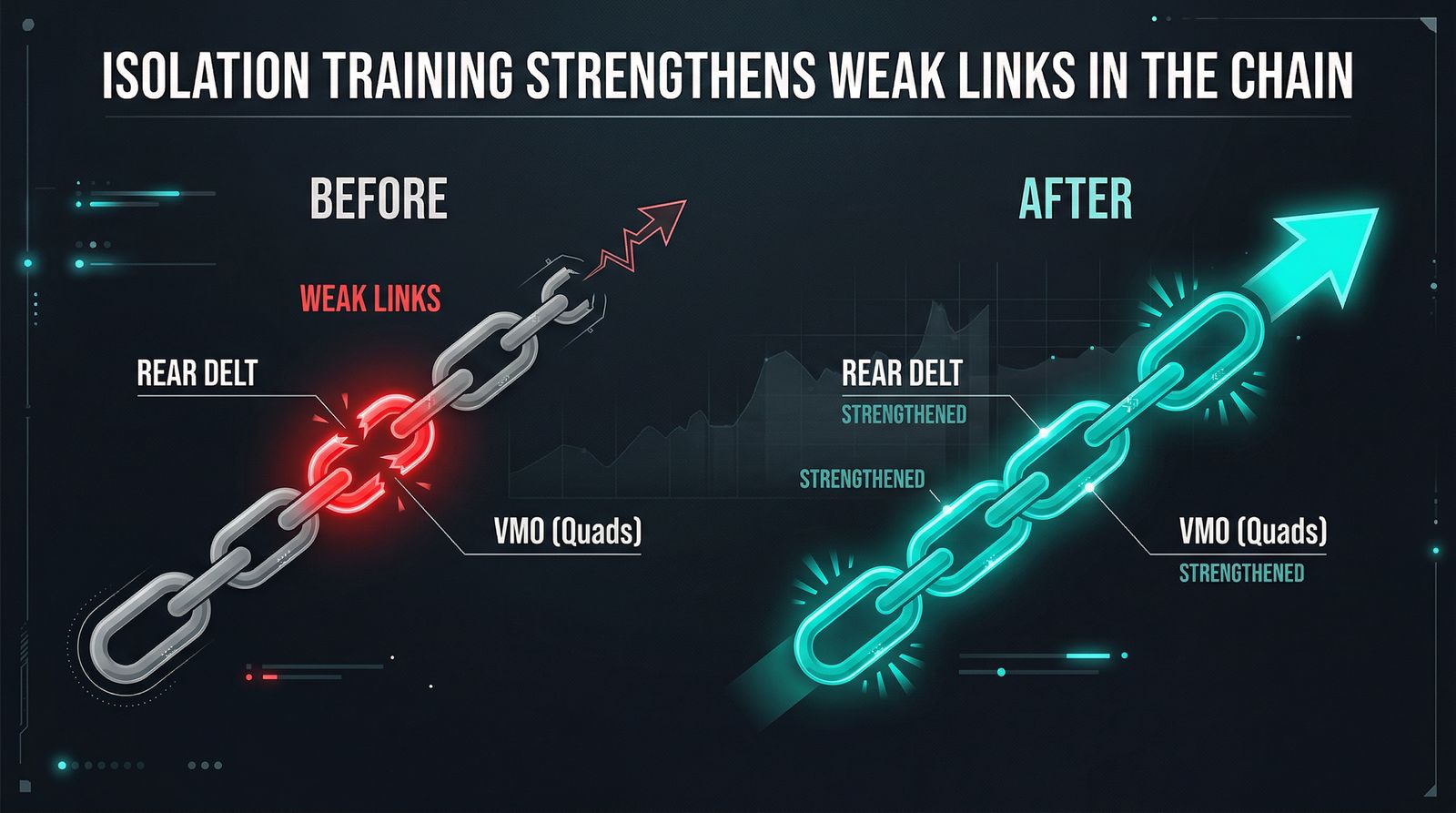
Consider any complex athletic movement: a punch, a tackle, a sprint, a pull-up. Each is a coordinated, multi-joint action involving the sequential activation of multiple muscle groups. The performance of that movement is limited by its weakest link, the individual muscle or group that cannot produce sufficient force or maintain stability under load.
This is precisely what bodybuilding-style training addresses. Isolation exercises (skull crushers, leg curls, lateral raises, face pulls, preacher curls) target individual muscles and force their hypertrophic development with a specificity that compound exercises cannot replicate. Schoenfeld (2010) documented that mechanical tension and metabolic stress (the primary mechanisms of muscle hypertrophy) are most effectively generated in a target muscle when that muscle is the primary mover in an exercise. Isolation exercises do exactly that.
If your bench press is failing at lockout, the limiting factor is likely tricep strength. The solution is to isolate and hypertrophy the tricep (through extensions, pushdowns, and close-grip work) so the weak link in the kinetic chain becomes stronger, not to bench press more explosively or add instability. A bigger, stronger tricep produces more force at every joint angle. It transfers directly, mechanically, to every push-based movement in which the tricep participates.
This is the central argument: bodybuilding isolation training systematically identifies and eliminates the weakest links in the muscular chain. It is the most direct method for building General Physical Preparedness (GPP), the raw physical hardware on which all athletic skills depend.
Ratamess et al. (2009), in the American College of Sports Medicine position stand on resistance training, confirmed that both multi-joint and single-joint exercises contribute meaningfully to strength and hypertrophy outcomes, and that the combination of compound and isolation work produces superior results to either in isolation. The evidence base for isolation training is mainstream, peer-reviewed, and well-established, not the dirty secret the functional training industry implies.
The Irony of Functional Incapacity
The fitness industry's "functional training" paradigm often produces a peculiar paradox: individuals who can perform impressive stability challenges on unstable surfaces, who demonstrate competent movement patterns with light loads, but who possess alarmingly little absolute force production capacity.
Behm & Colado (2012) reviewed the evidence on unstable surface training for rehabilitation and performance contexts, finding that unstable surface training reduces the force output available for strength development. The body's primary adaptation to instability is the recruitment of stabilising muscles, not the development of maximal force in prime movers. The result is a training stimulus that maximises joint awareness but minimises the load that can be applied to the muscles responsible for generating power and protecting the joints under heavy demand.
A competitor bodybuilder, by contrast, possesses extraordinary functional capacity. Their joints are armoured by dense, strong muscle that crosses and stabilises every major articulation. They have the absolute strength to perform virtually any physical task. Their body composition means they carry high lean mass with controlled adipose tissue. Suchomel, Nimphius & Stone (2016) reviewed the evidence that muscular strength is the foundational quality underlying almost every other athletic attribute: power, speed, agility, injury resistance. The bodybuilder's training directly develops this foundation.
The charge of non-functionality does not survive scrutiny. It reveals instead a category error: confusing sport-specific skill (which belongs in sport practice, not the gym) with physical preparedness (which is built in the gym through progressive overload of the musculoskeletal system).
Specificity Is a Spectrum, Not a Binary
The SAID principle does not divide exercises into "functional" and "non-functional" categories. It places all exercises on a spectrum of specificity relative to a target activity.
A heavy squat has extremely high specificity to strength training. A goblet squat has moderate specificity. A leg press has lower specificity but still builds the quadriceps required for the squat. A leg extension has the lowest specificity of all but may be the most appropriate tool for isolating a specific quad deficit or rehabilitating the knee after injury. None of these exercises is "non-functional." Each sits at a different point on the specificity spectrum and serves a different purpose within a complete programme.
Intelligent programming uses the full spectrum. Compound, multi-joint movements with heavy loads build the maximal strength and neural adaptations that govern performance. Isolation exercises build the muscular architecture (the raw size and strength of individual muscles) that underpins the compound movements. Kraemer & Ratamess (2004) described the systematic combination of these tools as the foundation of effective resistance training programming, and the evidence has not changed in the decades since.
The POWERSTHETICS model applies this principle directly: use hypertrophy training (including isolation work performed with the deliberateness and intensity of a competitive bodybuilder) to build the muscular hardware. Apply that hardware through heavy compound lifts to develop maximal force production. The two methods are complementary phases of a complete physical development system, not competitors.
The Supremacy of Strength and Conditioning Over Functional Training for Sports examines this from the athletic development perspective: how the SAID principle and the force-velocity curve apply to sports beyond the weight room.
The Discipline That Deserves Credit
Any honest conversation about bodybuilding methodology must acknowledge the magnitude of the commitment it requires. The preparation phases for competitive bodybuilding involve months of dietary restriction so severe that it produces physiological states few other athletes ever experience. Hormonal disruption, extraordinary cognitive demand from constant dietary monitoring, the psychological weight of visible leanness at its extremes: these are defining tests.
Elite competitive bodybuilders are among the most disciplined athletes in any sport. Their approach to nutrition, recovery, supplementation, and training periodisation is extraordinarily detailed and systematically applied. The methods they have developed through decades of practical experimentation (particularly in the areas of volume tolerance, hypertrophy stimulus, nutrient timing, and recovery management) have been retrospectively validated by sports science and are now foundational to mainstream strength and conditioning practice.
Dismissing bodybuilding as non-functional is scientifically incorrect, and it ignores the contribution that bodybuilding's methods and practitioners have made to everything we now understand about building strong, capable human bodies.
The Foundations of Macronutrients for Strength Athletes presents the nutritional framework that bodybuilding culture largely developed, and which sports science has confirmed as optimal for any strength or physique goal.
Key Takeaways
- Competitive bodybuilding is a demanding, disciplined pursuit that deserves full respect — the critique here is directed at the "functional training" marketing category, not at bodybuilders or their methods.
- "Functional" means transfer to a target activity, governed by the SAID principle — it is a spectrum, not a binary, and bodybuilding isolation work has direct transfer to every compound movement through kinetic chain strengthening.
- Unstable surface training reduces force output compared to stable training; its place is rehabilitation, not primary strength development (Behm & Colado, 2012).
- Isolation exercises systematically strengthen individual muscular links in the kinetic chain, eliminating weak points that limit performance in compound movements and real-world tasks.
- Muscular strength is the foundational athletic quality underlying power, speed, agility, and injury resistance — bodybuilding training develops exactly this foundation (Suchomel et al., 2016).
Put It Into Practice
This week: Identify the weakest muscular link in your most important lift. For the bench press, this is commonly the triceps (lockout failure). For the squat, it is often the glutes or adductors (collapsing out of the hole). For the deadlift, it may be the upper back (rounding off the floor). Add one high-volume isolation exercise for that muscle group at the end of your next session — 3-4 sets of 10-15 reps at an RPE 7-8.
This training block: Programme a 6-8 week hypertrophy block in your next off-season with a 60:40 compound-to-isolation ratio. Structure each session as: 2 compound lifts at 70-80% 1RM for 3-4 sets of 6-8 reps, followed by 3-4 isolation exercises at 3 sets of 10-15 reps targeting identified weak points. Track total weekly volume per muscle group — aim for 12-20 sets per muscle group per week (Ratamess et al., 2009). You will return to your main lifts with more muscular hardware to work with.
Long term: Abandon the functional versus non-functional framing entirely. Build your annual programme with exercises from across the specificity spectrum: heavy compound lifts (1-5 reps) for maximal strength, moderate-load compound work (6-10 reps) for technique and volume, and isolation exercises (10-15 reps) for targeted hypertrophy and kinetic chain integrity. Allocate at least one training block per year to hypertrophy-dominant work — the structural muscle built during these phases is the raw material that powers your compound lift progression.
Analysed by FINAL FORM AI. Your form, perfected.
References
- Schoenfeld, B. J. (2010). The mechanisms of muscle hypertrophy and their application to resistance training. Journal of Strength and Conditioning Research, 24(10), 2857-2872.
- Behm, D. G., & Colado, J. C. (2012). The effectiveness of resistance training using unstable surfaces and devices for rehabilitation. International Journal of Sports Physical Therapy, 7(2), 226.
- Ratamess, N. A., et al. (2009). Progression models in resistance training for healthy adults: ACSM position stand. Medicine and Science in Sports and Exercise, 41(3), 687-708.
- Kraemer, W. J., & Ratamess, N. A. (2004). Fundamentals of resistance training: progression and exercise prescription. Medicine and Science in Sports and Exercise, 36(4), 674-688.
- Suchomel, T. J., Nimphius, S., & Stone, M. H. (2016). The importance of muscular strength in athletic performance. Sports Medicine, 46(10), 1419-1449. PMID: 26838985
- Anderson, K., & Behm, D. G. (2005). The impact of instability resistance training on balance and stability. Sports Medicine, 35(1), 43-53. PMID: 15651912
- Paoli, A., Gentil, P., Moro, T., et al. (2017). Resistance training with single vs. multi-joint exercises at equal total load volume: effects on body composition, cardiorespiratory fitness, and muscle strength. Frontiers in Physiology, 8, 1105. PMID: 29312007
- Gentil, P., Soares, S., & Bottaro, M. (2015). Single vs. multi-joint resistance exercises: effects on muscle strength and hypertrophy. Asian Journal of Sports Medicine, 6(2), e24057. PMID: 26446291