Strength for Longevity: The Ultimate Investment in Your Future Self
Grip strength predicts mortality better than blood pressure. Muscle mass predicts functional independence at 80. The iron is the longest investment you can make.
By Dhiren Dunraj MSc

Key Insight
“The iron is not just for the platform or the beach. It is for the day when you are 80 years old and need to pick yourself up off the floor.”
You train for performance. You train for aesthetics. But the strongest reason to lift heavy through your entire life is that your strength is one of the most powerful predictors of how long you will live and how well you will live it. Strength training for longevity is a lifelong biological imperative, not a retirement-age hobby. Muscle is the organ of longevity.
The data on this is not nuanced in the way dietary science so often is. It is overwhelming, consistent, and demands a change in how every person who has ever touched a barbell thinks about why they train.
Grip Strength Predicts Mortality Better Than Blood Pressure
The PURE study, published in The Lancet by Leong et al. (2015), followed nearly 140,000 adults across 17 countries over a median of four years. Grip strength turned out to be a stronger predictor of all-cause mortality and cardiovascular mortality than systolic blood pressure.
Every 5 kg decrease in grip strength was associated with a 16% increase in all-cause mortality, a 17% increase in cardiovascular mortality, and a 9% increase in the risk of stroke. Your doctor measures your blood pressure at every appointment. Almost no clinician measures your grip strength. Yet the data suggests grip strength (a direct proxy for overall musculoskeletal strength) is the more powerful predictor of your survival.
This is not because a weak handshake kills you directly. Grip strength is a proxy for total-body muscular strength and the maintenance of lean mass. It reflects decades of physical activity, the integrity of your musculoskeletal system, and the metabolic health of your muscle tissue. A strong grip tells the story of a body that has been consistently demanded to produce force.
Strength training for longevity, practised intelligently across a lifetime, produces exactly this outcome.
Cardiorespiratory Fitness: The Ceiling Has No Upper Limit
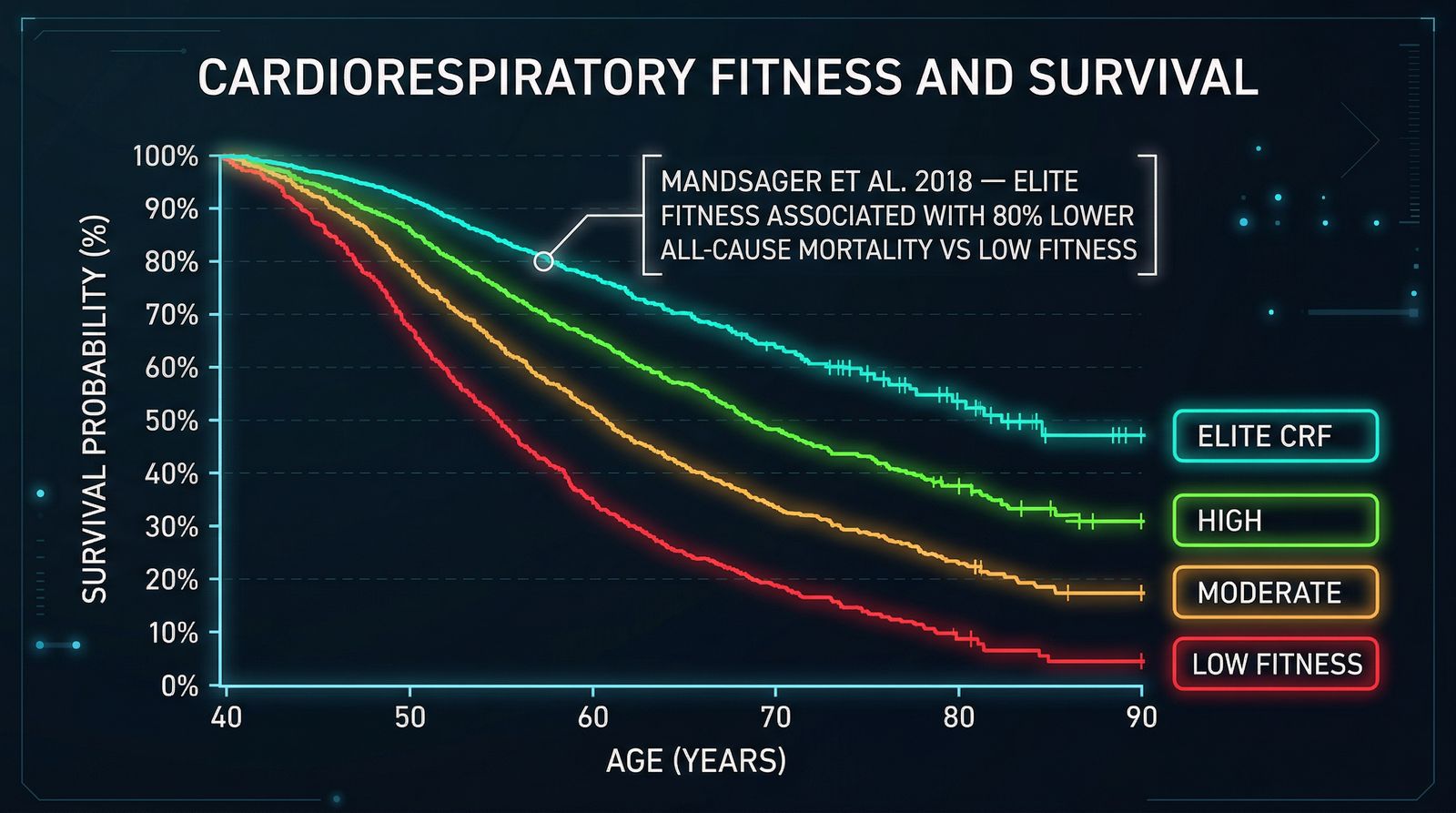
Strength alone does not complete the picture. The research by Mandsager et al. (2018), published in JAMA Network Open, followed over 122,000 patients who underwent exercise treadmill testing and tracked their survival for a median of 8.4 years.
Compared to those with the lowest cardiorespiratory fitness, individuals with elite fitness had an 80% reduction in all-cause mortality. The authors noted that the risk carried by low fitness was comparable to or greater than the risk carried by smoking. There was no upper limit to the benefit. The fitter you are, the longer you live, with no plateau detected at any fitness level.
You may be able to deadlift 250 kg, but if your VO2 max sits in the bottom quartile for your age group, your longevity outlook is significantly worse than that of a weaker but aerobically fitter person. Strength is necessary but not sufficient.
VO2 Max for Strength Athletes: The Engine of Recovery explores this in depth. The short version is that you need both. A body that is strong and aerobically capable is the most durable instrument for a long life. The iron game builds the former. Your Zone 2 work builds the latter.
Muscle Mass as a Metabolic and Endocrine Organ
Srikanthan & Karlamangla (2014) analysed data from the National Health and Nutrition Examination Survey and found that higher muscle mass index was independently associated with lower all-cause mortality in older adults, even after controlling for cardiovascular risk factors. The relationship held regardless of whether subjects were obese or lean.
This is because muscle is metabolically active around the clock, not passive tissue waiting to be called upon during exercise. Skeletal muscle is the primary site of insulin-mediated glucose disposal, meaning the more muscle you carry, the more effectively your body clears blood glucose after a meal. This mechanism alone confers significant protection against type 2 diabetes and metabolic syndrome.
Muscle also functions as an endocrine organ. During and after contraction, muscle secretes signalling proteins called myokines, including irisin, interleukin-6, and brain-derived neurotrophic factor (BDNF). These compounds exert systemic anti-inflammatory effects, improve lipid metabolism, and support brain health. Every strength training session is a biochemical broadcast to every organ in your body.
The Enemy: Sarcopenia and the Compounding Cost of Decline
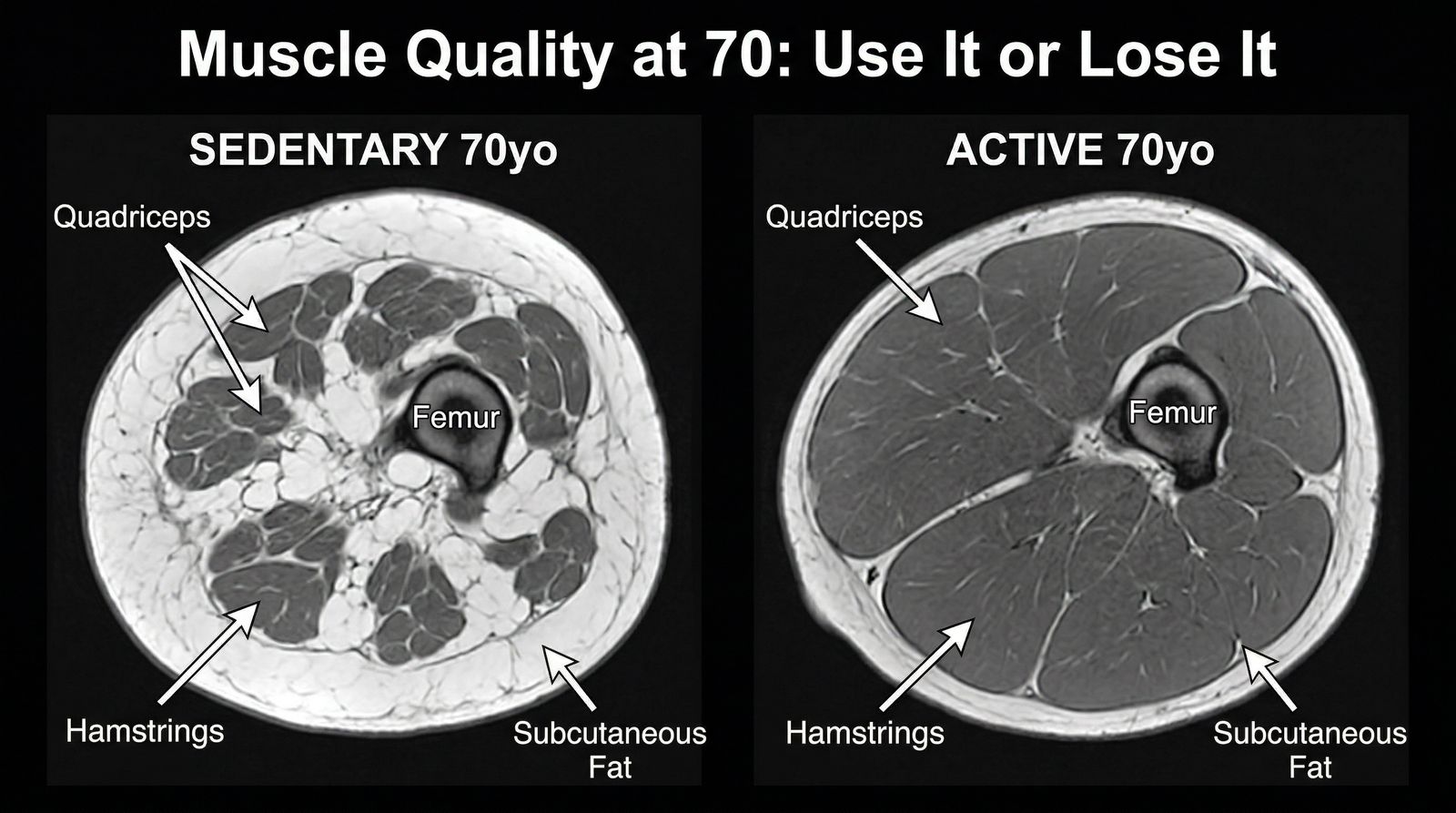
The age-related loss of muscle mass and function is formally defined as sarcopenia, a term whose severity has been consistently underappreciated in mainstream health discourse (Cruz-Jentoft et al., 2019). It begins in your third decade of life. After age 50, the average person loses 1-2% of muscle mass per year. After 60, the rate accelerates. By the time most people reach 70, they have lost 30-40% of the peak muscle mass they had in early adulthood.
Sarcopenia is the primary driver of frailty, the state of reduced physiological reserve that makes falls, hospitalisations, and infections disproportionately catastrophic. A fall that is a minor inconvenience at 35 is a life-altering or life-ending event at 82. The sequence is predictable: muscle loss leads to reduced gait speed and balance, which leads to falls, which leads to fractures, which leads to bed rest, which accelerates further muscle loss, which closes the loop toward total loss of independence.
Ageing does not make this inevitable. Not training does.
The intervention with the strongest, most consistent evidence for preventing and reversing sarcopenia is progressive resistance training (Fragala et al., 2019). The barbell is the most potent anti-ageing medicine available without a prescription, and it works at 25 and at 75.
Body Fat Percentage: The Nexus of Health, Performance, and Longevity examines the related question of how body composition (the ratio of lean to fat tissue, not only muscle mass) independently predicts survival.
The Centenarian Decathlon: Training for the Last Decade of Your Life
Physician and longevity researcher Peter Attia frames the challenge of longevity fitness through a concept he calls the Centenarian Decathlon. Instead of asking what physical feats you want to accomplish at your peak, ask what you want to be able to do in the last decade of your life.
Define your events. Consider some candidates:
- Get up off the floor unaided after a fall.
- Carry your own shopping without assistance.
- Lift your grandchild safely.
- Put a suitcase in the overhead locker without help.
- Walk up three flights of stairs without stopping.
- Maintain balance on an uneven surface.
None of these are endurance events. Every single one is a test of absolute or near-absolute strength, combined with mobility and balance. The ability to perform a bodyweight squat at 85 is determined by the strength you build during the decades before. You cannot compress this preparation into a short window before you need it. The physiological retirement account must be funded continuously, starting now.
If you want to be able to squat your bodyweight at 80, you need to account for the 30-40% muscle mass loss that will occur between now and then. If you can squat 2x bodyweight today, the trajectory is survivable. If you can barely manage your own bodyweight today, the mathematics are grim.
Train for the last decade. That means treating heavy compound strength training as a permanent practice rather than a phase of your life.
Strength Training for Longevity: Practical Principles
The longevity-optimised strength training programme does not look radically different from a well-constructed powerlifting programme. The principles converge:
Progressive overload remains essential. The stimulus for muscle protein synthesis and the maintenance of neuromuscular function is mechanical tension. The muscle must be regularly challenged with increasing loads. This principle applies at every age. Fragala et al. (2019) found that progressive resistance training improved muscle mass, strength, and functional capacity in older adults regardless of their starting point.
Compound movements are primary. Squats, deadlifts, presses, and pulls train multiple muscle groups, load the skeleton to maintain bone density, and produce systemic hormonal responses that isolation exercises cannot replicate. A programme built around these movements for life builds more than strength: it maintains the bone density and connective tissue integrity that prevents fractures from being fatal.
Consistency over intensity. The long-term data on strength training and longevity comes from individuals who maintained a training habit across decades, not those who trained maximally for a period and then stopped. A sustainable, enjoyable, and injury-managed practice across 40 years of training beats an aggressive but unsustainable programme across five.
Cardiorespiratory work is not optional. Given the data from Mandsager et al. (2018), the strength athlete who neglects their aerobic system is leaving enormous longevity benefit on the table. The minimum effective dose appears to be 150 minutes of moderate-intensity activity per week, with additional benefit from higher intensity work. This does not require running. Cycling, rowing, and brisk walking all deliver the stimulus.
The Iron as Medicine: Reframing Why You Train
The cultural narrative around strength training tends toward the immediate: bigger lifts, better aesthetics, next competition. These are legitimate and motivating goals. But they frame training as a finite pursuit, something you do until you've achieved what you wanted, or until life intervenes.
Reframing strength training for longevity requires a different lens. Every session is about more than today's performance: it maintains the biological machinery required for capability at every stage of life. The 35-year-old who squats heavy is making a deposit into an account that will pay dividends when they are 65, 75, and 85.
The iron does not care about your theories or your aesthetic goals. It cares only about force. Apply it consistently, across years and decades, and the adaptation is survival, the kind measured in years of capable, independent, high-functioning life.
No medication, no dietary supplement, no wellness protocol has the consistent, multi-mechanism longevity evidence that progressive resistance training does. It improves muscle mass, bone density, insulin sensitivity, myokine signalling, blood pressure, lipid profiles, and cognitive function. It does this across every age group and fitness level. It is available at every gym and, for the basics, in every home.
The only real question is whether the programme you are running right now is one you can sustain for the next 40 years.
Key Takeaways
- Grip strength predicted all-cause and cardiovascular mortality more powerfully than systolic blood pressure in the 140,000-person PURE study (Leong et al., 2015) — your strength is a direct survival metric.
- Elite cardiorespiratory fitness is associated with an 80% reduction in all-cause mortality, with no upper limit to the benefit detected at any fitness level (Mandsager et al., 2018).
- Sarcopenia begins in your 30s and strips 1-2% of muscle mass per year after 50; progressive resistance training has the strongest evidence for preventing and reversing it.
- Muscle functions as a metabolic and endocrine organ, improving insulin sensitivity and secreting anti-inflammatory myokines — benefits that operate continuously, not just during exercise.
- Train for your Centenarian Decathlon: the strength you need at 80 is determined by the strength you build in the decades before it.
Put It Into Practice
This week: Test your grip strength. If you do not have a dynamometer, perform a dead-hang from a pull-up bar and record your time. This is a practical measure of your functional strength and a longevity proxy worth tracking. Separately, calculate your estimated VO2 max zone using the formula: 220 minus your age, multiplied by 0.6-0.7 for Zone 2 heart rate. Do one 40-minute Zone 2 session this week.
This training block: Add one loaded carry variation — farmer's walks, suitcase carries, or Zercher carries — to the end of each lower body session. These build grip, core, and total-body strength with direct functional carryover. Simultaneously, commit to 150 minutes of Zone 2 cardio per week across 3-4 sessions on non-lifting days.
Long term: Reframe your primary motivation for training from short-term performance to lifelong capability. Ask yourself at the start of every training block: "Is this programme one I can sustain, adapt, and continue for the next decade?" Choose the exercise selection, load management, and injury prevention strategies that support a 40-year training career, not a 4-year peak.
Analysed by FINAL FORM AI. Your form, perfected.
References
- Leong, D. P., et al. (2015). Prognostic value of grip strength: findings from the Prospective Urban Rural Epidemiology (PURE) study. The Lancet, 386(9990), 266-273. PMID: 25982160
- Mandsager, K., Harb, S., Cremer, P., Phelan, D., Nissen, S. E., & Jaber, W. (2018). Association of cardiorespiratory fitness with long-term mortality among adults undergoing exercise treadmill testing. JAMA Network Open, 1(6), e183605. PMID: 30646252
- Srikanthan, P., & Karlamangla, A. S. (2014). Muscle mass index as a predictor of longevity in older adults. The American Journal of Medicine, 127(6), 547-553. PMID: 24561114
- Cruz-Jentoft, A. J., et al. (2019). Sarcopenia: revised European consensus on definition and diagnosis. Age and Ageing, 48(1), 16-31. PMID: 30312372
- Fragala, M. S., et al. (2019). Resistance training for older adults: position statement from the National Strength and Conditioning Association. Journal of Strength and Conditioning Research, 33(8), 2019-2052. PMID: 31343601
- García-Hermoso, A., Cavero-Redondo, I., Ramírez-Vélez, R., et al. (2018). Muscular strength as a predictor of all-cause mortality in an apparently healthy population: a systematic review and meta-analysis of data from approximately 2 million men and women. Archives of Physical Medicine and Rehabilitation, 99(10), 2100-2113.e5. PMID: 29425700
- Wolfe, R. R. (2006). The underappreciated role of muscle in health and disease. American Journal of Clinical Nutrition, 84(3), 475-482. PMID: 16960159
- Mitchell, W. K., Williams, J., Atherton, P., et al. (2012). Sarcopenia, dynapenia, and the impact of advancing age on human skeletal muscle size and strength; a quantitative review. Frontiers in Physiology, 3, 260. PMID: 22934016
- Kodama, S., Saito, K., Tanaka, S., et al. (2009). Cardiorespiratory fitness as a quantitative predictor of all-cause mortality and cardiovascular events in healthy men and women: a meta-analysis. JAMA, 301(19), 2024-2035. PMID: 19454641
- Ross, R., Blair, S. N., Arena, R., et al. (2016). Importance of assessing cardiorespiratory fitness in clinical practice: a case for fitness as a clinical vital sign: a scientific statement from the American Heart Association. Circulation, 134(24), e653-e699. PMID: 27881567