Why Every Athlete Should Be Squatting, Deadlifting, and Pressing
The squat, deadlift, and press are not powerlifting-specific. Charles Poliquin, Yuri Verkhoshansky, and the coaches who built the most decorated athletes in history all used them as the foundation of S&C — regardless of sport.
By Dhiren Dunraj MSc
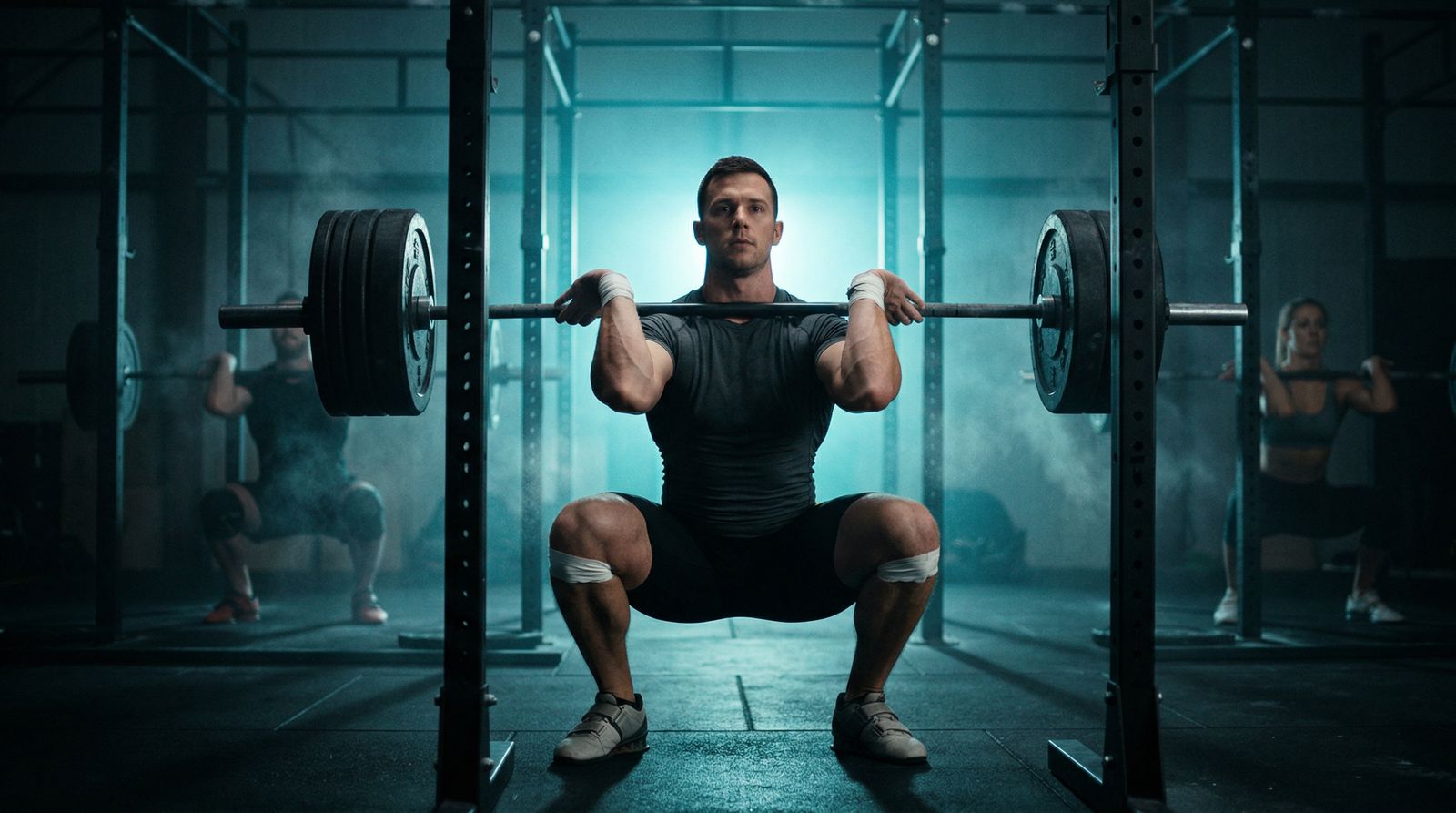
Key Insight
“"Strength is the mother of all physical qualities." — Charles Poliquin”
There is an industry built on the idea that athletes need "sport-specific" training: movement patterns that mimic the demands of their sport, performed with elastic bands, unstable surfaces, and light loads in multiple planes of motion. It is an industry that has produced a great deal of revenue and very little athletic performance.
The coaches who have actually produced elite athletes across multiple sports (Charles Poliquin, Yuri Verkhoshansky, Dan John, Al Vermeil) built their systems on a different premise entirely. Heavy compound barbell movements are the most effective conditioning tool available to any athlete, in any sport, at any level, not a powerlifting speciality. The squat, deadlift, and press are universal.
This is not a case against plyometrics, sprinting, or sport-specific skill work. It is a case for getting the hierarchy right, because most athletes, and many coaches, have it backwards.
Strength Is the Mother Quality
Charles Poliquin spent four decades coaching Olympic-level athletes across more than twenty sports: bobsled, wrestling, swimming, athletics, boxing, and dozens more. His programme was not sport-specific in the commercial sense; it was built around heavy barbell training (squats, deadlifts, presses, rows, and their variations) applied with precision.
His thesis was clear: strength is the mother of all physical qualities. Speed, power, agility, injury resistance, and work capacity are all downstream consequences of force production capacity. You cannot sprint powerfully from weak legs. You cannot change direction explosively without the leg strength to absorb and redirect force. You cannot resist injury without the structural integrity that years of progressive loading builds into tendons, ligaments, and connective tissue.
Suchomel, Nimphius and Stone (2016) provided the peer-reviewed confirmation of what great coaches had observed for decades. Their review of the literature identified absolute muscular strength as the foundational quality underpinning virtually every athletic physical attribute. The relationship is mechanistic: greater force production capacity raises the force-velocity curve across all velocities, making athletes faster, more powerful, and harder to break.
Poliquin's famous analogy frames this precisely: "You can't fire a cannon from a canoe." Sport-specific movement patterns, plyometrics, and explosive training are the cannon. The barbell is what builds the vessel stable enough to fire it from.
What the Great Coaches Actually Did
The history of elite strength and conditioning is a history of heavy compound movements applied intelligently to athletes in every sport, not of elastic bands and bosu balls.
Charles Poliquin took his athletes through systematic barbell progressions (rear-foot elevated split squats, Romanian deadlifts, incline presses, weighted pull-ups) and watched them become faster, more powerful, and more injury-resistant than their sport-only training peers. His athletes stood on Olympic podiums across multiple Games.
Yuri Verkhoshansky is known as the father of plyometrics, but his own writing makes clear that the shock method he developed was designed to be built on top of a substantial strength foundation. Siff's Supertraining (2003) is explicit: plyometric training applied to an athlete without adequate strength base does not produce superior explosiveness. It produces injury. The sequence matters: strength first, expression second.
Al Vermeil, who coached multiple NBA championship teams including the Chicago Bulls dynasty, was known for bringing heavy barbell work into professional basketball at a time when most teams thought it would slow players down. His athletes became more explosive, not less. The squat built the foundation that made Michael Jordan's lateral movement and vertical jump possible to sustain across an entire season.
Dan John, whose career spans coaching at every level from school sport to international athletics, returns to the same principle consistently: the big lifts are the foundation on which every other athletic quality is built, not one option among many. In his framework, the goblet squat, deadlift, and press variants are non-negotiable for any athlete he coaches, regardless of their sport.
The pattern across all of these coaches is identical: barbell strength as the foundation, sport-specific and explosive work built on top of it.
Why the Squat, Deadlift, and Press Are Universal
These three movement patterns transfer so universally for structural reasons.
The squat loads the entire posterior and anterior chain under axial load, developing the hip extensors, knee extensors, spinal erectors, and core musculature in the precise proportions that human locomotion requires. Hip extension is the engine of virtually every athletic action: sprinting, jumping, changing direction, tackling, throwing. A deep, heavy squat develops that engine more comprehensively than any sport-specific drill. Zatsiorsky and Kraemer (2006) identify the squat as the single most effective exercise for developing the neuromuscular qualities underpinning running and jumping performance.
The deadlift develops maximal posterior chain force production (the glutes, hamstrings, spinal erectors, and traps) from a position of peak mechanical disadvantage. The strength gained here transfers directly to acceleration mechanics, contact sport collisions, and the deceleration demands that protect hamstrings and lower back in almost every field sport. Poliquin noted that an athlete's deadlift strength correlated more strongly with sprint performance than almost any other single measure.
The press, both bench and overhead, develops upper body force transmission capacity: the ability to apply force through the shoulder girdle, whether in a tackle, a throw, a stroke, a punch, or simply maintaining posture under fatigue. Structural upper body strength is frequently the limiting factor in sport performance, and it is almost never developed adequately by sport-only training.
These three movements also develop qualities that no other training modality produces as efficiently: maximal motor unit recruitment, structural loading of the skeleton (which builds bone density and connective tissue integrity), systemic hormonal responses, and the neuromuscular coordination required to produce force with the entire body as a single integrated unit.
The Hasan Data: Strength Is the More Transferable Gain
The 2023 randomised controlled trial by Hasan (Scientific Reports, DOI: 10.1038/s41598-023-31375-4) compared eight weeks of plyometric training, isometric strength training, and a no-intervention control in ninety soccer players. The strength group improved more on every measured outcome: isometric strength (15.76% vs 8.83% plyometric vs 5.72% control), sprint time (30.26% vs 20.14% vs 15.54%), and single-leg triple hop (12.41% vs 7.78% vs 4.41%). Hasan concluded that strength training was more effective than plyometrics for muscle strength, sprint, and lower-limb functional performance in this sample.
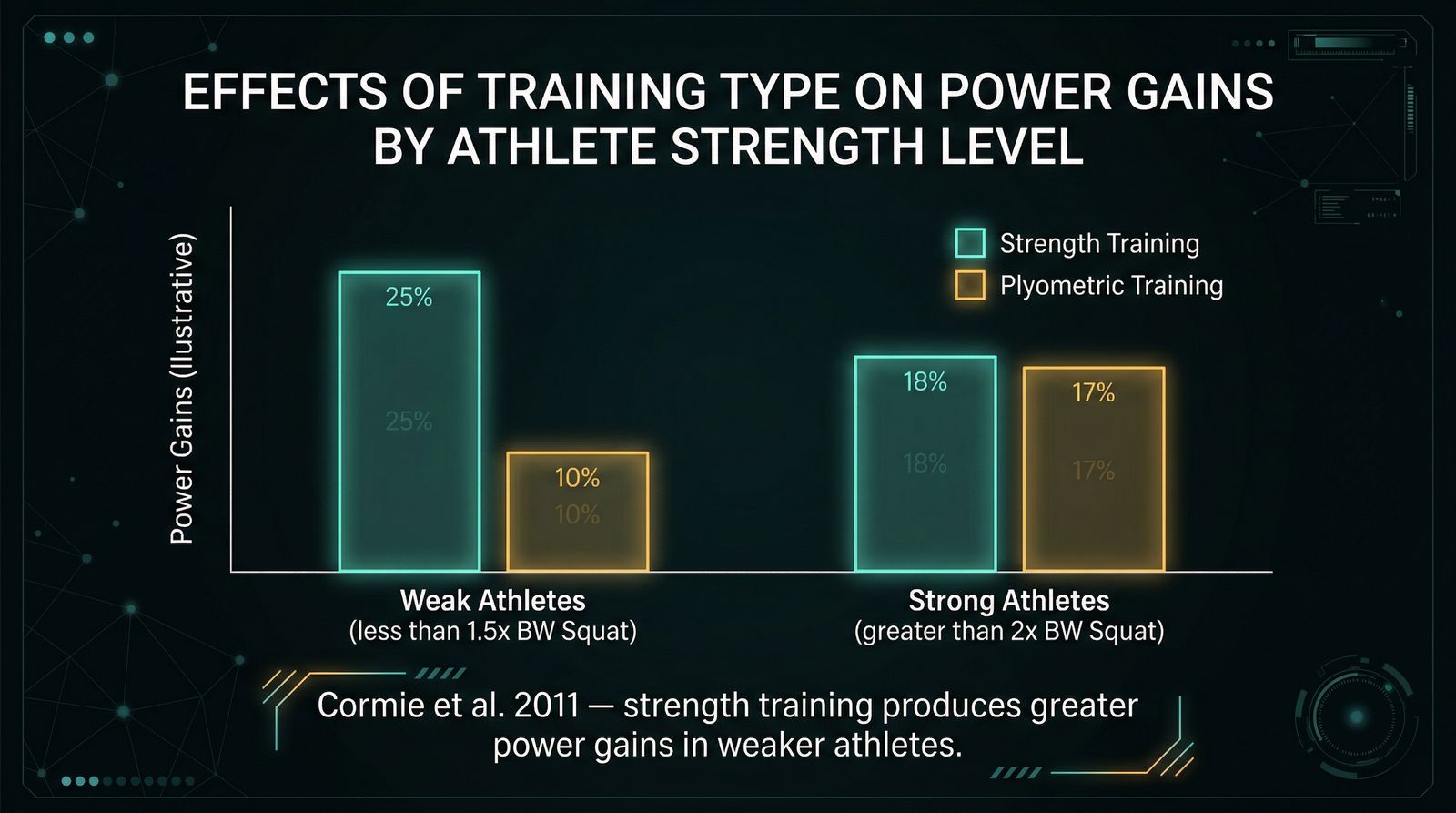
Cormie, McGuigan and Newton (2011) provide the mechanistic answer. Their research on neuromuscular power development found that in weaker athletes, strength training was the dominant driver of power and speed improvement. Getting stronger was getting faster, because the force ceiling was the bottleneck. In stronger athletes, the relationship changed: they had already raised the force ceiling through barbell work, and plyometric and velocity-specific training became increasingly effective at populating the high-velocity end of the force-velocity curve.
Plyometrics are most effective in athletes who have already built substantial strength. The barbell is the prerequisite, not an optional addition.
Where Explosive Work Fits, and Where It Doesn't
Plyometrics, sprinting, and other high-velocity training have genuine value. The stretch-shortening cycle adaptations they produce (improved tendon stiffness, rate of force development, and neuromuscular patterning at speed) are not fully replicated by barbell training alone, particularly in athletes who have already built a substantial strength base.
But this makes them specialised tools with specific prerequisites, not equals in the hierarchy. Verkhoshansky's original work stipulated minimum strength standards before athletes should begin serious plyometric loading. An athlete who cannot squat at least 1.5x bodyweight, in his framework, is not ready for depth jumps and hurdle hops. They are not strong enough to safely produce and absorb the forces involved, and the training stimulus is limited by the force capacity the movement can generate.
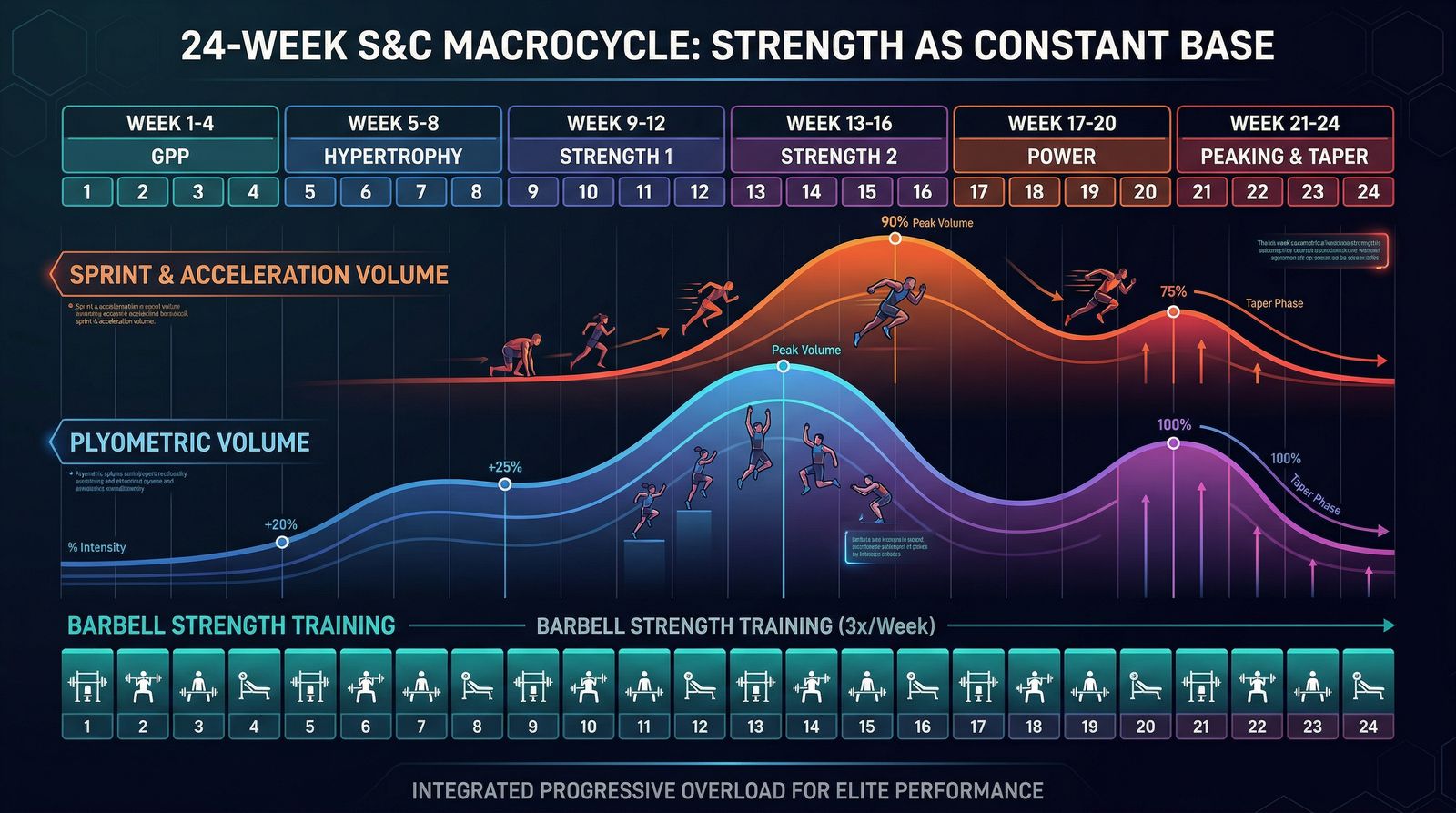
Applied intelligently, explosive work sits on top of the barbell foundation, not alongside it at equal weight, and certainly not as a replacement for it. The periodisation logic follows:
Strength Phase (8–16 weeks, barbell-dominant): Heavy compound work is the primary stimulus. Squat, deadlift, press, and their variations drive the adaptation. Plyometric work, if present, is at low volume and serves to maintain neurological freshness: a few sets of jumps or broad jumps before the main lifting session, not a competing stimulus.
Power Conversion Phase (4–8 weeks): Barbell loads shift toward the strength-speed zone: 60–80% 1RM performed explosively, trap bar jumps, speed deadlifts, push press. Plyometric volume increases: reactive jumps, depth drops, bounding. Sprint sessions can be introduced for athletes with performance goals. This phase converts the force base into high-velocity expression.
Expression Phase (2–4 weeks): Volume drops. Intensity peaks. The adaptations from both previous phases are realised. This is where athletic performance peaks.
The barbell never disappears from this structure. It is the spine of every phase. What changes is the load zone and the proportion of volume dedicated to it.
The Practical Argument for Any Athlete
If you compete in a field sport, a combat sport, a racket sport, or virtually any athletic discipline and you are not currently squatting and deadlifting under progressive load, you are leaving the most effective conditioning tool available to you unused.
Poliquin's swimmers broke world records. Vermeil's basketball players won championships. Verkhoshansky's track athletes set records in the throws and jumps. These athletes succeeded because of their heavy barbell work, not despite it. A body that can produce more force is a body that runs faster, jumps higher, absorbs impacts better, and sustains performance across longer seasons without breaking down.
The sport-specific training industry has persuaded many athletes that the squat is a powerlifter's tool and the deadlift is for strongmen. This is backwards. The squat and deadlift are human movement patterns. They develop the posterior chain that underpins every sport. They are available to every athlete, they are progressive in a way that almost no other training modality is, and they produce adaptations that nothing else replicates.
Plyometrics and sprint work are valuable additions to the athlete who has already built a strong foundation. They are poor substitutes for an athlete who has not.
Sprinting Biomechanics and Technique — technical mechanics of sprint training for athletes who have built the strength base to support it.
How to Structure Cardio Around Your Lifting — how to integrate explosive and conditioning sessions without compromising the barbell work that underpins them.
Key Takeaways
- Charles Poliquin's principle — "Strength is the mother of all physical qualities" — is supported by the research: Suchomel et al. (2016) identified maximal strength as the underpinning quality for speed, power, agility, and injury resistance across all athletic domains.
- The squat, deadlift, and press are universal athletic developers, not powerlifting specialities. Every sport that requires force production — which is every sport — benefits from athletes who are stronger in these patterns.
- Verkhoshansky, the father of plyometrics, stipulated minimum strength standards before his shock method should be applied. Plyometrics require a force foundation to be effective and safe.
- Cormie et al. (2011) found that plyometric training is most effective in athletes who have already built substantial barbell strength — the stronger the foundation, the greater the return from explosive work.
- The Hasan (2023) RCT found the strength group improved more than the plyometric and control groups on isometric strength, sprint time, and single-leg triple hop, and concluded strength training was more effective for those outcomes.
- Periodisation puts barbell strength as the permanent base and cycles explosive work on top of it — not as an equal component, but as a conversion tool that depends on the strength foundation for its effectiveness.
Put It Into Practice
This week: If you are an athlete who has been avoiding heavy barbell work in favour of sport-specific training, perform one heavy squat session and one heavy deadlift session this week. Work up to a challenging set of 3–5 reps on each. The weight does not need to be impressive. The movement pattern does. Note how your legs and posterior chain feel differently loaded compared to anything you have done in sport-specific conditioning.
This training block: If you do not have consistent strength standards — a squat of at least 1.5x bodyweight for men or 1.0x for women, a deadlift of at least 2.0x bodyweight for men or 1.5x for women — make barbell strength your primary training goal for the next 8–12 weeks. Run a simple linear progression or a basic powerlifting programme. Keep explosive and sport-specific work present but secondary. Build the cannon before you try to fire it.
Long term: Adopt Poliquin's periodisation logic. Barbell strength phases come first and last longest. Power conversion phases follow and are shorter. Expression and sport-specific phases peak performance before competition. Then the cycle repeats, starting again with the barbell. No phase permanently abandons the compound lifts — they shift into maintenance or power-zone work, but they are never absent. The athletes who sustain elite performance across long careers are the ones who never stop squatting and deadlifting.
Analysed by FINAL FORM AI. Your form, perfected.
References
- Poliquin, C. (1997). The Poliquin Principles: Successful Methods for Strength and Mass Development. Dayton Writers Group.
- Siff, M. C. (2003). Supertraining (6th ed.). Supertraining Institute.
- Zatsiorsky, V. M., & Kraemer, W. J. (2006). Science and practice of strength training. Human Kinetics.
- Suchomel, T. J., Nimphius, S., & Stone, M. H. (2016). The importance of muscular strength in athletic performance. Sports Medicine, 46(10), 1419-1449.
- Cormie, P., McGuigan, M. R., & Newton, R. U. (2011). Developing maximal neuromuscular power: Part 2 - training considerations for improving maximal power production. Sports Medicine, 41(2), 125-146.
- Hasan, S. (2023). Effects of plyometric vs. strength training on strength, sprint, and functional performance in soccer players: a randomized controlled trial. Scientific Reports, 13, 4256. PMID: 36918731
- Bompa, T. O., & Buzzichelli, C. (2018). Periodization: Theory and methodology of training. Human Kinetics.
- Suchomel, T. J., Nimphius, S., Bellon, C. R., & Stone, M. H. (2018). The importance of muscular strength: training considerations. Sports Medicine, 48(4), 765-785. PMID: 29372481
- Schoenfeld, B. J. (2010). The mechanisms of muscle hypertrophy and their application to resistance training. Journal of Strength and Conditioning Research, 24(10), 2857-2872. PMID: 20847704
- Kraemer, W. J., & Ratamess, N. A. (2004). Fundamentals of resistance training: progression and exercise prescription. Medicine & Science in Sports & Exercise, 36(4), 674-688. PMID: 15064596