The Big Three Make You Jacked
The science behind why the Big Three build the best physiques. Compound lifts win on every mechanism of hypertrophy — and the greatest bodybuilders in history knew it.
By Dhiren Dunraj MSc
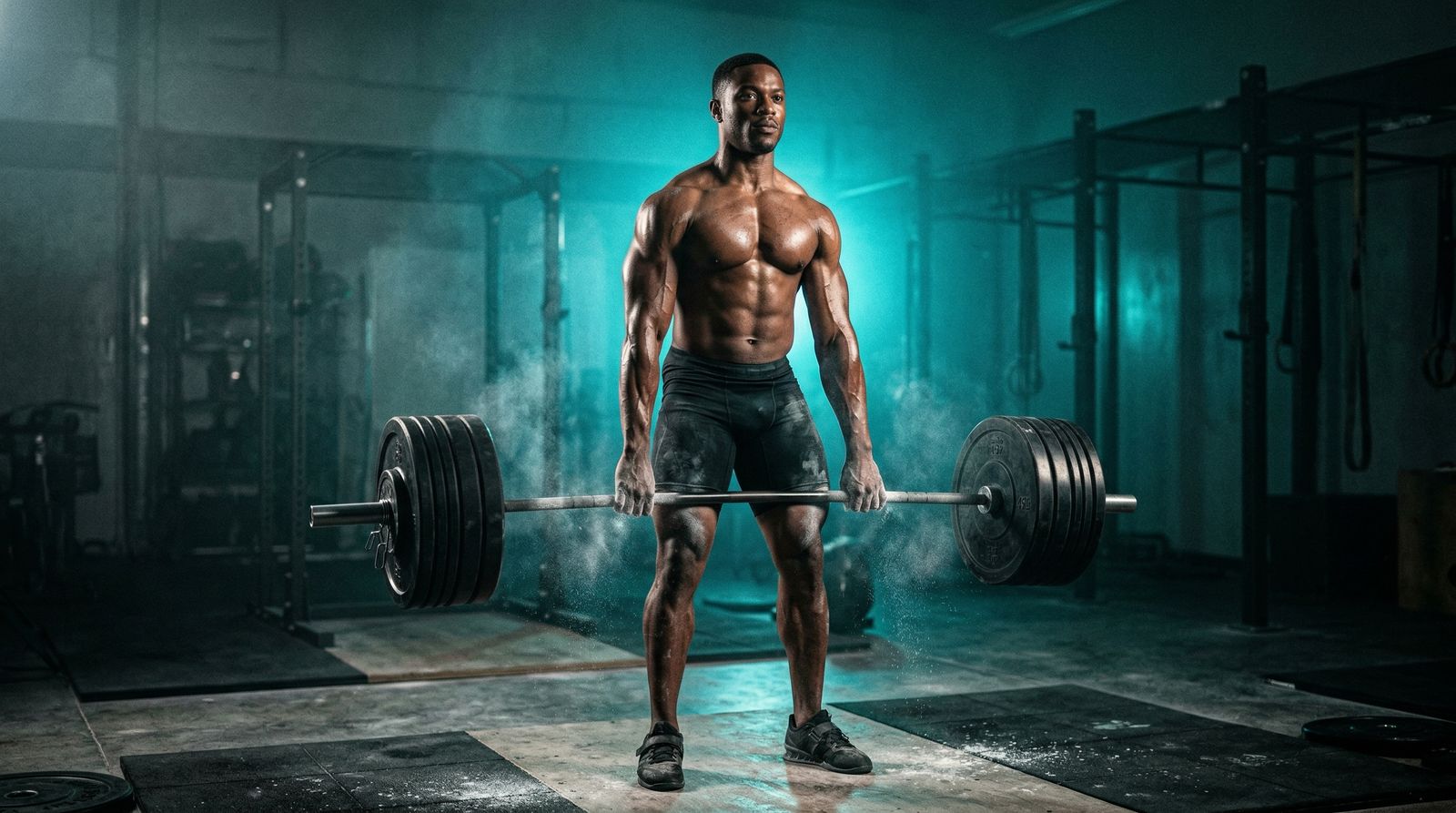
Key Insight
“The athletes who built the most revered physiques in bodybuilding history did not build them on cables and machines. They built them under a loaded barbell.”
There is a persistent belief in commercial gyms that powerlifting builds strength and bodybuilding builds muscle, as though these are separate biological processes with separate training requirements. The squat rack is for powerlifters. The cable station is for aesthetics.
This belief is wrong, and the evidence against it is not subtle.
The squat, bench press, and deadlift, collectively the Big Three, are among the most powerful hypertrophy tools ever studied. They recruit more total muscle mass per repetition, generate greater mechanical tension per unit of training time, and produce more favourable systemic adaptations than any isolation-focused programme. The athletes who understood this earliest built the most impressive physiques in the history of strength sport.
This article is the science behind what they already knew, and the practical framework for applying it.
What Actually Drives Muscle Growth
Understanding why compound lifts dominate hypertrophy requires understanding what drives muscle growth in the first place.
Schoenfeld (2010) published a landmark review identifying three primary mechanisms of hypertrophy: mechanical tension, metabolic stress, and exercise-induced muscle damage. Of these, mechanical tension is the primary driver. When a muscle is placed under high load through a full range of motion, the mechanical stress on muscle fibres triggers a cascade of anabolic signalling, mechanotransduction pathways that upregulate muscle protein synthesis and satellite cell activity.
Heavy compound lifts generate more mechanical tension across more total muscle mass than any other training modality. A heavy squat places the quadriceps, hamstrings, glutes, adductors, and spinal erectors under enormous simultaneous load through a large range of motion. No isolation exercise replicates this stimulus.
Metabolic stress (the accumulation of lactate, hydrogen ions, and other byproducts during sustained muscular effort) plays a supporting role. This is what higher-rep isolation work optimises for, and it contributes to hypertrophy, but the current evidence positions it as secondary when sufficient mechanical tension is present (Schoenfeld, 2010).
The older framework distinguishing "myofibrillar" from "sarcoplasmic" hypertrophy (the idea that heavy lifting builds dense, contractile muscle while higher-rep work builds fluid-filled, non-functional size) has not held up well under scrutiny. The current literature suggests that hypertrophy is hypertrophy. The contractile proteins and the surrounding cellular components grow together in response to progressive overload. What differs between training approaches is the magnitude of mechanical tension applied, and compound lifts deliver more of it across more tissue.
Why Bodybuilding Is Anything But 'Non-Functional' explores how isolation and compound training complement each other within this framework.
The Historical Evidence: The Strongest Were the Most Muscular
If the mechanism alone is not persuasive, the historical record is.
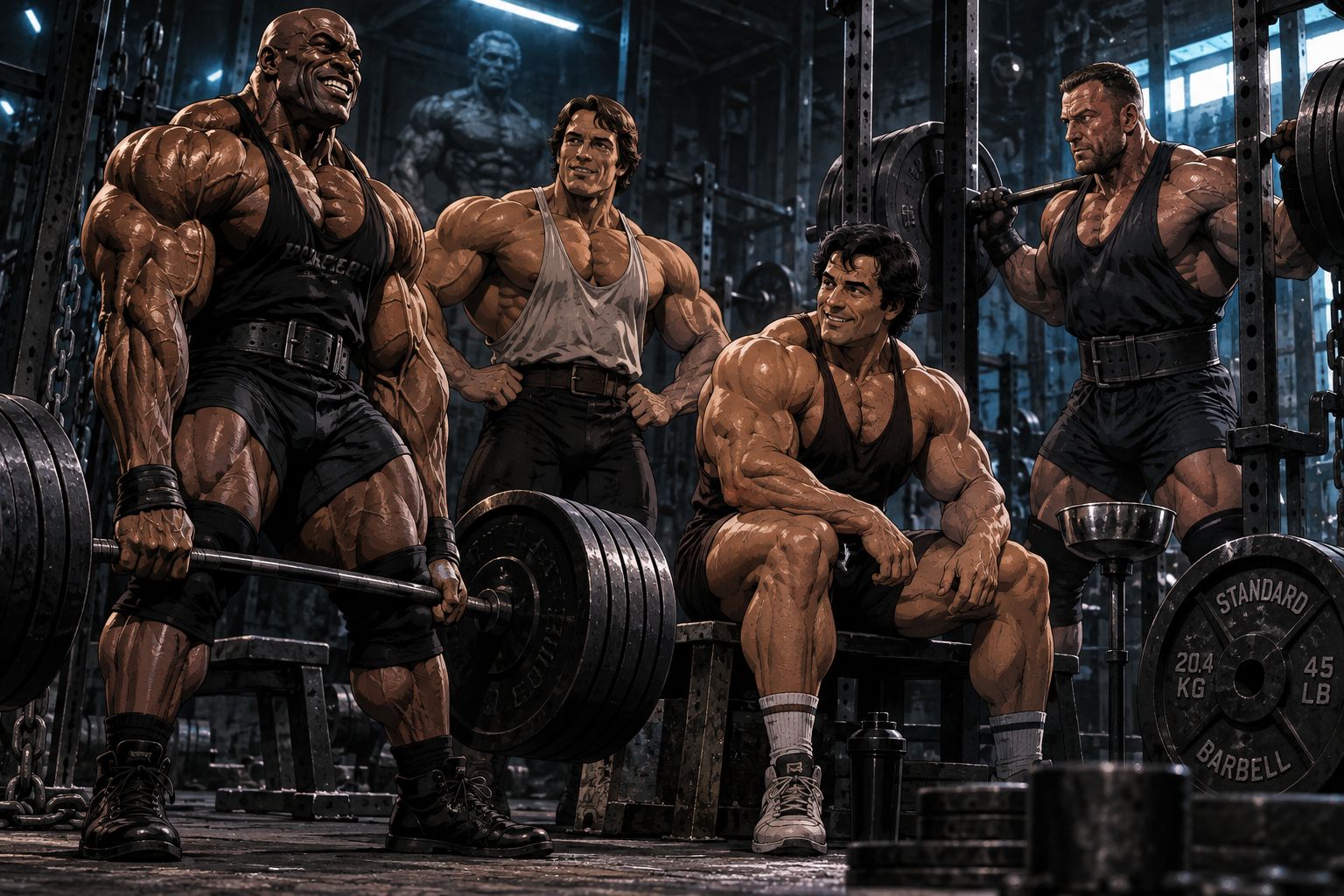
Ronnie Coleman won eight consecutive Mr. Olympia titles and built what is widely considered the most muscular physique in bodybuilding history. He squatted 800 lbs, deadlifted 800 lbs, and bench pressed over 500 lbs. His leg development, posterior chain thickness, and overall muscle density were constructed on the barbell under maximal loads. Coleman was explicit about this: the compounds were the spine of his training, not a supplementary afterthought.
Arnold Schwarzenegger built the physique that defined modern bodybuilding on a foundation of heavy pressing, squatting, and pulling. The Golden Era athletes he trained alongside (Franco Columbu, Frank Zane, Dave Draper) treated heavy compound work as the non-negotiable base. Isolation was layered on top. It was never the foundation.
Franco Columbu, twice Mr. Olympia and one of the most densely muscled athletes in the sport's history, was simultaneously a world-class powerlifter. He saw no contradiction between these pursuits. The powerlifting made the bodybuilding possible. The strength was the muscle.
Dorian Yates ushered in the mass monster era with six consecutive Olympia titles. His back development, still considered among the greatest ever, was built on heavy barbell rows, deadlifts, and weighted pull-ups: progressive overload on fundamental patterns, not cables or machines.
This is a pattern, and it aligns with what the mechanotransduction research predicts.
The Research: Compound Lifts and Whole-Body Hypertrophy
The evidence for compound lift superiority in building muscle is consistent across multiple lines of research.
Gentil, Soares, and Bottaro (2015) compared multi-joint and single-joint resistance exercises and found that multi-joint movements produced comparable or superior hypertrophy outcomes with significantly greater training efficiency, meaning more muscle stimulated per set, per unit of time in the gym. For trainees with limited training time, the compound movements were unambiguously superior.
Schoenfeld, Ogborn, and Krieger (2017) examined the dose-response relationship between training volume and hypertrophy, establishing that muscle growth follows a graded response to volume, but the quality of each set matters. A set of heavy squats that recruits the quadriceps, hamstrings, glutes, and erectors simultaneously provides a higher-quality hypertrophic stimulus per set than isolated work on each of those muscles individually.
Schoenfeld et al. (2019) further demonstrated that beyond a certain volume threshold, additional sets do not produce proportional hypertrophy gains. This finding favours compound-dominant programming: if there is a ceiling to useful volume, it is more efficient to reach that ceiling with movements that stimulate multiple muscle groups per set rather than accumulating excessive isolation volume.
More muscle recruited per set means more total mechanical tension per unit of training time. More tension means more growth signal. More growth signal, with adequate nutrition and recovery, means more muscle.
Key Insight
“Compound lifts do not compromise between strength and hypertrophy. They deliver the most efficient dose of mechanical tension across the most muscle mass in the least time.”
The Squat: The Most Complete Lower Body Builder
Calling the back squat a leg exercise undersells it to the point of being misleading.
A properly executed heavy back squat recruits the quadriceps, hamstrings, glutes, adductors, spinal erectors, core stabilisers, upper back, and the shoulder girdle as a stabilising system. Wretenberg, Feng, and Arborelius (1996) documented extensive muscle activation across the entire lower and posterior kinetic chain during heavy barbell squats, with meaningful differences between high-bar and low-bar positions in terms of hip versus knee dominance, but significant hypertrophic stimulus in both variants.
For glute development specifically, Contreras et al. (2016) found that barbell hip thrusts produced high glute EMG activation. The squat performed to full depth also loads the glutes hard while simultaneously developing the quadriceps, adductors, and erectors. The squat is the best total lower body exercise, not the best glute isolation exercise, and the glute development comes included.
There is no machine, no isolation exercise, no cable variation that builds the legs and posterior chain the way a heavy squat does. The stimulus is too comprehensive for any single-joint movement to replicate.
The Deadlift: Total Posterior Chain Development
The deadlift is the most complete posterior chain exercise ever measured, and it is consistently underutilised in aesthetic-focused training.
Escamilla et al. (2002) conducted detailed electromyographic analysis of the deadlift and found significant activation of the hamstrings, glutes, spinal erectors, trapezius, latissimus dorsi, rhomboids, and forearm musculature, effectively every major posterior chain muscle working at or near maximum capacity simultaneously.
For back thickness, the deadlift is arguably unrivalled. The trap and rhomboid development that distinguishes serious deadlifters is visible even in street clothes. The lat engagement through the pull produces the characteristic wide, dense upper back that no amount of lat pulldown volume fully replicates.
Every bodybuilder who has ever had a genuinely impressive back trained the deadlift seriously. This observation becomes less controversial the more carefully you look at the evidence.
Key Insight
“The deadlift forces every muscle from your traps to your hamstrings to work at near-maximum capacity simultaneously. No isolation routine replicates this stimulus.”
The Bench Press: More Than a Chest Exercise
The flat barbell bench press is the most widely practised exercise in commercial gyms, yet it is underestimated as a hypertrophy tool precisely because of its association with strength sport.
Trebs, Brandenburg, and Pitney (2010) measured substantial activation of the pectorals across their full length, the anterior deltoids, the triceps through a full range of motion, and the stabilising musculature of the rotator cuff and scapula during the barbell bench press. The free barbell version produced greater pectoral activation than machine equivalents, attributed to the stabilisation demands and the unrestricted range of motion.
Arnold's chest development, still benchmarked against in bodybuilding circles more than 50 years later, was built on heavy barbell bench pressing as the primary movement. He credited it directly. The cables and dumbbell work were supplementary. The barbell was the foundation.
The POWERSTHETICS Manifesto articulates why combining strength and aesthetics is the most complete approach to physical development, not a compromise.
The Hormonal Environment: A Systemic Advantage
Beyond the direct mechanical stimulus, compound lifts produce systemic hormonal responses that isolation exercises do not match.
Kraemer et al. (1991) demonstrated that heavy multi-joint resistance exercise produces acute elevations in testosterone and growth hormone that are significantly greater than the response to single-joint work at equivalent volumes. Raastad, Bjoro, and Hallen (2000) confirmed that high-intensity compound protocols elicit hormonal responses that support an anabolic environment across the entire body, not just in the muscles being directly trained.
The acute hormonal hypothesis (the idea that post-exercise testosterone spikes directly cause hypertrophy) has been challenged in recent years. The current consensus is more nuanced: while transient hormone elevations alone may not drive hypertrophy, the overall hormonal milieu created by heavy compound training supports recovery, protein synthesis, and adaptive capacity in ways that favour muscle growth across training sessions.
The practical implication remains the same. A programme built around heavy squats, bench presses, and deadlifts creates a more favourable physiological environment for total-body muscle growth than a programme built around isolation work, even when total volume is matched.
Volume Efficiency: Why Compounds Require Less to Achieve More
One persistent objection to compound-focused training for hypertrophy is that it does not provide enough isolation volume for individual muscle groups. Ralston et al. (2017) found that weekly set volume correlates with strength gains, and Schoenfeld et al. (2019) established a similar relationship for hypertrophy, but both lines of evidence point to diminishing returns beyond moderate volumes.
This is where compound lifts hold their advantage. Four working sets of heavy squats have stimulated the quadriceps, hamstrings, glutes, adductors, and erectors with high-quality mechanical tension through a full range of motion. The effective hypertrophic stimulus from those four sets across five muscle groups is more than the equivalent isolation volume could deliver in the same timeframe.
Suchomel, Nimphius, and Stone (2016) reviewed the relationship between muscular strength and athletic performance and concluded that multi-joint strength development transfers more broadly to physical capacity than isolated strength gains. The same principle applies to hypertrophy: compound-derived muscle growth is built on movement patterns that carry over to real-world and athletic performance.
The athlete doing three or four heavy compound sessions per week with targeted accessory work is not undertrained. They are efficiently trained, and efficiency matters because recovery is a finite resource.
Strength for Longevity: The Ultimate Investment in Your Future Self explores why building strength through compound patterns matters far beyond the gym or the platform.
What This Means Practically
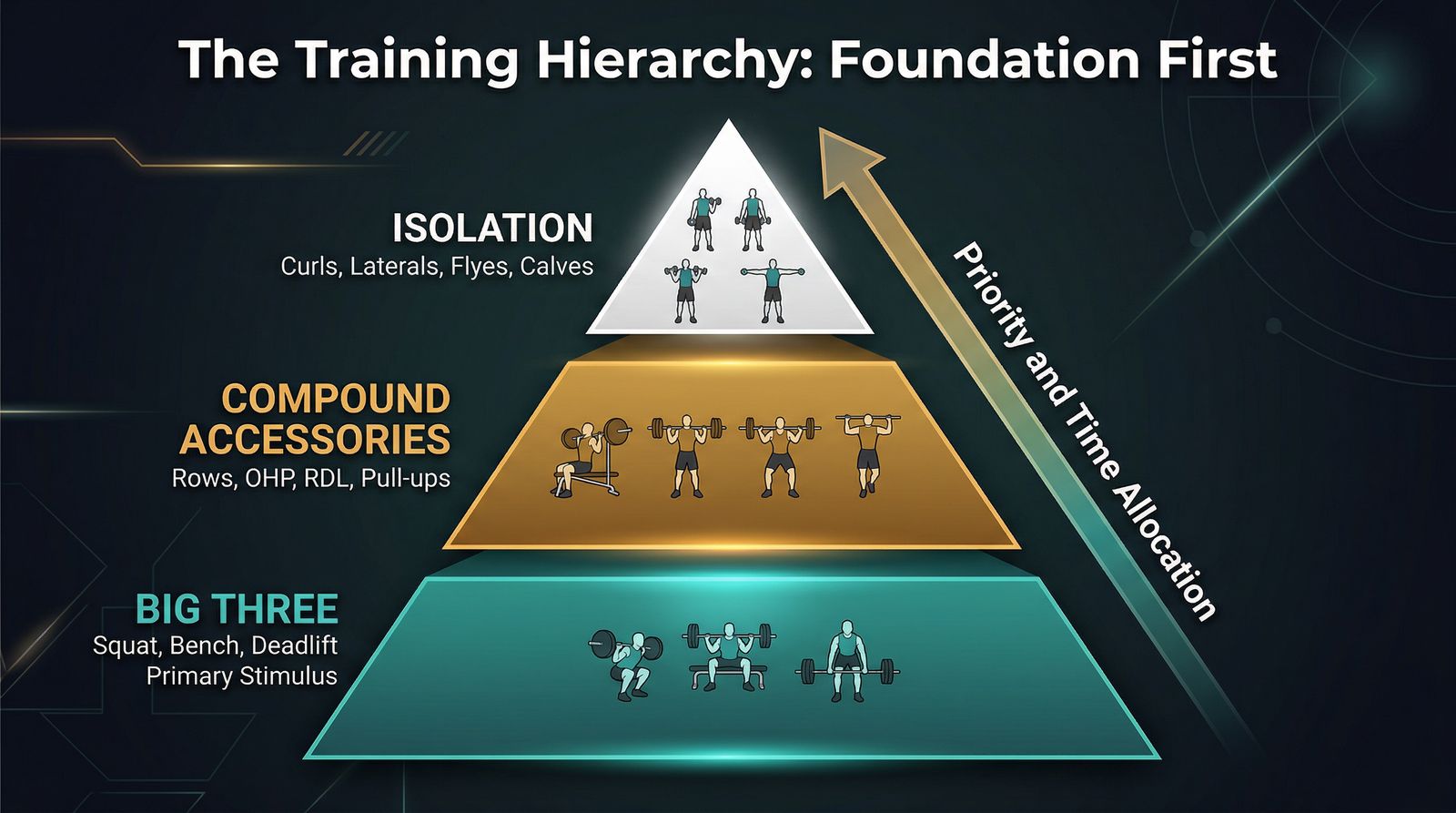
None of this is an argument against isolation work. Bicep curls have a place. Lateral raises have a place. Cable flyes have a place. They are secondary, not useless. Treating them as primary is where most trainees plateau.
Build your programme around the Big Three. Squat, bench, and deadlift with progressive overload as the non-negotiable core of your training week. Track these lifts. Prioritise them when you are fresh. Increase the weight methodically over time.
Then, with the remaining training capacity, add isolation work. Layer the detail on top of the foundation. Build the arms, the shoulders, the calves. All of it contributes, and with a compound foundation underneath, it contributes far more effectively than it would on its own.
The elite bodybuilders who built the physiques that people still study decades later understood this without needing a literature review. The science has since confirmed what they figured out through practice.
You are not choosing between strength and aesthetics. You are choosing the most efficient path to both.
Key Takeaways
- Mechanical tension is the primary driver of muscle hypertrophy, and heavy compound lifts generate more of it across more muscle mass than any isolation exercise (Schoenfeld, 2010).
- Multi-joint movements produce comparable or superior hypertrophy outcomes with significantly greater training efficiency — more muscle stimulated per set, per unit of time (Gentil et al., 2015).
- The myofibrillar vs sarcoplasmic hypertrophy dichotomy is outdated; current evidence indicates that progressive overload drives growth in contractile and non-contractile components together.
- The greatest bodybuilders in history — Coleman, Schwarzenegger, Columbu, Yates — built their physiques on a foundation of heavy barbell compounds, not isolation work.
- Beyond a moderate volume threshold, additional sets produce diminishing hypertrophy returns, favouring compound-dominant programming that efficiently reaches that threshold across multiple muscle groups (Schoenfeld et al., 2019).
- Isolation work has a legitimate role, but it is secondary — treating it as the foundation is where most trainees plateau.
Put It Into Practice
This week: Audit your current programme. Identify whether the squat, bench press, and deadlift (or close variants) are placed first in your sessions when you are freshest, or buried after isolation work. If they are not the priority, restructure your next session so they are. Track the weight, sets, and reps on each compound lift — this is your primary progress metric.
This training block: Build a 4-week mesocycle with the Big Three as the non-negotiable core: squat twice per week, bench twice per week, deadlift once per week. Programme progressive overload on these lifts first. Allocate your remaining training capacity to 2-3 accessory movements per session that address weak points identified in your compound lifts. Aim for 10-20 total sets per muscle group per week, counting compound contributions.
Long term: Commit to tracking your compound lift progression over 12 months. If your squat moves from 100 kg to 140 kg, your bench from 80 kg to 110 kg, and your deadlift from 120 kg to 170 kg, you will have built substantially more muscle than any isolation-focused programme would have produced in the same timeframe. The barbell is the foundation. Everything else is layered on top.
Analyse your form on the Big Three with The Final Form AI. Because the foundation only works if the technique is right.
References
- Schoenfeld, B. J. (2010). The mechanisms of muscle hypertrophy and their application to resistance training. Journal of Strength and Conditioning Research, 24(10), 2857-2872.
- Schoenfeld, B. J., Ogborn, D., & Krieger, J. W. (2017). Dose-response relationship between weekly resistance training volume and increases in muscle mass. Journal of Sports Sciences, 35(11), 1073-1082.
- Gentil, P., Soares, S., & Bottaro, M. (2015). Single vs. multi-joint resistance exercises: effects on muscle strength and hypertrophy. Asian Journal of Sports Medicine, 6(2), e24057.
- Kraemer, W. J., et al. (1991). Endogenous anabolic hormonal and growth factor responses to heavy resistance exercise in males and females. International Journal of Sports Medicine, 12(2), 228-235.
- Raastad, T., Bjoro, T., & Hallen, J. (2000). Hormonal responses to high- and moderate-intensity strength exercise. European Journal of Applied Physiology, 82(1-2), 121-128.
- Escamilla, R. F., et al. (2002). An electromyographic analysis of sumo and conventional style deadlifts. Medicine and Science in Sports and Exercise, 34(4), 682-688.
- Wretenberg, P., Feng, Y., & Arborelius, U. P. (1996). High- and low-bar squatting techniques during weight-training. Medicine and Science in Sports and Exercise, 28(2), 218-224.
- Trebs, A. A., Brandenburg, J. P., & Pitney, W. A. (2010). An electromyography analysis of 3 muscles surrounding the shoulder joint during the performance of a chest press exercise at several angles. Journal of Strength and Conditioning Research, 24(7), 1925-1930.
- Ralston, G. W., et al. (2017). The effect of weekly set volume on strength gain: a meta-analysis. Sports Medicine, 47(12), 2585-2601.
- Contreras, B., et al. (2015). A comparison of gluteus maximus, biceps femoris, and vastus lateralis EMG amplitude for the barbell, band, and American hip thrust variations. Journal of Applied Biomechanics, 32(3), 254-260.
- Schoenfeld, B. J., et al. (2019). Resistance training volume enhances muscle hypertrophy but not strength in trained men. Medicine and Science in Sports and Exercise, 51(1), 94-103.
- Suchomel, T. J., Nimphius, S., & Stone, M. H. (2016). The importance of muscular strength in athletic performance. Sports Medicine, 46(10), 1419-1449. PMID: 26838985
- Wackerhage, H., Schoenfeld, B. J., Hamilton, D. L., et al. (2019). Stimuli and sensors that initiate skeletal muscle hypertrophy following resistance exercise. Journal of Applied Physiology, 126(1), 30-43. PMID: 30335577
- Paoli, A., Gentil, P., Moro, T., et al. (2017). Resistance training with single vs. multi-joint exercises at equal total load volume: effects on body composition, cardiorespiratory fitness, and muscle strength. Frontiers in Physiology, 8, 1105. PMID: 29312007