The Intelligent Deficit: Preserving Strength While Cutting
Cutting while maintaining strength is genuinely hard. Here is the evidence-based framework that gives you the best odds.
By Dhiren Dunraj MSc

Key Insight
“Losing weight is easy. Losing fat while maintaining the force production to squat 200 kg requires absolute precision, and the honesty to acknowledge how hard that is.”
Cutting while maintaining strength is hard. The trade-off is physiologically real. When you place the human body in a caloric deficit, it does not willingly sacrifice adipose tissue while preserving expensive, metabolically demanding muscle mass. The body seeks thermodynamic equilibrium. It will shed contractile tissue if given the opportunity.
For a lifter, a poorly managed cut costs months of strength, not only aesthetic progress. Neural adaptations decay when heavy training is interrupted. Mechanical leverages shift as you lose body mass. Joint cushioning decreases, the glycolytic energy system becomes compromised, and the hormonal environment turns catabolic. Testosterone drops. Cortisol rises. Your one-rep max suffers.
And yet the case for getting leaner is also real. A better strength-to-bodyweight ratio, improved relative strength, and the longevity benefits of maintaining a healthy body fat percentage are all legitimate goals that require moving through periods of caloric restriction.
The question is how to execute the caloric deficit for strength performance with enough intelligence that you preserve what matters most.
Rate of Loss: The Slowest Effective Pace Is the Fastest Practical Pace
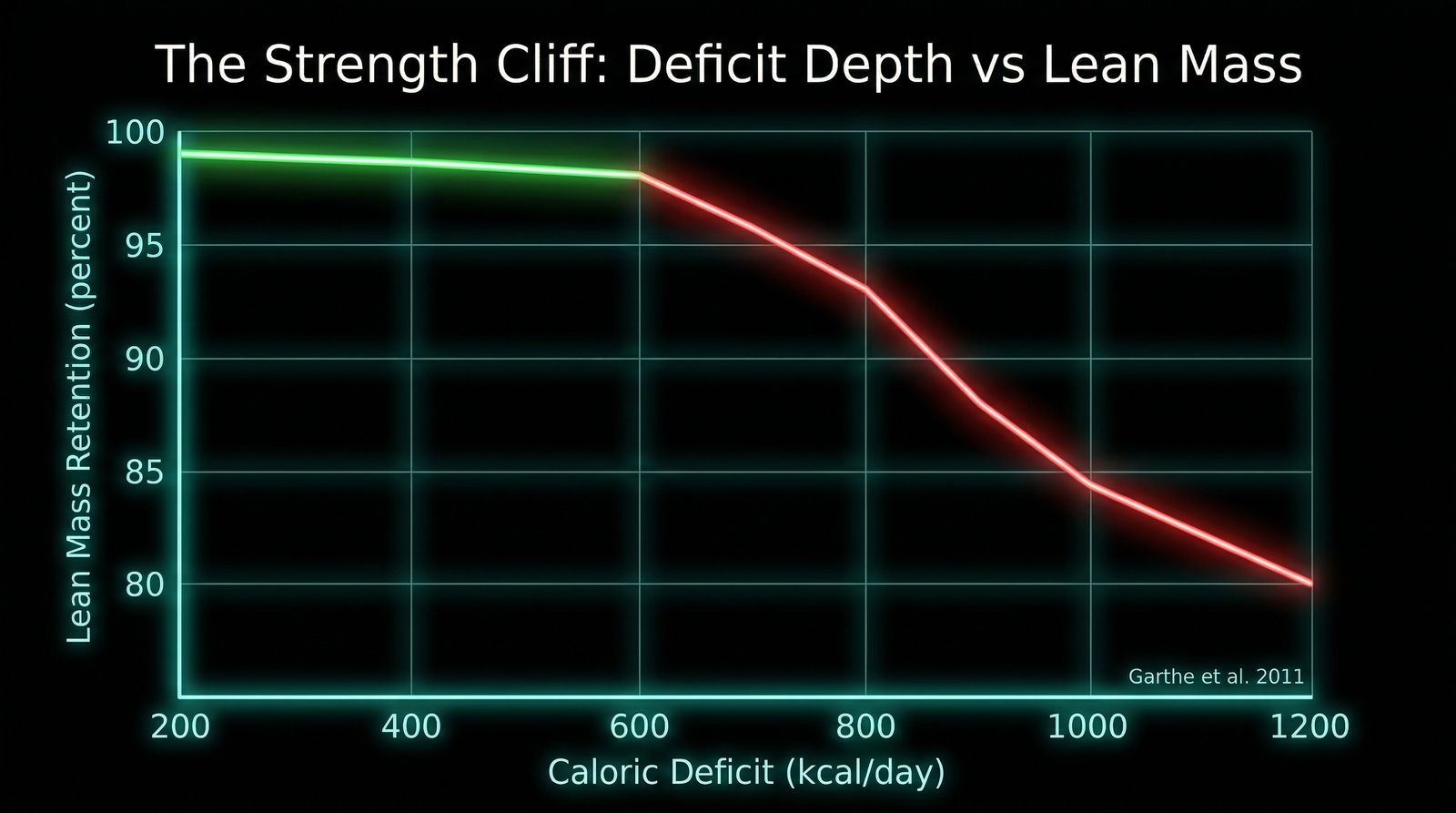
The relationship between rate of weight loss and muscle retention is settled physiology. The faster you lose weight, the more of the mass lost comes from lean tissue rather than adipose tissue.
Garthe et al. (2011) studied elite athletes randomised to either a slow weight loss protocol (approximately 0.7% of body weight per week) or a fast weight loss protocol (approximately 1.4% per week). Athletes in the slow group gained lean mass on average. They also showed significant improvements in strength and power outcomes. The fast-loss group lost lean mass and showed only marginal strength improvements.
The aggressive 1 kg per week cuts that are common in weight-class sport preparation are incompatible with maintaining strength. The only exception is the very early stage of a deficit, where initial losses are disproportionately water, glycogen, and gut contents rather than true tissue.
For the strength athlete, the ceiling for the rate of loss should be 0.5-0.7% of body weight per week. For an 80 kg lifter, this means a maximum of 400-560 g of loss per week. This requires a daily caloric deficit of approximately 300-400 calories, not the aggressive 800-1000 calorie deficits that performance coaches frequently prescribe under competitive pressure.
Any deficit greater than this starts buying fat loss at too high a price in lean mass. You are cutting force production, not only fat.
The Protein Floor: Your Anabolic Shield
In a caloric deficit, the protein requirement for a strength athlete rises substantially above maintenance recommendations. This is counterintuitive to those who think protein is primarily a muscle-building tool during a surplus. In reality, during a deficit, protein is a muscle-retention tool. It is the primary substrate for maintaining the anabolic signalling environment that prevents your body from catabolising contractile tissue.
Helms et al. (2014) conducted a systematic review of dietary protein in resistance-trained athletes during caloric restriction and found that requirements exceeded those of the general population. The evidence supported intakes of 2.3-3.1 g per kg of lean body mass during deficit phases, significantly higher than the 1.6-2.0 g per kg typically recommended for muscle building in a surplus.
The practical translation for most lifters: during a caloric deficit, your protein intake should reach at least 2.2 g per kg of total body weight, and ideally 2.4-3.0 g per kg of lean body mass. This provides the amino acid substrate to continually stimulate muscle protein synthesis, even in a negative energy environment. The Reality of Weight Loss: Protein Leverage vs Insulin vs Calorie Tracking explains the satiety advantages of high protein intake, the same mechanism that makes a high protein floor easier to sustain on reduced calories.
The protein floor is non-negotiable. Every other macronutrient is adjusted around it. Carbohydrates and fats are the variables used to reach the target deficit. Protein is the constant.
Training Adjustments: Protect the Signal, Reduce the Noise
Cutting does not mean switching to high-rep, light-weight "toning" work. This is one of the most damaging myths in strength sports nutrition. The signal that tells your body to preserve muscle mass is mechanical tension, specifically the recruitment of high-threshold motor units under heavy loads. If you remove that signal, the body treats heavy muscle mass as metabolically redundant and burns it as fuel.
Keep your heavy compound work. Your top sets of squat, bench, and deadlift should remain as programmed. Reduce the deficit elsewhere in your session, not in the movements that provide the strongest muscle retention signal.
What must be reduced during a cut is total volume. Your recovery capacity is compromised because food is the primary recovery substrate. When energy availability falls, so does the rate of cellular repair, glycogen resynthesis, and hormonal recovery between sessions. Trying to maintain the same volume you ran during a hypercaloric block will lead to accumulated fatigue, declining performance, and ultimately injury.
Barakat et al. (2020) summarised the evidence on body recomposition in trained individuals and supported a modest deficit with maintained resistance training intensity as the most effective strategy for preserving lean mass during fat loss.
A practical heuristic: reduce accessory volume by 20-30% relative to your off-season baseline. Cut one set per exercise from your accessory work. Maintain your main lift top sets. Accept that personal records are unlikely during a deficit and that this is appropriate load management, not a failure.
Refeeds: The Metabolic Reset Tool
Prolonged caloric deficits do not produce a steady, linear decrease in body fat. The body adapts. Metabolic adaptation to weight loss involves a coordinated downregulation of energy expenditure through multiple mechanisms: reduced non-exercise activity thermogenesis (NEAT), decreased resting metabolic rate, reduced thyroid hormone output, and elevated hunger hormones including ghrelin (Trexler et al., 2014). The result is that the same deficit that produced fat loss in week two produces much less by week eight.
A strategic refeed (a 24-48 hour period where caloric intake is returned to maintenance level primarily through additional carbohydrate) serves multiple functions simultaneously. It replenishes muscle and liver glycogen, providing the high-octane fuel required for your heaviest training sessions. It briefly suppresses ghrelin and elevates leptin, providing a window of reduced hunger and improved hormonal signalling. It restores training performance in the short term.
Refeeds also serve a psychological function. Prolonged caloric restriction is psychologically demanding. The scheduled permission to eat at maintenance for a day or two prevents the cognitive fatigue and dietary chaos that causes most cuts to unravel through willpower erosion rather than physiological failure.
Programme refeeds every 1-2 weeks during a cut. Schedule them before your heaviest training day of the week, typically your squat or deadlift session. The glycogen replenishment will be immediately evident in your performance.
Diet Breaks: Resetting the Hormonal Environment
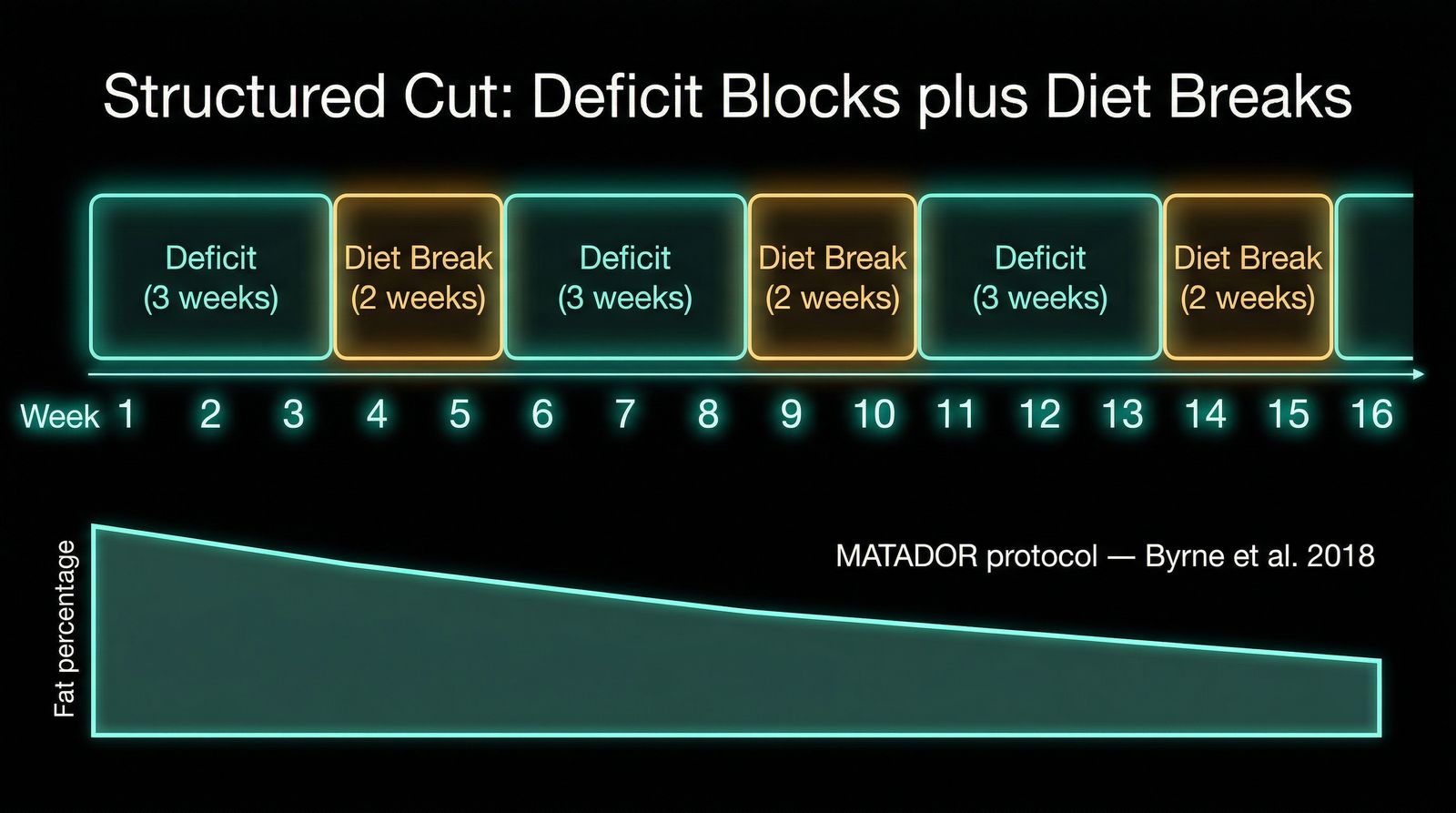
For cuts that extend beyond 10-12 weeks, a more extended intervention is required. This is where the MATADOR study (Byrne et al., 2018) provides compelling evidence. The Minimising Adaptive Thermogenesis And Deactivating Obesity Rebound study compared continuous caloric restriction against intermittent energy restriction, a protocol alternating two-week deficit phases with two-week maintenance phases.
The intermittent restriction group lost significantly more fat mass over the study period and showed a smaller drop in resting energy expenditure. The proposed mechanism is that the two-week maintenance phases partially restored resting metabolic rate and the hormonal environment, resetting the metabolic adaptation that blunts the effectiveness of prolonged restriction.
For the strength athlete cutting to a lower bodyweight while keeping your lifts, or executing a long off-season fat loss phase, the application is direct: plan your cut as alternating blocks. Four to six weeks in a deficit, followed by two weeks at maintenance, followed by the next deficit block. This is longer in calendar time but produces better lean mass retention and superior long-term results.
The diet break is a strategic use of physiology to outmanoeuvre your own adaptive responses, not a failure of discipline.
The Hierarchy of Decisions During a Cut
Prioritisation matters when everything is constrained. When energy availability is reduced, you cannot optimise everything simultaneously. The order of decisions for the strength athlete cutting intelligently:
- 1Set the rate of loss first. 0.5-0.7% of bodyweight per week. This determines your caloric deficit.
- 2Set the protein floor second. 2.2-2.4 g per kg body weight minimum, adjusted to 2.4-3.0 g per kg lean mass if lean enough to warrant precision.
- 3Allocate carbohydrates third. Prioritise the training window. Place the largest carbohydrate serving in the meal before and after your heaviest session.
- 4Fill remaining calories with fat as the final variable. Dietary fat supports hormone production and satiety but has the most flexibility.
- 5Programme refeeds every 1-2 weeks, scheduled before your most demanding session.
- 6Plan diet breaks every 4-6 weeks for cuts exceeding 10 weeks total.
The Foundations of Macronutrients for Strength Athletes provides the physiological basis for each macronutrient's role in training performance, the foundation on which this cutting hierarchy sits.
Key Takeaways
- Cutting while maintaining strength is genuinely difficult — the body does not willingly preserve metabolically expensive muscle during a deficit, and honesty about this shapes every practical decision.
- Rate of loss should not exceed 0.5-0.7% of body weight per week; faster losses sacrifice lean mass at an accelerating rate (Garthe et al., 2011).
- Protein floor during a deficit should reach 2.2-3.0 g per kg of body weight or lean body mass, significantly above maintenance requirements (Helms et al., 2014).
- Keep training intensity high on primary lifts; reduce accessory volume by 20-30% to account for compromised recovery capacity.
- Strategic refeeds (24-48 hours at maintenance via carbohydrates, every 1-2 weeks) and diet breaks (2 weeks at maintenance every 4-6 weeks for long cuts) mitigate metabolic adaptation and improve long-term outcomes (Byrne et al., 2018).
Put It Into Practice
This week: Calculate your true maintenance calories from at least two weeks of consistent weight and food intake data. Subtract exactly 300-400 calories to establish your intelligent deficit. Do not exceed this ceiling. Simultaneously, calculate your protein target (2.2 g per kg of body weight) and set it as a non-negotiable daily minimum regardless of how the rest of your intake falls.
This training block: Audit your accessory volume and remove one working set from each accessory exercise. Leave all main lift top sets exactly as programmed. Schedule a refeed day this week on the day before your heaviest squat or deadlift session. Treat it as preparation, not reward.
Long term: Never execute a deep, extended cut during a competition peak phase. Confine your cutting periods to off-season or early general preparation phases. This preserves your performance when it matters most, and ensures the cut is long enough to be conducted at a safe rate of loss without compromising the platform.
Analysed by FINAL FORM AI. Your form, perfected.
References
- Garthe, I., et al. (2011). Effect of two different weight-loss rates on body composition and strength and power-related performance in elite athletes. International Journal of Sport Nutrition and Exercise Metabolism, 21(2), 97-104. PMID: 21558571
- Byrne, N. M., et al. (2018). Intermittent energy restriction improves weight loss efficiency in obese men: the MATADOR study. International Journal of Obesity, 42(2), 129-138. PMID: 28925405
- Barakat, C., et al. (2020). Body recomposition: can trained individuals build muscle and lose fat at the same time? Strength and Conditioning Journal, 42(5), 7-21.
- Helms, E. R., Zinn, C., Rowlands, D. S., & Brown, S. R. (2014). A systematic review of dietary protein during caloric restriction in resistance trained lean athletes. International Journal of Sport Nutrition and Exercise Metabolism, 24(2), 127-138. PMID: 24092765
- Trexler, E. T., Smith-Ryan, A. E., & Norton, L. E. (2014). Metabolic adaptation to weight loss: implications for the athlete. Journal of the International Society of Sports Nutrition, 11(1), 7. PMID: 24571926
- Mettler, S., Mitchell, N., & Tipton, K. D. (2010). Increased protein intake reduces lean body mass loss during weight loss in athletes. Medicine & Science in Sports & Exercise, 42(2), 326-337. PMID: 19927027
- Longland, T. M., Oikawa, S. Y., Mitchell, C. J., et al. (2016). Higher compared with lower dietary protein during an energy deficit combined with intense exercise promotes greater lean mass gain and fat mass loss: a randomized trial. American Journal of Clinical Nutrition, 103(3), 738-746. PMID: 26817506
- Peos, J. J., Helms, E. R., Fournier, P. A., et al. (2021). Continuous versus intermittent dieting for fat loss and fat-free mass retention in resistance-trained adults: the ICECAP trial. Medicine & Science in Sports & Exercise, 53(8), 1685-1698. PMID: 33587549
- Helms, E. R., Aragon, A. A., & Fitschen, P. J. (2014). Evidence-based recommendations for natural bodybuilding contest preparation: nutrition and supplementation. Journal of the International Society of Sports Nutrition, 11, 20. PMID: 24864135