Cardio for Fat Loss: The Cost to Your Strength
How much cardio is enough? How much is too much? The interference effect is real — here is how to manage it.
By Dhiren Dunraj MSc

Key Insight
“Every minute on a treadmill is a minute your body could spend recovering from the barbell. Spend those minutes wisely, or they will spend your strength for you.”
Both sides of the cardio debate are wrong.
The lifter who refuses all cardio is leaving body composition, cardiovascular health, and long-term performance on the table. The coach who prescribes 45 minutes of steady-state five days a week is bleeding their athletes dry. And the influencer who tells you sprints are "just as good" without explaining the mechanisms is selling you a slogan instead of a strategy.
Cardio is a weapon, and weapons have recoil. The question is which calibre to load, when to pull the trigger, and how to absorb the kickback without it knocking your squat off course.
This article is the targeting system.
THE INTERFERENCE EFFECT
The interference effect is the measurable reduction in strength and hypertrophy that occurs when endurance training is stacked on top of resistance training. It is real, documented, and the reason every cardio decision you make as a strength athlete requires deliberate programming.
Wilson et al. (2012) compiled the landmark meta-analysis across 21 concurrent training studies. The verdict: combining aerobic and resistance training in the same programme can blunt gains in strength, hypertrophy, and power. The interference was most severe for lower body strength and for high-volume running-based cardio.
Hawley (2009) laid out the proposed molecular explanation. Strength training fires the mTOR-Akt pathway, the signalling cascade that drives muscle protein synthesis. Endurance training fires the AMPK pathway, the cascade that promotes mitochondrial biogenesis and fat oxidation. AMPK directly suppresses mTOR. Two signals, one cell, competing for dominance.
Key Insight
“The interference effect is a dial, not a switch. Your programming decisions determine how far that dial turns.”
The interference effect is dose-dependent, modality-dependent, and timing-dependent. Murach & Bagley (2016) reviewed the hypertrophy data specifically and found that when cardio volume is controlled and the modality is low-impact, hypertrophy outcomes are not meaningfully compromised. Separating sessions by six or more hours is this article's rule of thumb for keeping it that way.
The interference effect is largest when cardio volume is high, when running is the modality (eccentric damage compounds with barbell eccentric loads), and when both training types occur in the same session.
The takeaway is to programme cardio with the same precision you programme your competition lifts.
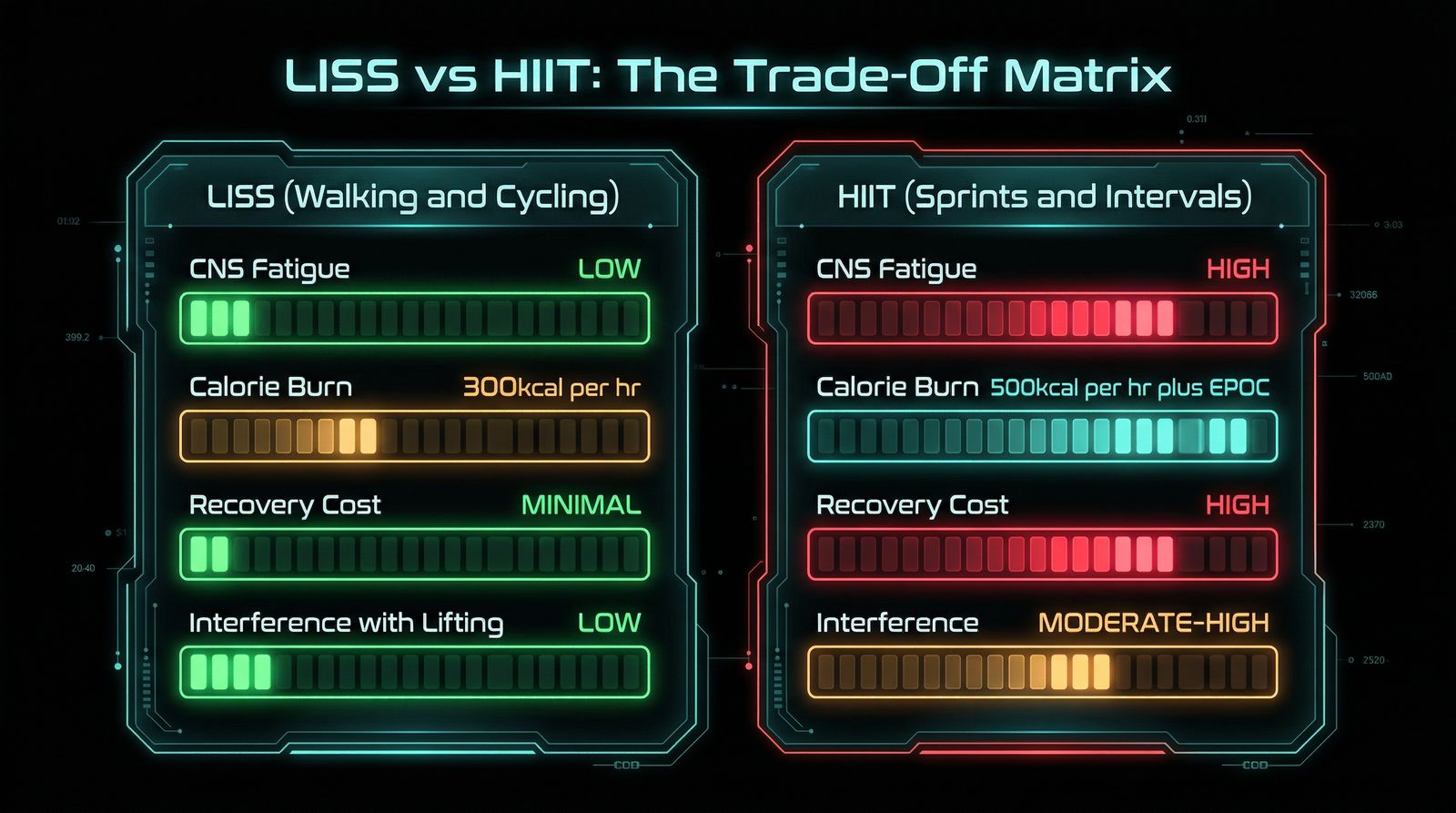
THE ZONE 2 FOUNDATION
Zone 2 cardio (sustained effort at 60-70% of maximum heart rate, conversational pace, oxidative metabolism dominant) has earned its reputation for good reason. For the strength athlete, it serves three distinct purposes that no amount of sprinting can replace.
Aerobic base development. Your aerobic system is the recovery engine between sets, between sessions, and between training blocks. A stronger aerobic base means faster phosphocreatine resynthesis, better lactate clearance, and improved inter-set recovery. VO2 Max for Strength Athletes: The Engine of Recovery covers this in depth: your VO2 max is a strength performance multiplier, not a cardio vanity metric.
Active recovery. Light Zone 2 work on rest days increases blood flow to damaged tissue without creating additional mechanical stress. A 25-minute cycle at conversational pace after a brutal squat session accelerates recovery. A 25-minute sprint session after that same squat day buries you deeper.
Cardiovascular health. You are a strength athlete, but you are also a human being with a heart that needs to function for decades. Zone 2 work builds cardiac output, improves endothelial function, and reduces resting heart rate. These adaptations protect you over a career, not just a training block.
Key Insight
“Zone 2 is your infrastructure, not your fat loss weapon. Build the foundation, then deploy the firepower.”
The prescription: 1-2 sessions per week, 20-30 minutes each. Cycling, rowing, incline walking, or the elliptical. Keep it low-impact. Keep it conversational. This is non-negotiable baseline work for any serious strength athlete who plans to lift for years, not months.
THE CASE FOR SPRINTING
The standard advice for strength athletes has been simple: LISS only, HIIT never, end of discussion. That advice is incomplete. For a strength athlete whose primary goal is staying lean while preserving muscle, Zone 4/5 sprint work is, in many respects, superior to additional Zone 2 volume.
The evidence stacks up across four mechanisms.
EPOC: The Real Afterburn
Post-exercise oxygen consumption (EPOC) is the elevated metabolic rate that persists after training ends. Borsheim & Bahr (2003) established that EPOC magnitude is driven primarily by exercise intensity, not duration. A 15-minute sprint session generates substantially more EPOC than a 45-minute Zone 2 session.
Estimates for high-intensity intervals run up to 14-24 hours of elevated metabolic rate and roughly 50-150 kcal of additional expenditure beyond the session itself, though the size of the effect varies widely between studies. Zone 2 EPOC, by contrast, returns to baseline within 1-2 hours.
Key Insight
“EPOC is a measured physiological phenomenon. The afterburn from a 15-minute sprint session continues working while you sleep.”
Over a training week, this compounds. Two sprint sessions generating meaningful EPOC can approach the total caloric cost of three Zone 2 sessions, in roughly one-third the time.
mTOR/AMPK: The Pathway Conflict Is Shorter
Sprinting activates AMPK. But the duration of that AMPK activation is dramatically shorter than it is with prolonged steady-state cardio.
A 10-20 minute sprint session creates a sharp, transient AMPK spike that resolves within hours. A 45-60 minute Zone 2 session creates a sustained AMPK elevation that lingers and compounds the interference window with your next lifting session. Shorter AMPK activation means a smaller window of mTOR suppression. Smaller window means less interference with your strength adaptations.
Warning
“This advantage only holds when sprint sessions stay short. A 40-minute "HIIT" session is medium-intensity cardio wearing a costume, not a sprint protocol. Keep sprint work to 10-20 minutes of actual effort.”
A properly structured sprint session creates less pathway conflict with your strength training than the same caloric expenditure achieved through extended Zone 2 work. Less time under AMPK dominance means more time for mTOR-driven recovery and growth.
Muscle Preservation in a Deficit
When you are in a caloric deficit, muscle preservation is everything. The body is looking for reasons to catabolise tissue, and the type of training stimulus you provide determines which tissue gets protected.
Sprinting recruits Type II (fast-twitch) muscle fibres, the same fibre population you are trying to preserve and develop as a strength athlete. This recruitment sends a powerful signal: these fibres are essential, do not break them down for fuel. Zone 2 cardio, by contrast, preferentially recruits Type I (slow-twitch) fibres and does not provide a meaningful protective stimulus for the fast-twitch pool.
In a deficit, every training signal matters. Sprint work tells your body to preserve the exact muscle fibres that produce force under a barbell. Steady-state cardio does not send that message.
Time Efficiency
A complete sprint session (warm-up, 6-8 intervals, cool-down) takes 15-20 minutes. An equivalent-calorie Zone 2 session takes 40-50 minutes. For a strength athlete already spending 60-90 minutes under the bar four days a week, the time savings are the difference between a sustainable programme and one that consumes your entire schedule.
Key Insight
“20 minutes of sprints, not 45 of walking or 60 of cycling. The deficit is built, the muscle is preserved, you are done.”
Time is a recovery resource. Every additional minute spent training is a minute not spent recovering. Sprinting delivers more caloric impact per minute than any other cardio modality, which means less total training time, which means more recovery bandwidth for what actually matters: your lifts.
NEAT: THE FREE CALORIE BURN
Before adding any formal cardio (Zone 2 or sprints), account for the variable that most lifters completely ignore: non-exercise activity thermogenesis (NEAT).
NEAT is the energy burned through all movement outside of structured exercise. Walking. Standing. Carrying groceries. Fidgeting. Existing as a person who moves through space instead of sitting in a chair for 16 hours a day.
Levine (2002) documented that NEAT differences between otherwise similar individuals can account for 500-2000 kcal per day. The gap between a high-NEAT and low-NEAT individual is larger than the caloric cost of most formal cardio programmes.
For the strength athlete managing body composition, a daily step target of 8,000-12,000 steps generates 200-500 kcal of additional expenditure with functionally zero recovery cost. No CNS fatigue. No eccentric damage. No AMPK activation competing with your mTOR signalling. Just calories burned across the day through movement that your body barely registers as effort.
Key Insight
“Step count is the highest-leverage, lowest-cost fat loss tool available to a strength athlete. Maximise it before you add a single formal cardio session.”
Set a target. Track it. A 20-minute walk after each meal covers most of it. If your daily steps are consistently below 6,000, you are leaving hundreds of free calories on the table every single day.
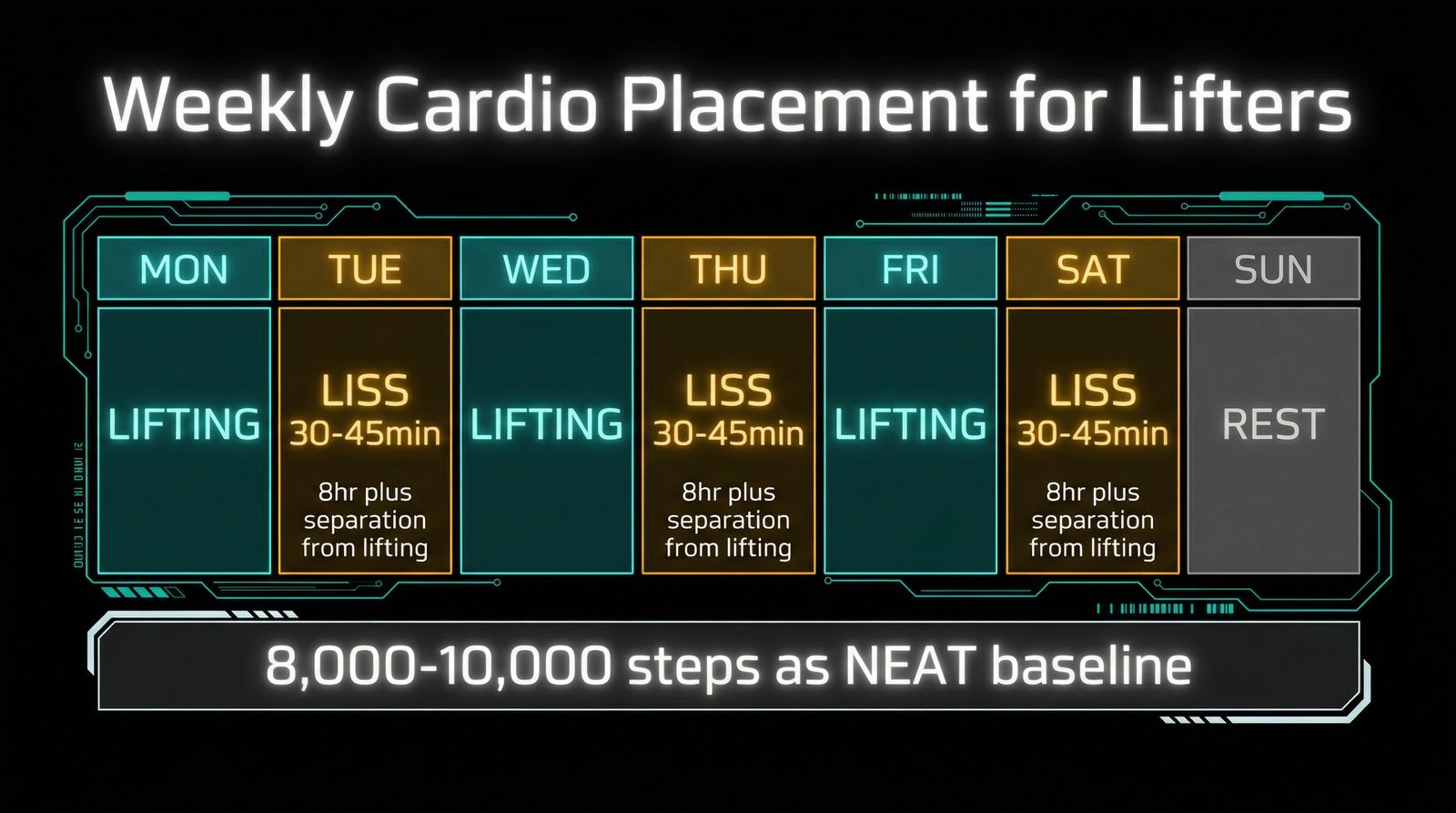
THE PROTOCOL
Stop treating cardio as a monolithic category. It is two distinct tools with two distinct purposes, and the optimal programme deploys both.
Zone 2 (aerobic base and recovery): 1-2 sessions per week, 20-30 minutes each.
- Modality: cycling, rowing, incline walking, elliptical. No running during heavy squat/deadlift blocks.
- Timing: rest days or at least 6-8 hours separated from lifting.
- Intensity: conversational. If you cannot speak in full sentences, you are too high.
- Purpose: cardiovascular health, active recovery, aerobic base. This is infrastructure, not fat loss.
Zone 4/5 sprints (fat loss and conditioning): 1-2 sessions per week, 10-20 minutes of work.
- Modality: assault bike, rower, stationary bike sprints. Low-impact, high-output.
- Protocol: 15-30 second all-out efforts, 60-90 seconds recovery, 6-10 rounds.
- Timing: at least 6-8 hours from lifting. Never before a heavy session. Ideally on a day you are not squatting or deadlifting heavy.
- Purpose: EPOC-driven caloric deficit, fast-twitch fibre preservation, time-efficient conditioning.
The combination is the protocol. Zone 2 alone builds your base but is inefficient for fat loss. Sprints alone condition you but neglect your aerobic foundation and recovery capacity. Together, they cover every need a strength athlete has from their cardio programming.
Warning
“If you are in a deep caloric deficit (more than 500 kcal/day below maintenance), drop to one sprint session per week maximum. Your recovery capacity is already compromised. Do not compound the stress. Lean on NEAT and Zone 2 during aggressive cuts.”
Four rules that do not bend:
- 1Separate lifting and cardio by 6-8 hours minimum. Same-session concurrent training maximises pathway interference. Do not do it.
- 2Low-impact modalities only during strength blocks. Running creates eccentric damage that compounds with barbell training. Cycle, row, or walk.
- 3Never perform cardio immediately before heavy lifting. Glycogen depletion, elevated core temperature, pre-fatigued musculature. If you must do both in one window, lift first.
- 4Scale cardio to your energy availability. Deep deficit means less cardio, not more. Every session competes with your lifting for a shrinking pool of recovery resources.
BUILDING THE DEFICIT INTELLIGENTLY
Cardio is one of three tools for creating the caloric deficit that drives fat loss. The priority order for a strength athlete who wants to preserve performance:
- 1Increase NEAT first. Step count targets of 8,000-12,000 per day. Recovery cost: near zero. Caloric impact: 200-500 kcal/day. This is the foundation of every intelligent cut.
- 1Apply dietary restriction second. A 300-400 kcal daily deficit from food intake is the safest primary mechanism. The Intelligent Deficit: Preserving Strength While Cutting covers the rate of loss, protein floor strategy, and deficit cycling in full.
- 1Add Zone 4/5 sprints third. 1-2 sessions per week for EPOC-driven caloric expenditure and muscle preservation. Short sessions, high impact, minimal time cost.
- 1Add Zone 2 fourth, as infrastructure and supplementary deficit. 1-2 sessions per week on rest days for aerobic base maintenance and active recovery. The caloric contribution is modest but the recovery and health benefits are genuine.
Key Insight
“The deficit is built in layers. Each layer is added only when the previous one is maximised. Most lifters skip straight to layer three or four and wonder why their strength craters.”
Do not add more cardio when the deficit stalls. Reassess NEAT compliance, dietary adherence, and sleep quality first. Cardio volume is the last lever to pull, not the first.
Cardio is not the enemy. Undisciplined, unstructured, recovery-ignorant cardio programming is.
KEY TAKEAWAYS
- The interference effect is real (concurrent aerobic and resistance training can blunt strength and hypertrophy) but it is dose-dependent and programmable. Separate sessions by 6-8 hours, choose low-impact modalities, and manage total volume.
- Zone 2 cardio (1-2x/week, 20-30 min) builds your aerobic base, supports recovery, and protects cardiovascular health. It is infrastructure, not your primary fat loss tool.
- Zone 4/5 sprint work (1-2x/week, 10-20 min) is superior for fat loss in strength athletes: greater EPOC, shorter AMPK activation window, fast-twitch fibre preservation, and dramatically better time efficiency.
- NEAT (non-exercise activity thermogenesis) via daily step targets of 8,000-12,000 can contribute 200-500 kcal/day at virtually zero recovery cost. Maximise this before adding any formal cardio.
- The optimal protocol combines both Zone 2 and Zone 4/5 work. Neither alone covers all needs. Together, they build the aerobic base, drive the deficit, and preserve the muscle.
PUT IT INTO PRACTICE
This week: Check your average daily step count. If it is below 8,000, set a target of 9,000-10,000 and hit it through deliberate walking: 20 minutes after each meal covers most of it. Then add one sprint session: 8 rounds of 20-second all-out effort on an assault bike or rower with 60 seconds rest between rounds. Total time commitment: under 20 minutes. Track how your body responds.
This training block: If you are in a fat loss phase, programme two cardio modalities per week: one Zone 2 session (25-30 minutes, cycling or incline walking, rest day) and one sprint session (10-15 minutes of interval work, at least 6 hours from lifting). Monitor your squat and deadlift performance across the block. Any strength decline beyond 5% warrants a reduction in overall deficit size, not an increase in cardio volume.
Long term: Reclassify cardio from a single category into two distinct tools with two distinct jobs. Zone 2 is infrastructure: it stays in your programme year-round at low volume. Sprint work is a precision weapon, deployed during fat loss phases, scaled back during peaking blocks, and always programmed with the same intentionality as your competition lifts. An athlete who manages both modalities as deliberately as barbell volume will consistently outperform one who treats cardio as an afterthought or avoids it entirely.
REFERENCES
- Wilson, J. M., et al. (2012). Concurrent training: a meta-analysis examining interference of aerobic and resistance exercises. Journal of Strength and Conditioning Research, 26(8), 2293-2307. PMID: 22002517
- Borsheim, E., & Bahr, R. (2003). Effect of exercise intensity, duration and mode on post-exercise oxygen consumption. Sports Medicine, 33(14), 1037-1060. PMID: 14599232
- Murach, K. A., & Bagley, J. R. (2016). Skeletal muscle hypertrophy with concurrent exercise training: contrary evidence for an interference effect. Sports Medicine, 46(8), 1029-1039. PMID: 26932769
- Hawley, J. A. (2009). Molecular responses to strength and endurance training: are they incompatible? Applied Physiology, Nutrition, and Metabolism, 34(3), 355-361. PMID: 19448698
- Levine, J. A. (2002). Non-exercise activity thermogenesis (NEAT). Best Practice & Research Clinical Endocrinology & Metabolism, 16(4), 679-702.
- Fyfe, J. J., Bishop, D. J., & Stepto, N. K. (2014). Interference between concurrent resistance and endurance exercise: molecular bases and the role of individual training variables. Sports Medicine, 44(6), 743-762. PMID: 24728927
- Schumann, M., Feuerbacher, J. F., Sünkeler, M., et al. (2022). Compatibility of concurrent aerobic and strength training for skeletal muscle size and function: an updated systematic review and meta-analysis. Sports Medicine, 52(3), 601-612. PMID: 34757594
- Trapp, E. G., Chisholm, D. J., Freund, J., & Boutcher, S. H. (2008). The effects of high-intensity intermittent exercise training on fat loss and fasting insulin levels of young women. International Journal of Obesity, 32(4), 684-691. PMID: 18197184
- Wewege, M., van den Berg, R., Ward, R. E., & Keech, A. (2017). The effects of high-intensity interval training vs. moderate-intensity continuous training on body composition in overweight and obese adults: a systematic review and meta-analysis. Obesity Reviews, 18(6), 635-646. PMID: 28401638
- Tudor-Locke, C., Craig, C. L., Brown, W. J., et al. (2011). How many steps/day are enough? For adults. International Journal of Behavioral Nutrition and Physical Activity, 8, 79. PMID: 21798015
Analysed by FINAL FORM AI. Your form, perfected.