Making Weight: The Smart Lifter's Guide
Cut smart, recover fast, and step on the platform at full strength.
By Dhiren Dunraj MSc

*Only relevant if you compete in a weight class. Solo lifters: see The Intelligent Deficit.*
Key Insight
“"Making weight is a calculation, not a badge of honour. Get the calculation right and you compete at your strongest, in the right class, with energy to spare."”
Making weight is a calculation, not a badge of honour. Get the calculation right and you compete at your strongest, in the right class, with energy to spare. Get it wrong and you've systematically undermined a preparation block that took months to build. You'll find out the hard way on the platform.
The mythology around big cuts is deep in powerlifting culture. Lifters talk about their cuts with a peculiar pride, the saunas, the fasting, the dramatic morning-of weigh-in sequences. The culture sometimes treats the severity of a cut as evidence of seriousness. It isn't. A large cut is frequently evidence of poor planning, suboptimal weight class selection, or an ego that won't let a lifter compete where their actual bodyweight puts them.
This article is not anti-cut. Modest cuts, executed intelligently, are a legitimate strategic tool. This article is pro-calculation. Know exactly what you're trading, know exactly what you'll get back, and make the decision with accurate information.
Weight Class Strategy: The Actual Maths
The fundamental logic of weight class competition is straightforward: you want to be as strong as possible relative to the bodyweight limit of your class. This means the question to ask is "what's the class where my strength-to-bodyweight ratio is maximised?" rather than "what's the lowest class I can reach?"
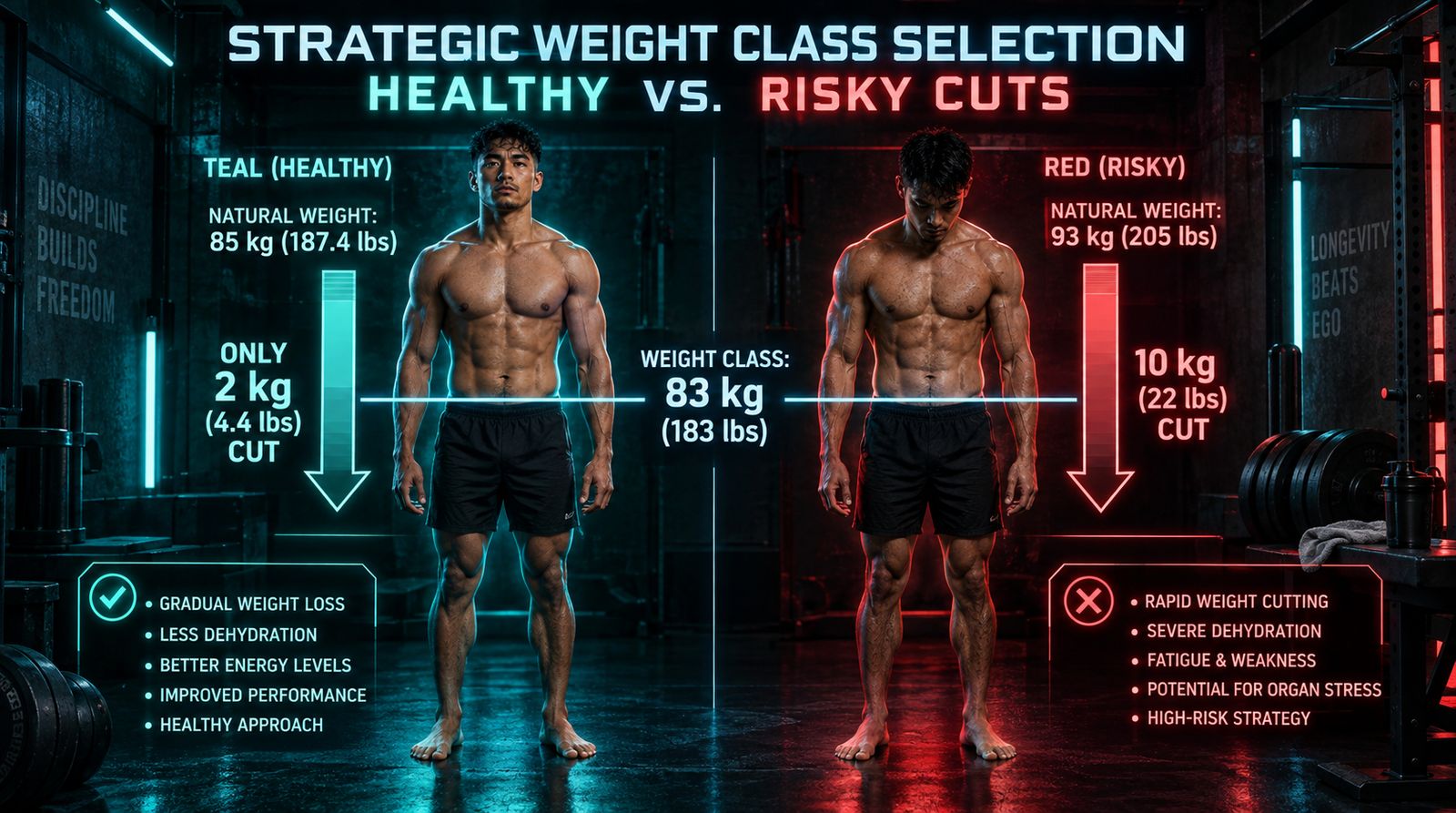
A lifter who walks around at 95kg and competes at 93kg has a modest cut. Perhaps 2kg of water over 24 hours. Their performance cost is low, their recovery is complete, and they're competing at close to full capacity. The strategy is sound.
A lifter who walks around at 103kg and cuts to 93kg has a different situation. They've removed 10kg, roughly 10% of their bodyweight, in acute fluid. Their plasma volume is depleted. Their joints are operating on less synovial fluid. Their glycogen restoration is incomplete. They're competing at a meaningful deficit against someone who walked in at 93kg naturally. The theoretical advantage of being in a lower class exists only if their actual competition-day strength exceeds that of a natural 93kg lifter. Frequently, it doesn't.
The calculation only works in one direction: the strength gained from being the heaviest competitor in a class must outweigh the performance cost of the cut. When that equation turns negative, when the cut costs more than the class advantage provides, the cut is counterproductive. Most large cuts are in negative territory for most lifters. They just don't have the data to see it.
The practical rule of thumb: if a cut requires losing more than 5% of bodyweight acutely, the performance cost is likely to exceed the strategic benefit for most lifters. There are exceptions (experienced lifters with exceptional rehydration protocols, 24-hour weigh-ins, and well-established cut-and-refuel sequences), but those lifters are the outliers. If you're reading an article about how to make weight, you're probably not them yet.
Long-Term Weight Management: The Better Strategy
The optimal approach to weight class management is to compete at your natural walk-around weight or within 2–3kg of it. This is a performance conclusion, not a matter of taste.
Competing at or near your natural weight means full glycogen stores, full hydration, normal plasma volume, and optimal joint lubrication. It means you walk onto the platform at 100% of your current preparation, with your energy systems fully charged, your connective tissue fully supported, and your cognitive function unimpaired. You're competing as the strongest version of yourself on that day.
The alternative strategies are not inherently wrong. Building toward a weight class, eating in a controlled surplus to grow into the next class up, is a legitimate long-term approach when the evidence suggests you'd be more competitive at the higher weight. **Managing body composition within your current class** through intelligent nutrition and training is preferable to cutting, and delivers the same class advantage without the performance cost.
What neither of these strategies involves is arriving at a competition carrying 8kg of fluid you artificially removed three days earlier and spent the intervening hours desperately trying to replace. That is a problem masquerading as a strategy.
Nutritional periodisation for long-term weight management means eating at maintenance during normal training blocks, a slight surplus during hypertrophy-focused accumulation phases, and a modest deficit during competition prep, and only if body composition goals and performance goals align. The key word is modest. A small reduction in body fat over a sixteen-week preparation block moves bodyweight down without touching performance. A 3% body fat reduction over three months is a very different intervention to a 6% bodyweight water cut over forty-eight hours.
The Mechanism of Acute Water Cuts
Understanding what happens during a water cut allows you to plan one intelligently, and to recognise when you've gone too far.
The body's water content is regulated tightly by plasma osmolarity, the concentration of solutes in the blood. When fluid intake drops and sweating increases (via sauna, hot bath, or light exercise in warm clothing), plasma volume decreases. This drop in plasma volume translates directly to a lower number on the scale.
That reduction is temporary. The body treats plasma volume reduction as an emergency. Within 60–90 minutes of beginning rehydration, the kidneys begin retaining fluid aggressively and plasma volume starts restoring. Within 24 hours of full rehydration, with proper electrolyte and carbohydrate support, most physiological parameters return to normal. The window of impairment exists only between the cut and the refuel.
That window is the problem. If you're competing 2 hours after weigh-in, that window overlaps directly with your performance window. If you're competing 24 hours after weigh-in, the window is closed before you lift a single gram.
For a standard water cut, the body can typically shed 2–5% of bodyweight in a 24-hour period through sweat and fluid restriction. Experienced lifters with more developed protocols achieve 6–8% in extreme cases. These numbers are ceilings, not targets. They mark the upper limits of what is physiologically achievable before the risks become clinically significant.
24-Hour vs 2-Hour Weigh-In: Two Completely Different Games
This is the most important variable in weight cut strategy, and it's the one most commonly misunderstood.
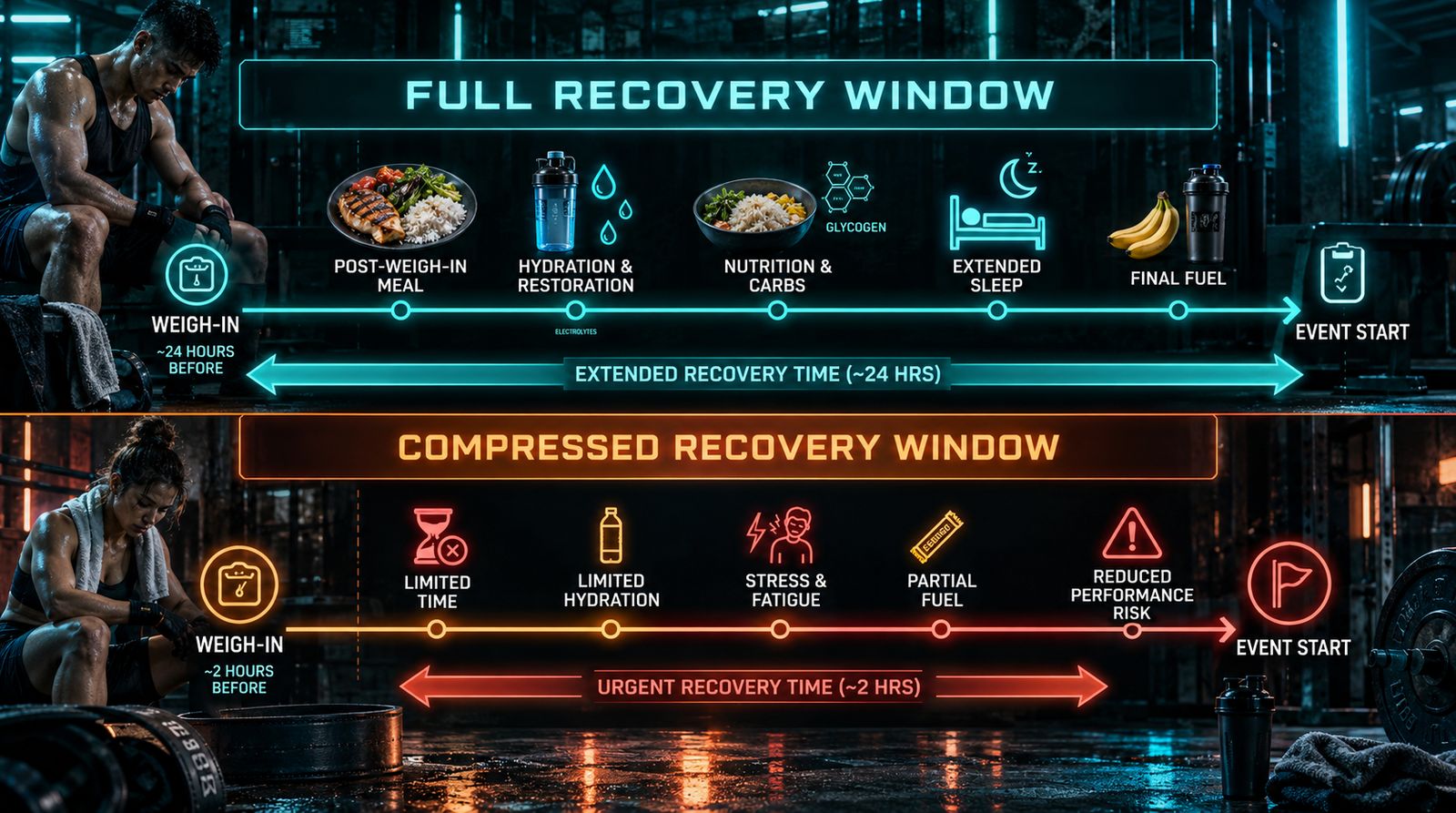
The 24-hour weigh-in means the lifter has a full day between stepping on the scales and their first attempt. This timeline allows for meaningful cuts, up to 4–6% of bodyweight for most lifters, because full rehydration and refuelling is achievable within the window. A lifter who weighs in at 92kg having cut from 97kg has 24 hours to restore 5kg of fluid, eat a proper meal, sleep, and wake up at something close to full capacity. With a disciplined rehydration protocol, this is viable.
The 2-hour weigh-in is a different problem. Two hours is not enough time for full plasma volume restoration or for meaningful glycogen replenishment. The maximum viable cut in a 2-hour scenario is roughly 1.5–2% of bodyweight. Above that threshold, the performance cost exceeds the strategic benefit and you'll be lifting in a compromised state regardless of how aggressively you refuel in the available time.
Attempting a 5% cut with a 2-hour weigh-in is the most common and most preventable strategic error in competitive powerlifting. It's choosing to compete at 80% of your capacity for a theoretical weight class advantage that your depleted physiology cannot actually deliver. The maths never works.
Before you decide on a cut, confirm the weigh-in format. It will determine the upper limit of what is responsible.
Rehydration and Refuel Protocols
The sequence of your rehydration matters as much as the total volume you consume. Most lifters know they need to drink water after weigh-in. Fewer know that drinking water is the last thing you should do.
Step one: electrolytes first. An electrolyte-rich solution containing sodium, potassium, and magnesium allows the body to retain fluid rather than passing it. When you drink plain water on a depleted electrolyte background, plasma osmolarity drops below the renal threshold and the kidneys begin excreting the excess fluid. You drink a litre of water, visit the bathroom three times, and absorb perhaps a quarter of it. Electrolytes first. The fluid stays where you need it.
Practical sources: commercial electrolyte drinks, oral rehydration salts, or simply adding sodium and potassium to water. The specific product matters less than the principle, electrolytes before significant fluid volume.
Step two: fast-digesting carbohydrates. Glucose and fructose begin glycogen restoration immediately. Watermelon, fruit, sports drinks with carbohydrates, white rice, white bread. Foods that the gut can process quickly without significant blood flow diversion. The goal here is beginning the glycogen top-up process while continuing to restore plasma volume. Speed of absorption matters more than volume of food.
Step three: sustained rehydration. Continue sipping fluids consistently across the full recovery window. Steady, consistent intake that the body can absorb rather than excrete, instead of gulping large amounts at intervals.
Step four: a proper meal. If timing allows, specifically if you're in a 24-hour weigh-in scenario, eat a full carbohydrate-based meal 3–4 hours before your first attempt. Pasta, rice, potatoes. The foods that will be fully digested by the time you step on the platform. Not too close to the first attempt, a full stomach under maximal intra-abdominal pressure creates its own problems.
In a 2-hour scenario, step four is not available. This is another reason the 2-hour cut limit is so constrained, you simply cannot execute the full protocol.
When a Cut Is Never Worth It
Large cuts, above 6–8% of bodyweight, compromise performance measurably and carry real health risks. This is documented physiology, not theoretical caution.
Acute dehydration at significant levels reduces muscular endurance and peak power output. The contractile properties of skeletal muscle are impaired when intracellular fluid decreases. Strength, specifically one-rep-max performance on compound barbell movements, begins declining at dehydration levels above roughly 3–5% of bodyweight, the research suggests. Large cuts push well past that threshold.
Joint function is compromised. Synovial fluid is water-based, the viscous solution that lubricates and cushions joint surfaces during loading. A dehydrated joint is not fully lubricated. Under maximal compression loads, a 300kg squat, a 250kg deadlift, improperly lubricated joints absorb impact differently. The risk is not hypothetical.
Cognitive function and reaction time are measurably reduced at significant dehydration levels. The commands, the timing, the technical execution under load: all of these depend on a nervous system that's operating with full fluid support. A dehydrated athlete is not cognitively sharp. At the edge of maximal strength output, where the difference between a made lift and a missed lift can be a single technical cue, cognitive impairment matters.
A lifter who has cut 8% of bodyweight and incompletely rehydrated is not at 100% on the platform. They're competing with one hand tied behind their back and calling it a strategy. The bar still loads to the same number. The judges still apply the same standard. The physiological impairment is invisible to everyone in the room except the lifter's nervous system.
The decision to cut weight should be made months before a competition, when there is time to test the protocol, evaluate the recovery, and make an honest assessment of the cost-benefit equation. And it should always be made in the direction of smaller, not larger. The least cut that achieves the strategic objective is always the correct cut.
Key Takeaways
- Competing at or near your natural bodyweight is a performance strategy, not a concession. Full hydration and full glycogen produce the best total.
- The viable cut limit depends entirely on the weigh-in format: up to 4–6% is recoverable with a 24-hour window; 1.5–2% maximum with 2 hours.
- Electrolytes must come before plain water in any rehydration protocol. Fluid retention depends on osmolarity, not volume.
- Cuts above 5–6% of bodyweight measurably reduce strength output, joint lubrication, and cognitive function. The performance cost exceeds the class advantage for most lifters.
- Decide on your weight class and cut strategy months before competition. Testing the protocol in a low-stakes environment removes the uncertainty from the actual day.
Put It Into Practice
This week: Establish your natural walk-around weight, your average weight across a normal training week, eating and drinking normally, with no manipulation. This is your baseline. Every weight class decision should start from this number, not from "I want to be in the X class."
This training block: If you're planning a modest cut for an upcoming peaking block, rehearse the protocol in the final weeks of prep. Two weeks out, simulate the cut-and-rehydration sequence on a non-competition day. Execute the fluid restriction, weigh in, execute the rehydration protocol, and train a heavy session two hours later. The data from that simulation is more valuable than any theoretical guidance.
Long term: Track your competition-day bodyweight versus your weigh-in weight across multiple meets. The pattern will show you, with your own data, how well you rehydrate, how much the cut costs you subjectively, and whether the weight class position is delivering the strategic advantage you're cutting for. Let the numbers make the decision.
Analysed by FINAL FORM AI. Your form, perfected.
References
- 1Reale R, Slater G, Burke LM. 'Acute-weight-loss strategies for combat sports and applications to Olympic success.' Int J Sports Physiol Perform. 2017. PMID: 27347784
- 2Reale R, Slater G, Burke LM. 'Individualised dietary strategies for Olympic combat sports: acute weight loss, recovery and competition nutrition.' Eur J Sport Sci. 2017. PMID: 28316263
- 3Khodaee M, Olewinski L, Shadgan B, et al.. 'Rapid weight loss in sports with weight classes.' Curr Sports Med Rep. 2015. PMID: 26561763
- 4Barley OR, Chapman DW, Abbiss CR. 'The current state of weight-cutting in combat sports.' Sports (Basel). 2019. PMID: 31117325
- 5Reljic D, Hässler E, Jost J, et al.. 'Rapid weight loss and the body fluid balance and hemoglobin mass of elite amateur boxers.' J Athl Train. 2013. PMID: 23672332
- 6Helms ER, Aragon AA, Fitschen PJ. 'Evidence-based recommendations for natural bodybuilding contest preparation: nutrition and supplementation.' J Int Soc Sports Nutr. 2014. PMID: 24864135
- 7Garthe I, Raastad T, Refsnes PE, et al.. 'Effect of two different weight-loss rates on body composition and strength and power-related performance in elite athletes.' Int J Sport Nutr Exerc Metab. 2011. PMID: 21558571
- 8Matthews JJ, Nicholas C. 'Extreme rapid weight loss and rapid weight gain observed in UK mixed martial arts athletes preparing for competition.' Int J Sport Nutr Exerc Metab. 2017. PMID: 27710145