The Reality of Weight Loss: Protein Leverage vs Insulin vs Calorie Tracking
An evidence-based verdict on the three competing theories of fat loss — and how to synthesise them for a lifter trying to cut without losing the bar.
By Dhiren Dunraj MSc

Key Insight
“You cannot out-train a poor nutritional framework, and the iron does not care about your theories — only your results.”
Walk into any gym and you will encounter three warring camps. One screams about thermodynamics and calorie tracking. Another demonises insulin and carbohydrates as the root cause of all fat gain. A third preaches that protein is the master lever that governs everything else. Each camp has its zealots, its YouTube channels, and its selectively cited studies.
When you are under the bar trying to stay lean without watching your squat collapse by 30 kg, the ideological wars are irrelevant. You need a framework that is mechanistically honest, practically executable, and specifically tuned for the demands of a strength athlete. This article delivers that verdict by showing you how the protein leverage hypothesis, the insulin-carbohydrate model, and the energy balance model interact under the specific stress of heavy resistance training, rather than by picking a winner from the three camps.
The Energy Balance Model: Foundation, Not Ceiling
The Calories In, Calories Out (CICO) model states that body mass changes are governed by the first law of thermodynamics. Energy balance is a physical law, not a hypothesis. If your energy intake exceeds your expenditure across time, mass increases. If expenditure exceeds intake, mass decreases. It is mathematically inescapable.
But CICO is a framework for understanding the direction of change, not the quality of that change. If you lose five kilograms, but three of those kilograms are lean contractile tissue, your relative strength has plummeted, your metabolic rate has decreased, and your hormonal environment has worsened. You have lost the wrong mass.
The NIH metabolic ward experiments led by Kevin Hall represent the gold standard for testing CICO under controlled conditions. Hall et al. (2015) confined participants in an inpatient setting where every calorie consumed and expended was measured with precision. When calories and protein were matched, fat restriction and carbohydrate restriction produced comparable fat loss outcomes over a short-term period. This directly challenged claims that carbohydrate restriction was metabolically superior. Energy balance governs the outcome. What differs between diets is their effect on adherence, satiety, and the composition of the mass lost.
A separate Hall et al. (2019) study introduced ultra-processed versus minimally processed diets in another randomised controlled inpatient trial. Participants consuming ultra-processed diets spontaneously ate 500 more calories per day than those eating whole-food diets, gaining an average of 0.9 kg over two weeks. The diets were matched for presented calories, protein, carbohydrate, fat, and fibre. The difference was in food structure and processing, factors that affect how quickly energy is absorbed and how strongly appetite is regulated. Energy balance still governed the outcome, but the inputs to the equation were being manipulated by food quality.

The Insulin-Carbohydrate Model: Mechanisms Real, Conclusions Overstated
The carbohydrate-insulin model, championed most prominently by David Ludwig and colleagues (2021), proposes that diets high in refined carbohydrates drive chronic hyperinsulinaemia, which promotes fat storage and drives compensatory hunger. The proposed solution is to reduce carbohydrate load to lower insulin and liberate stored fat.
The mechanistic logic is real. Insulin is a potent anti-lipolytic hormone. At high concentrations, it suppresses the release of fatty acids from adipose tissue. Highly processed, rapidly absorbed carbohydrates do produce large and rapid insulin spikes. And there is genuine evidence that reducing refined carbohydrate intake improves metabolic markers in insulin-resistant populations.
The error is in the size of the claim. Hall's NIH metabolic ward data showed that, under controlled conditions with matched calories and protein, carbohydrate restriction did not produce meaningfully more fat loss than fat restriction. The insulin-carbohydrate model predicts it should. It does not, at least not at the timescales studied.
What the insulin-carbohydrate model actually identifies is a mechanism that drives excess energy intake in the real world rather than one that overrides energy balance: ultra-processed carbohydrates reduce satiety, reward the brain's dopaminergic system, and undermine appetite regulation, leading people to consume more calories than they intend.
For the strength athlete, the practical implications are different from the general population. You are not insulin resistant. Your muscle tissue consumes glucose voraciously during and after heavy training. Insulin, far from being an enemy, is the most anabolic hormone in your pharmacopoeia when it fires at the right time. The Foundations of Macronutrients for Strength Athletes covers the physiology of insulin in training in detail, but the summary is this: time your carbohydrates around your training window, prioritise whole-food sources, and carbohydrate management becomes a performance advantage rather than a fat-loss liability.
The Protein Leverage Hypothesis: The Master Lever for Lifters
Simpson and Raubenheimer (2005) proposed one of the most elegant and practically powerful frameworks in nutritional science: the protein leverage hypothesis. The central claim is that human appetite is regulated with strong priority towards achieving a target absolute protein intake. When the protein density of your diet falls, as it does in most ultra-processed food environments, you will continue to eat until your protein quota is satisfied, inevitably over-consuming fat and carbohydrates in the process.
Controlled feeding studies support this mechanism. When protein is diluted in the diet, ad libitum caloric intake rises. When protein density is increased, total caloric intake falls, even without explicit caloric restriction. You eat less because the satiety signal is satisfied.
The protein leverage hypothesis does not contradict CICO. It explains a primary mechanism by which the "calories in" side of the equation is biologically regulated, and how that regulation fails in a low-protein dietary environment. It is the upstream cause for many people's chronic overeating, not a competing theory.
For the strength athlete, protein leverage is the master lever for three compounding reasons:
First: satiety. High protein intakes suppress appetite more powerfully than equivalent calories from fat or carbohydrate, through mechanisms including GLP-1, PYY, and CCK release, as well as direct hepatoportal sensing. You naturally eat less without suffering.
Second: thermic effect. Protein has the highest thermic effect of food (TEF) of any macronutrient, with approximately 25-30% of its caloric content expended during digestion and metabolism. Consuming 200 calories of protein costs 50-60 calories to process. Consuming 200 calories of fat costs approximately 4-6 calories. This is a meaningful difference at scale.
Third: muscle protection. In a caloric deficit, protein is the primary substrate for preserving lean mass. Helms et al. (2014) found that resistance-trained athletes in a deficit required higher protein intakes than previously recommended, up to 2.3-3.1 g per kg of lean body mass, to protect contractile tissue. The protein leverage effect compounds here: higher protein intakes simultaneously reduce total caloric intake, protect muscle, and accelerate fat metabolism. It is the strongest single variable a lifter can manipulate.
The Synthesis: A Practical Verdict
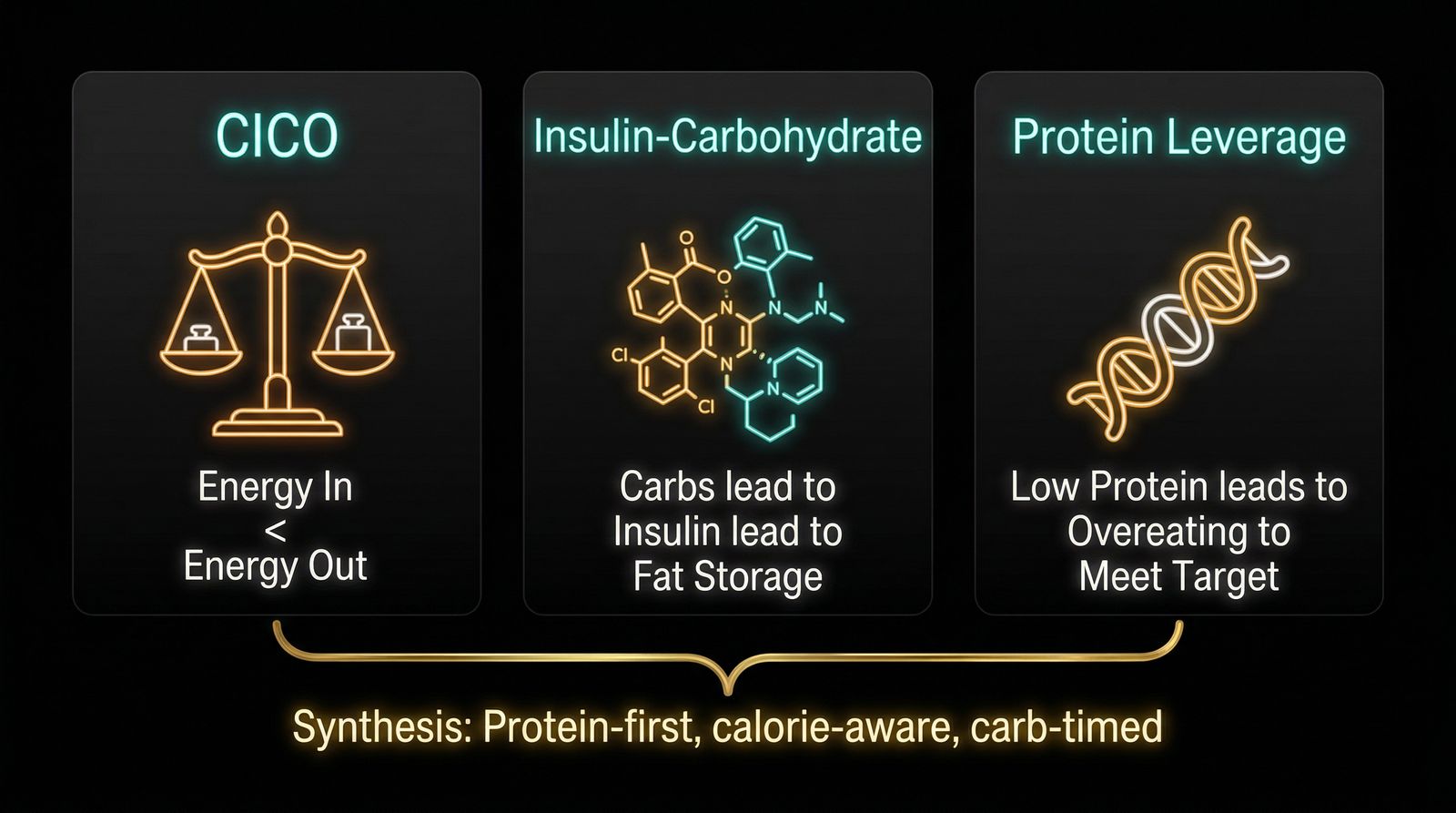
The intellectual honesty the iron game demands requires acknowledging that these three models are complementary lenses on the same physiology rather than competitors, each capturing a different layer of the system.
Energy balance is the constraint. You cannot escape it. A caloric deficit produces weight loss. A surplus produces weight gain. Every practical strategy must work within this framework.
The insulin-carbohydrate model identifies a food quality failure mode. Ultra-processed, rapidly absorbed carbohydrates undermine appetite regulation and drive excess intake. For a strength athlete, the solution is carbohydrate quality and timing, not avoidance. Whole-food, fibre-rich carbohydrate sources consumed around training are vastly different metabolic inputs from white bread and sugary drinks consumed at random.
Protein leverage is your primary practical tool. Setting a high protein floor (2.2 g per kg of body weight as a minimum, rising to 2.4-3.0 g per kg during a deficit) automatically regulates the energy balance equation through satiety, produces a high thermic cost, and protects the lean mass you have built through months of heavy training.
The verdict for lifters is to stop arguing over which model is "correct" and use all three. Operate within energy balance. Manage carbohydrate quality and timing. Set an inviolable protein floor. When you do this, fat loss happens with less hunger, less muscle loss, and less disruption to your training performance than any single-model approach can achieve.
Key Takeaways
- Energy balance is a physical law, not a dietary opinion — the direction of fat loss or gain is always determined by calories in versus calories out.
- The NIH metabolic ward studies (Hall et al., 2015) demonstrated that carbohydrate restriction offers no meaningful fat loss advantage over fat restriction when calories and protein are matched, contradicting the strongest version of the insulin hypothesis.
- The protein leverage hypothesis (Simpson & Raubenheimer, 2005) explains why high-protein diets spontaneously reduce total caloric intake — your body will not stop eating until its protein quota is met.
- For lifters in a deficit, protein intake should reach 2.2-3.0 g per kg of bodyweight to protect muscle mass, control hunger, and maximise the thermic effect of food.
- Carbohydrate quality and timing — not carbohydrate avoidance — is the practical takeaway from the insulin-carbohydrate model for strength athletes.
Put It Into Practice
This week: Set your absolute protein target at 2.2 g per kg of body weight and hit it every day this week regardless of everything else you eat. Track it. Notice what happens to your spontaneous hunger by day four or five.
This training block: If you are cutting, bracket your carbohydrates around your training sessions. Consume 60-70% of your daily carbohydrate allowance in the two meals surrounding your hardest training session. Keep the remainder of your day protein-and-fat focused. Use whole-food carbohydrate sources — rice, oats, potato — rather than processed alternatives.
Long term: Stop selecting one dietary model and dismissing the others. Build a framework that uses all three: track your energy balance, prioritise protein at every meal, and manage carbohydrate quality and timing around your training. Measure your results under the bar. Adjust the variables based on real-world performance, not theoretical allegiance.
Analysed by FINAL FORM AI. Your form, perfected.
References
- Simpson, S. J., & Raubenheimer, D. (2005). Obesity: the protein leverage hypothesis. Obesity Reviews, 6(2), 133-142.
- Hall, K. D., et al. (2015). Calorie for Calorie, Dietary Fat Restriction Results in More Body Fat Loss than Carbohydrate Restriction in People with Obesity. Cell Metabolism, 22(3), 427-436. PMID: 26278052
- Hall, K. D., et al. (2019). Ultra-processed diets cause excess calorie intake and weight gain: an inpatient randomized controlled trial in adults. Cell Metabolism, 30(1), 67-77. PMID: 31105044
- Ludwig, D. S., et al. (2021). The carbohydrate-insulin model: a physiological perspective on the obesity pandemic. The American Journal of Clinical Nutrition, 114(6), 1873-1885. PMID: 34515299
- Helms, E. R., Zinn, C., Rowlands, D. S., & Brown, S. R. (2014). A systematic review of dietary protein during caloric restriction in resistance trained lean athletes. International Journal of Sport Nutrition and Exercise Metabolism, 24(2), 127-138. PMID: 24092765
- Hall, K. D., & Guo, J. (2017). Obesity energetics: body weight regulation and the effects of diet composition. Gastroenterology, 152(7), 1718-1727. PMID: 28193517
- Sacks, F. M., Bray, G. A., Carey, V. J., et al. (2009). Comparison of weight-loss diets with different compositions of fat, protein, and carbohydrates. New England Journal of Medicine, 360(9), 859-873. PMID: 19246357
- Gardner, C. D., Trepanowski, J. F., Del Gobbo, L. C., et al. (2018). Effect of low-fat vs low-carbohydrate diet on 12-month weight loss in overweight adults and the association with genotype pattern or insulin secretion: the DIETFITS randomized clinical trial. JAMA, 319(7), 667-679. PMID: 29466592
- Hall, K. D., Farooqi, I. S., Friedman, J. M., et al. (2022). The energy balance model of obesity: beyond calories in, calories out. American Journal of Clinical Nutrition, 115(5), 1243-1254. PMID: 35134825
- Raubenheimer, D., & Simpson, S. J. (2019). Protein leverage: theoretical foundations and ten points of clarification. Obesity, 27(8), 1225-1238. PMID: 31339001