Cardio Zones Explained: Which Zone Actually Burns Fat
Zone 1 burns fat. Zone 5 burns fat and torches calories. Zone 3 is largely wasted effort.
By Dhiren Dunraj MSc

Key Insight
“Zone 1 burns fat. Zone 5 burns fat and remakes your metabolism. Zone 3 mostly wastes your time. The athlete who understands this programmes like an elite coach.”
Not every piece of cardio you do is equivalent. The forty-five minutes of moderate jogging and the twenty-minute sprint session differ in more than intensity. They create different physiological states with different substrate utilisation, different hormonal responses, different adaptation signals, and different costs to your recovery. Understanding this reshapes how you programme conditioning.
Heart rate training zones are the standard framework for categorising exercise intensity. The number of zones used varies between systems (three-zone, five-zone, and seven-zone models all exist) but the underlying physiology is consistent. This article uses the five-zone model as it offers sufficient resolution for practical programming without unnecessary complexity.
Why Zones Matter
At different intensities, your body is in genuinely different physiological states: different dominant fuel sources, different hormonal environments, different levels of ventilatory stress, different recovery demands. These states do not blend seamlessly into one another. There are distinct physiological thresholds where the state shifts.
The two most important thresholds are:
Ventilatory Threshold 1 (VT1): The intensity at which breathing becomes noticeably harder and talking becomes difficult. Below VT1, exercise is aerobic, conversational, and primarily fuelled by fat. This divides Zone 2 from Zone 3.
Ventilatory Threshold 2 (VT2) / Lactate Threshold: The intensity at which lactate accumulates faster than it can be cleared, sometimes called the anaerobic threshold. Above VT2, exercise can only be sustained for minutes rather than hours. This divides Zone 4 from Zone 5.
Seiler (2010) reviewed how elite endurance athletes distribute their training across intensity zones and found a consistent pattern: the most successful athletes spend approximately 75–80% of their training volume at low intensities (below VT1) and 15–20% at high intensities (above VT2). Almost none at the moderate, grey-zone intensities in between. Understanding why leads directly to how a powersthetics athlete should think about their conditioning.
Zone 1: Active Recovery and Fat Oxidation (50–60% HRmax)
Zone 1 is the easiest training zone: heart rate at 50–60% of maximum, a pace that feels almost effortlessly gentle. Easy walking, very light cycling, gentle swimming. You could sustain this indefinitely. Breathing is deep and completely comfortable. You could hold a full conversation without effort.
Physiologically, Zone 1 is characterised by near-total aerobic metabolism, dominant fat oxidation, and parasympathetic nervous system activity. The body is in recovery mode. Lactate production is minimal, muscle glycogen is barely touched, and hormonal stress markers remain near-baseline.
This zone has two primary uses: active recovery between higher-intensity sessions, and as an entry point for athletes building aerobic base from scratch. A walk at an easy pace puts most people squarely in Zone 1. Light cycling, gentle swimming, or an easy hike all qualify.
For a lifter, Zone 1 work on rest days accelerates recovery by increasing blood flow to damaged tissue without adding to cumulative fatigue. It costs nothing and contributes to step count, NEAT, and the general low-intensity caloric expenditure that underpins fat loss.
Zone 2: The Fat Oxidation Sweet Spot (60–70% HRmax)
Zone 2 is where most fat-burning happens in the purest physiological sense. Heart rate at 60–70% maximum: brisk walking to a very easy jog. Breathing is clearly elevated but fully controlled; you can still hold a conversation, though not as effortlessly as in Zone 1.
At Zone 2 intensities, fat oxidation (the rate at which the body burns stored fat as fuel) reaches its peak. This is the so-called FATmax, the intensity at which fat contribution to total energy expenditure is maximised. The aerobic system is operating well within its capacity, lactate is being cleared as fast as it is produced, and the body can sustain the effort for hours.
Seiler's (2010) research on elite endurance athletes identifies Zone 2 as the workhorse of aerobic base development. Long Zone 2 sessions (45 minutes to several hours) develop mitochondrial density, cardiac stroke volume, and aerobic enzyme activity. These are the adaptations that improve VO2max over the long term and expand the engine available for all other training.
For the powersthetics athlete, Zone 2 is the zone of easy cardio: brisk walking at a decent pace, light cycling, easy rowing. It is far above sedentary but well below the intensity of any meaningful aerobic challenge. Recovery cost is minimal. A 45–60 minute Zone 2 session on a rest day from lifting is essentially free in physiological terms.
Levine (2002) documented that NEAT (which largely operates in Zones 1–2) is the most variable component of total daily energy expenditure. Maximising time in Zone 1–2 through walking and light activity is one of the highest-return fat loss interventions available.
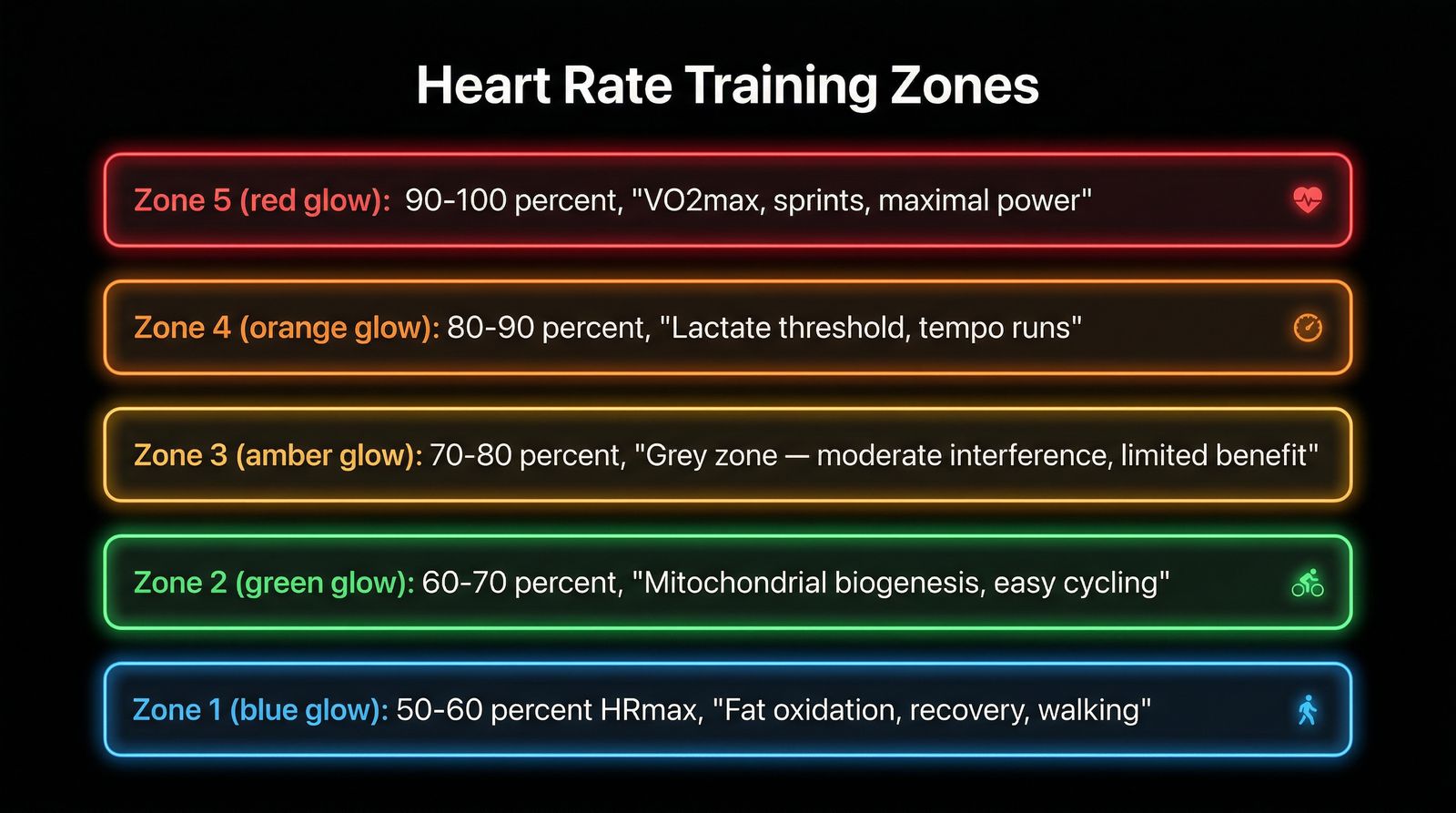
Zone 3: The Grey Zone — Avoid Unless Intentional (70–80% HRmax)
Zone 3 is the most commonly trained zone for recreational athletes, and, for most goals, the least useful. Heart rate at 70–80% maximum. Breathing is clearly elevated; conversation is possible but effortful. A moderate jog, a tempo bike ride, a moderately hard swim.
Zone 3 sits above VT1 but below VT2. It is aerobically demanding enough to prevent the body from operating in the parasympathetic, restorative state of Zone 1–2, but not intense enough to generate the adaptations (maximum VO2max stimulus, large EPOC, neuromuscular power development) that Zone 4–5 training produces.
Borsheim and Bahr (2003) found that EPOC magnitude scales with intensity: low intensities produce minimal EPOC, moderate intensities produce modest EPOC, high intensities produce substantial EPOC. Zone 3 sits in the middle: enough intensity to create fatigue and glycogen depletion, not enough to generate significant afterburn or the hormonal responses of true high-intensity work.
For a strength athlete with limited recovery resources, Zone 3 is the worst trade. It creates genuine fatigue (elevated heart rate stress, systemic metabolic demand, interference with the parasympathetic recovery processes) without producing the adaptations that would justify that cost. It impairs the next day's lifting more than Zone 1–2 work, but produces less adaptation stimulus than Zone 4–5 work.
Zone 3 has a legitimate application: building aerobic base in endurance athletes who need to increase volume above what Zone 2 alone allows. For the powersthetics athlete who is primarily a strength athlete adding conditioning for body composition and health, Zone 3 is the zone to avoid. Moderate jogging at a "comfortable effort" is the zone that most people default to and most smart programmers avoid.
Zone 4: Lactate Threshold Training (80–90% HRmax)
Zone 4 is hard. Heart rate at 80–90% maximum, above the lactate threshold, the intensity at which lactate begins to accumulate and the body must rely increasingly on anaerobic glycolysis. A hard tempo run, a sustained threshold bike interval, intense rowing. Conversation becomes essentially impossible. You are working.
Zone 4 training develops VO2max capacity, raises the lactate threshold, and improves the body's ability to sustain high outputs over time. It is the training zone of competitive endurance athletes: the interval sessions that build race pace and push the aerobic ceiling upward.
For the powersthetics athlete, Zone 4 is used deliberately and sparingly. It carries a significant recovery cost: the systemic fatigue generated by a genuine lactate threshold session is comparable to a hard strength training session. It competes for recovery resources.
If your goal is building aerobic base for health, performance recovery, and general conditioning (as opposed to competitive endurance performance), Zone 4 training should appear perhaps once per week at most, and only if your overall programme has the recovery bandwidth to absorb it. Most strength athletes do not need Zone 4 work to achieve their body composition and health goals. Zone 2 and Zone 5 accomplish more for less total cost.
Zone 5: Maximum Intensity — Sprinting's Domain (90–100% HRmax)
Zone 5 is where sprinting lives. Heart rate at 90–100% maximum: all-out sprint efforts, maximal power output, maximum neuromuscular drive. You cannot talk. You cannot think clearly. You are producing the highest output your body can generate. Duration at true Zone 5 is measured in seconds, not minutes.
The physiological signature of Zone 5 is distinct from all other zones. Catecholamine release (adrenaline and noradrenaline) is maximal, driving fat mobilisation and sympathetic activation. Growth hormone secretion is triggered. Glycolytic and phosphocreatine pathways are working at capacity. Neuromuscular recruitment reaches its maximum. Every available motor unit is being called upon.
EPOC from Zone 5 work is substantial. Borsheim and Bahr (2003) confirmed that high-intensity exercise produces the largest and most prolonged elevation in post-exercise oxygen consumption. In their review, metabolic rate could stay elevated for hours after a genuine maximal effort session, with the longest estimates approaching 24 hours. This afterburn is part of why sprint training punches above its session length for fat loss.
Zone 5 carries a high recovery cost. Treat a sprint session exactly as you would treat a heavy strength training day. It is a training stimulus, not throwaway conditioning, and it requires full recovery before the next intense session.
For a powersthetics athlete: 1–2 sprint sessions per week, timed to avoid the days immediately before heavy lower body lifting sessions. Full recovery between sprint repetitions (2–3 minutes minimum per effort) to ensure each rep actually hits Zone 5.
Sprinting for Fat Loss: The Superior Tool makes the detailed case for Zone 5 work as the primary conditioning tool for the powersthetics athlete.
Where Walking Fits: Zone 1 and Lower Zone 2
Walking at a normal pace sits in Zone 1. A brisk walk (the kind where you are moving purposefully but not breathlessly) sits at the lower end of Zone 2 for most people. Both are appropriate and desirable.
Walking's value lies in its recovery cost of essentially zero, its operation in the fat oxidation zone, and its enormous contribution to NEAT and daily caloric expenditure. The 10,000-step target that accumulates through a day of walking represents a substantial energy contribution, and unlike Zone 3 jogging, it does not compete with the lifting and sprinting that are doing the real physique work.
Zone 1–2 is also the zone of active recovery. Walking on rest days, easy cycling, light rowing: all accelerate recovery by increasing blood flow to damaged tissues without adding to the fatigue that high-intensity work generates.
Walking for Fat Loss: The Underrated Pillar makes the NEAT argument and the case for daily steps as the background fat loss engine.
Where Sprinting Fits: Zone 5
Sprinting, when performed correctly (short, all-out, with full recovery) reaches Zone 5. The maximal effort of a 30–60 metre sprint drives heart rate to its ceiling within the effort, and the metabolic disturbance persists well into the recovery period.
The key to maintaining Zone 5 in a sprint session is the rest period. Sprint with incomplete recovery, and each subsequent rep becomes progressively slower and less intense as fatigue accumulates. The session drifts toward Zone 4 or even Zone 3 as quality declines. Sprint with full recovery (2–3 minutes per effort), and each rep can be a genuine maximal effort. The goal is maximal neuromuscular output per rep rather than cardiovascular conditioning through accumulated fatigue, producing the Zone 5 hormonal and metabolic response on each effort.
This is why sprint programming for fat loss and athletic development looks so different from interval programming for cardiovascular fitness. The intervals are long. The reps are short. The intensity is absolute.
How a Powersthetics Athlete Programmes All Zones
The framework that emerges from this zone analysis:
Daily (Zone 1–2): Hit your step count target: 8,000–10,000 steps. Use walking as your primary low-intensity conditioning. The fat oxidation, NEAT contribution, and recovery support of Zone 1–2 work runs in the background of every day without competing with your training.
2× per week (Zone 5): Sprint sessions of 15–25 minutes active work, with full recovery between efforts. Treat these exactly like lifting days. They have a recovery cost and require a rest day or light day after them. Schedule them away from heavy lower-body lifting sessions.
Zone 3 (mostly avoided): Moderate-intensity jogging, cycling at tempo. This zone is the primary zone to move away from if you are currently defaulting to "some cardio" several times per week. For a lifter, its cost-benefit ratio is the worst of any zone.
Zone 4 (deliberate and occasional): If you are building aerobic base (to improve recovery between sets, to raise VO2max, to support general cardiovascular health), one Zone 4 session per week can be productively included during phases where recovery capacity allows. Tempo intervals, hard cycling intervals, rowing efforts. Not more than once per week without strong reason.
Zone 2 (deliberate sessions when warranted): 30–60 minute Zone 2 sessions for aerobic base building. Less urgent for a strength athlete than the Zone 1 walking baseline, but valuable when building general conditioning or recovering from an intense training block.
The polarised model that Seiler (2010) identified in elite endurance athletes (most time in Zone 1–2, most high-intensity time in Zone 4–5, very little in Zone 3) translates logically to the powersthetics context. Replace Zone 4–5 endurance work with Zone 5 sprint work. Maintain Zone 1–2 through daily walking. Avoid Zone 3 as the default conditioning mode.
VO2 Max for Strength Athletes: The Engine of Recovery explains why VO2max matters even for powerlifters, and how Zone 2 work builds the recovery engine.
Key Takeaways
- Training zones describe fundamentally different physiological states: different substrate utilisation, hormonal responses, and recovery demands — not all cardio is equivalent.
- Zone 1–2 (50–70% HRmax): fat oxidation dominant, parasympathetic, zero recovery cost. Walking's home zone. Essential for NEAT, daily fat burning, and active recovery.
- Zone 3 (70–80% HRmax): the grey zone. Enough intensity to create fatigue and glycogen depletion; not enough to generate the hormonal response of Zone 5 or the recovery friendliness of Zone 2. Avoid as a default.
- Zone 4 (80–90% HRmax): lactate threshold training. Significant recovery cost. Use deliberately, once per week maximum, only when aerobic base building is a specific goal.
- Zone 5 (90–100% HRmax): maximal intensity — sprinting's domain. Maximum EPOC, growth hormone response, catecholamine surge. Treat like a lifting session: full recovery between reps and after the session.
- The powersthetics programming model: daily Zone 1–2 via walking; Zone 5 via sprint sessions 1–2× per week; Zone 3 largely avoided; Zone 4 only with specific purpose (Seiler, 2010).
Put It Into Practice
This week: Identify which zone most of your current cardio falls into. If your standard "cardio" is 30–45 minutes of moderate jogging — Zone 3 — replace it with either a sprint session (Zone 5) or a walk (Zone 1–2). Both are better investments than Zone 3 for the goals of a lifter.
This training block: Programme your conditioning week as: Zone 1–2 daily via step count target; 2× Zone 5 sprint sessions scheduled on non-consecutive days and away from heavy lower-body lifting. If you want one deliberate aerobic base session, add one 40–50 minute Zone 2 effort (easy enough to sustain a conversation throughout).
Long term: Adopt the polarised model. Your conditioning should be mostly easy and occasionally very hard. The middle ground — moderate jogging at comfortable effort — is where most recreational athletes spend most of their time. It is also where the worst cost-benefit ratio lives. Move away from it.
Analysed by FINAL FORM AI. Your form, perfected.
References
- Seiler, S. (2010). What is best practice for training intensity and duration distribution in endurance athletes? International Journal of Sports Physiology and Performance, 5(3), 276-291. PMID: 20861519
- Allen, H., & Coggan, A. R. (2010). Training and racing with a power meter. VeloPress.
- Borsheim, E., & Bahr, R. (2003). Effect of exercise intensity, duration and mode on post-exercise oxygen consumption. Sports Medicine, 33(14), 1037-1060. PMID: 14599232
- Levine, J. A. (2002). Non-exercise activity thermogenesis (NEAT). Best Practice & Research Clinical Endocrinology & Metabolism, 16(4), 679-702.
- Stöggl, T., & Sperlich, B. (2014). Polarized training has greater impact on key endurance variables than threshold, high intensity, or high volume training. Frontiers in Physiology, 5, 33. PMID: 24550842
- Romijn, J. A., Coyle, E. F., Sidossis, L. S., et al. (1993). Regulation of endogenous fat and carbohydrate metabolism in relation to exercise intensity and duration. American Journal of Physiology, 265(3 Pt 1), E380-E391. PMID: 8214047
- van Loon, L. J., Greenhaff, P. L., Constantin-Teodosiu, D., et al. (2001). The effects of increasing exercise intensity on muscle fuel utilisation in humans. Journal of Physiology, 536(Pt 1), 295-304. PMID: 11579177
- Achten, J., & Jeukendrup, A. E. (2003). Maximal fat oxidation during exercise in trained men. International Journal of Sports Medicine, 24(8), 603-608. PMID: 14598198
- MacInnis, M. J., & Gibala, M. J. (2017). Physiological adaptations to interval training and the role of exercise intensity. Journal of Physiology, 595(9), 2915-2930. PMID: 27748956