VO2 Max for Strength Athletes: The Engine of Recovery
VO2 max is not just for runners. For strength athletes it predicts how fast you recover between sets — and how long you live.
By Dhiren Dunraj MSc

Key Insight
“Your one-rep max tests your strength. Your VO2 max tests the underlying engine that allows you to recover, adapt, and sustain that strength across a lifetime.”
Strength athletes have a habit of dismissing cardiorespiratory fitness as irrelevant to their goals. The logic seems intuitive: heavy lifting is maximal-effort work, not an endurance event. Your one-rep max lasts three seconds. What does your oxygen uptake capacity have to do with whether the bar moves?
More than you think. Your VO2 max governs how quickly you recover between heavy sets, how much volume you can sustain across a training session, how efficiently your body delivers nutrients and clears metabolic byproducts between training days, and, most consequentially, how long you will live. The athlete who understands and trains their aerobic system becomes a stronger, more resilient, and longer-lived strength athlete without becoming an endurance athlete.
Defining VO2 Max: What It Actually Measures
VO2 max is the maximum rate at which your body can consume oxygen during sustained, progressively intense exercise. It is typically expressed in millilitres of oxygen per kilogram of body weight per minute (mL/kg/min).
The determinants of VO2 max are well characterised in the exercise physiology literature. Bassett & Howley (2000) produced the definitive review of limiting factors, identifying two primary determinants:
Cardiac output: the volume of blood your heart can pump per minute. This is itself the product of stroke volume (the amount of blood ejected per heartbeat) and heart rate. Endurance training progressively increases stroke volume through cardiac remodelling, in which the left ventricle enlarges and strengthens, allowing more blood to be expelled with each beat. This means a trained endurance athlete can deliver more oxygenated blood to working muscles at any given heart rate than an untrained individual.
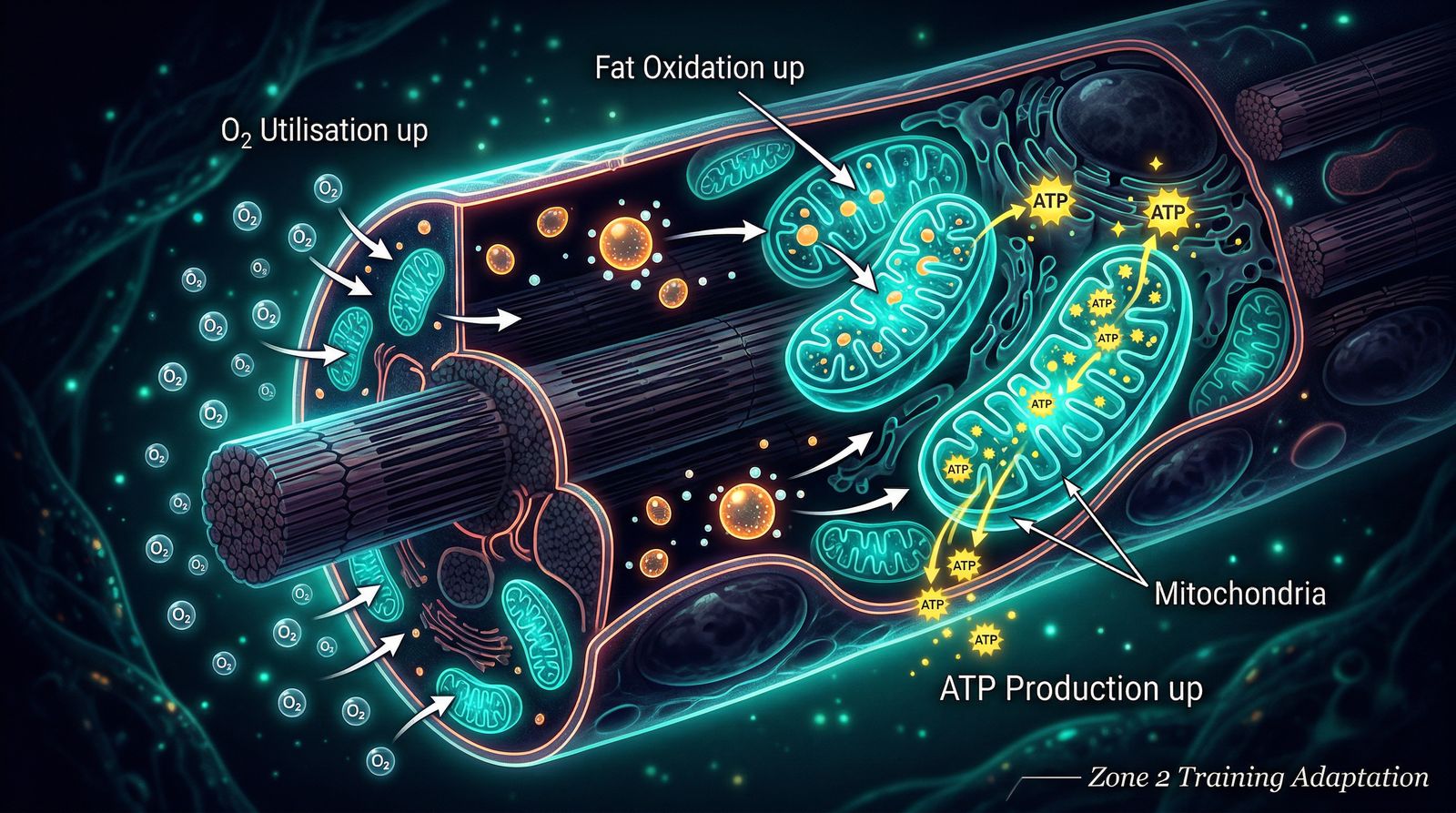
Peripheral oxygen extraction: the efficiency with which working muscles extract oxygen from the blood that reaches them. This is determined by capillary density within muscle tissue and, most critically, the density of mitochondria (the organelles responsible for aerobic ATP production). More mitochondria in a larger capillary network means a greater capacity to extract and use the oxygen delivered by the cardiovascular system.
The practical implication is that VO2 max can be improved through training that targets both components: cardiovascular adaptations (improved stroke volume and cardiac output) and peripheral adaptations (increased mitochondrial density and capillary density in skeletal muscle).
For a strength athlete, the peripheral adaptations are particularly relevant because they occur in the same skeletal muscles used for heavy lifting. A lifter with high mitochondrial density in their quadriceps, hamstrings, and back muscles recovers faster between sets, sustains performance across longer sessions, and adapts more completely overnight, because the machinery for aerobic energy production is denser and more efficient.
Why VO2 Max Is a Longevity Metric
Myers et al. (2002) published one of the most influential studies on exercise capacity and mortality, tracking 6,213 men referred for exercise testing. Each 1-MET increase in exercise capacity (where 1 MET corresponds to approximately 3.5 mL/kg/min of VO2) was associated with a 12% improvement in survival. The mortality reduction associated with improved fitness was greater than that associated with most traditional cardiovascular risk factors.
Mandsager et al. (2018) extended this picture to over 122,000 participants and found that elite cardiorespiratory fitness was associated with an 80% reduction in all-cause mortality, with no upper benefit limit: the fitter you are, the better your survival outlook, at any measured fitness level. The authors noted that the risk carried by low fitness was comparable to or greater than the risk carried by smoking.
These effects are among the largest modifiable predictors of lifespan identified by modern epidemiology. For the strength athlete who trains hard and eats intelligently, neglecting VO2 max is leaving one of the most powerful longevity levers unpulled.
Body Fat Percentage: The Nexus of Health, Performance, and Longevity examines how VO2 max interacts with body composition in the overall longevity picture. Strength Training for Longevity: The Most Powerful Medicine makes the parallel case for musculoskeletal strength.
Zone 2 Training: Building Mitochondrial Density Without Compromising Strength
Zone 2 training is the method by which most non-elite athletes can drive meaningful VO2 max improvement without the systemic fatigue cost that compromises heavy lifting.
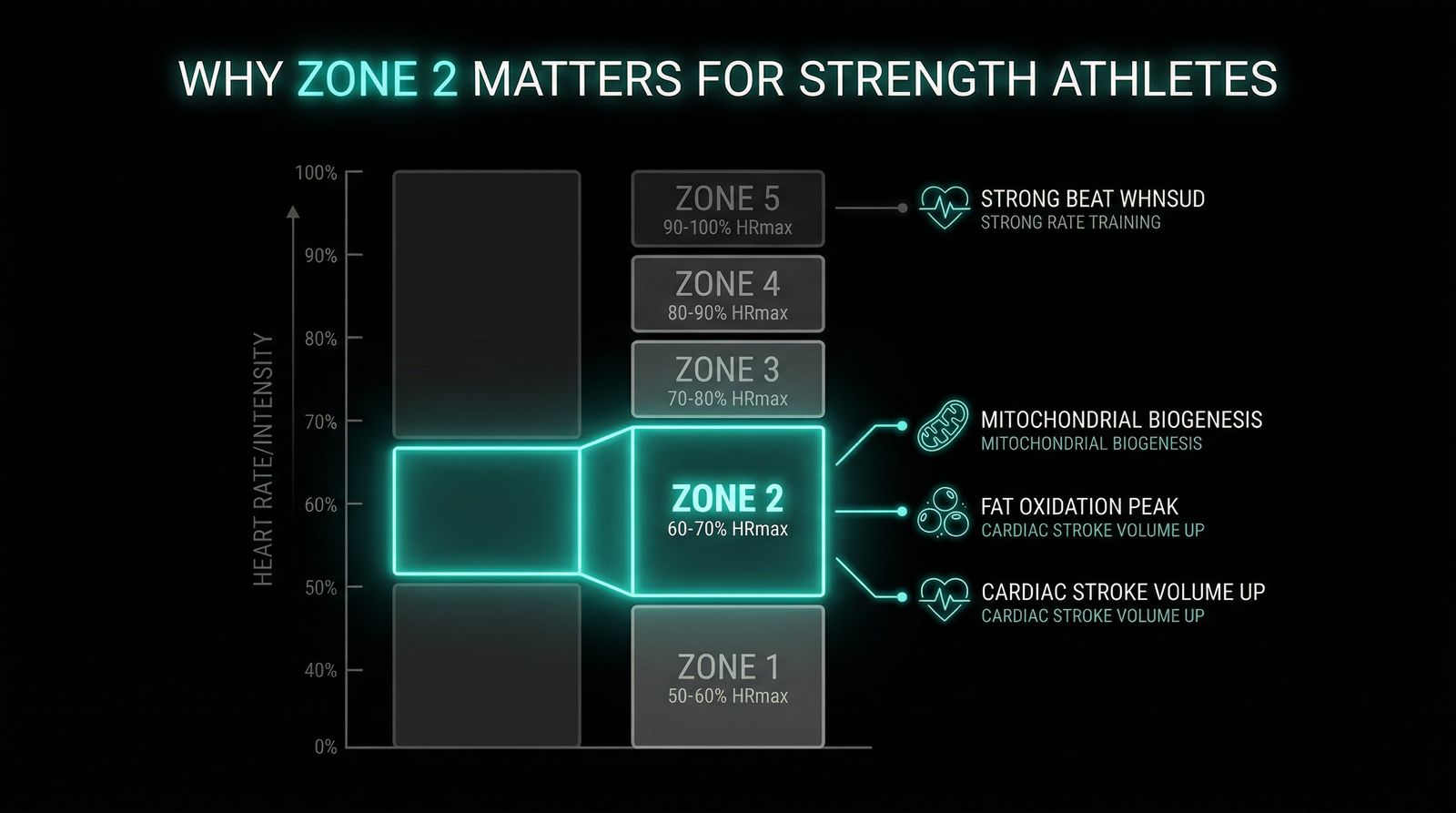
Zone 2 refers to exercise performed at an intensity corresponding to 60-70% of maximum heart rate, an intensity where you can sustain a conversation in full sentences, but you are breathing more deliberately than at rest. This is well below the lactate threshold; you are working entirely aerobically, burning predominantly fat as fuel and generating minimal metabolic fatigue products.
Zone 2 training selectively recruits Type I (slow-twitch) muscle fibres and drives mitochondrial biogenesis in those fibres through AMPK pathway activation and increased PGC-1α expression. Over weeks to months of consistent Zone 2 work, mitochondrial density in skeletal muscle increases substantially, improving the peripheral component of VO2 max and enhancing fat oxidation capacity at all intensities.
Seiler & Tonessen (2009) documented that elite endurance athletes spend approximately 80% of their training volume in Zone 2 or below, with the remaining 20% at high intensities. For strength athletes, this distribution cannot be directly replicated due to the demands of heavy barbell training. However, the evidence on Zone 2's effectiveness at relatively modest weekly volumes is solid.
A target of 150-180 minutes of Zone 2 cardio per week, distributed across three to four sessions of 40-50 minutes each, is sufficient to drive meaningful aerobic adaptation in most non-elite athletes without creating the systemic fatigue that compromises strength training performance. Zone 2 sessions should be performed on non-lifting days or separated from heavy lifting by at least six hours, as discussed in detail in Cardio for Fat Loss: The Real Cost to Your Strength.
Preferred modalities for strength athletes performing Zone 2 work are cycling, rowing, and brisk walking, all of which minimise the eccentric loading on the quadriceps and hamstrings that overlaps with squat and deadlift recovery demands.
Practical VO2 Max Testing: No Lab Required
Laboratory VO2 max testing (a graded exercise test on a treadmill or cycle ergometer with expired gas analysis) is the gold standard but inaccessible to most athletes outside research or elite sport settings. Fortunately, validated field testing methods provide reasonable VO2 max estimates that are sufficient for tracking progress over time.
The Cooper 12-Minute Run Test (Cooper, 1968): Run as far as possible in 12 minutes on a flat surface. The VO2 max estimate is calculated as: VO2 max (mL/kg/min) = (distance in metres − 504.9) / 44.73. This test has been validated against laboratory measurements across a wide range of populations and is reproducible enough for longitudinal tracking. Perform it on a running track or GPS-measured flat surface.
The Resting Heart Rate Method (Uth et al.): VO2 max can be estimated from the ratio of maximum heart rate (220 minus age as a starting estimate) to resting heart rate measured first thing in the morning: VO2 max ≈ 15 × (HRmax / HRrest). A resting heart rate of 50 in a 35-year-old would produce an estimate of approximately 55 mL/kg/min, elite for a non-endurance athlete. This method is less accurate for individual estimates but useful as a rough benchmark and for monitoring adaptation over months.
Submaximal cycle test (Astrand-Ryhming): Using a cycle ergometer at a standardised submaximal workload and measuring steady-state heart rate allows VO2 max to be estimated from published nomograms. Many commercial bikes with watt output now allow this protocol without specialist equipment.
Wearable device estimates: Modern fitness trackers (Garmin, Polar, Apple Watch) use proprietary algorithms based on heart rate variability and workload data to estimate VO2 max. These estimates correlate moderately well with laboratory measurements (r ≈ 0.7-0.8 in validation studies) and are consistent enough to track improvement over time, though absolute values should be treated with appropriate scepticism.
For most strength athletes, the most practical approach is a combination of the Cooper 12-minute test performed every 8-12 weeks, supplemented by resting heart rate monitoring as a daily proxy for aerobic adaptation. A decreasing resting heart rate over months of consistent Zone 2 work is a reliable signal that cardiac adaptation is occurring.
The Hybrid Athlete: A Framework, Not a Compromise
The false dichotomy between being strong and being aerobically fit is dissolving in both research and practice. The "hybrid athlete" concept (pursuing meaningful levels of both strength and cardiorespiratory fitness simultaneously) requires intelligent programme management, not a compromise in either domain.
The strength athlete who targets a VO2 max above 45 mL/kg/min (men) or 40 mL/kg/min (women), placing them in the top quartile of age-matched cardiorespiratory fitness, while maintaining competitive powerlifting strength is building a body that is powerful and resilient at once: one that can express maximal force and sustain exertion, and that recovers faster between sets, between sessions, and between seasons.
Your VO2 max is a test of your underlying engine. Train both systems, measure both systems, and treat your cardiorespiratory fitness with the same systematic attention you give your one-rep maxes.
Key Takeaways
- VO2 max is determined primarily by cardiac output (stroke volume and heart rate) and peripheral oxygen extraction (mitochondrial density and capillary density in skeletal muscle), as established by Bassett & Howley (2000).
- Elite cardiorespiratory fitness is associated with an 80% reduction in all-cause mortality risk with no upper benefit limit detected (Mandsager et al., 2018) — making VO2 max one of the most consequential longevity metrics available.
- Zone 2 training (60-70% max heart rate, conversational intensity) drives mitochondrial biogenesis in skeletal muscle through AMPK pathway activation, improving aerobic efficiency and recovery without the CNS cost that interferes with heavy lifting.
- The target for strength athletes is 150-180 minutes of Zone 2 per week across 3-4 sessions, performed on non-lifting days or separated from lifting by at least 6 hours.
- Practical VO2 max testing without lab access includes the Cooper 12-minute run test, resting heart rate monitoring, and calibrated wearable device estimates — all sufficient for tracking longitudinal improvement.
Put It Into Practice
This week: Determine your estimated maximum heart rate (220 minus your age) and calculate your Zone 2 range (60-70% of that number). Perform one 45-minute Zone 2 session on a stationary bike or rower, maintaining your heart rate within the zone throughout. Note your average heart rate and perceived exertion — this is your Zone 2 baseline.
This training block: Build to 150 minutes of Zone 2 cardio per week across three to four sessions, scheduled on non-lifting days or at least six hours after your main lifting session. After eight weeks, perform the Cooper 12-minute run test on a flat track and calculate your VO2 max estimate. Repeat the test every 8-12 weeks to track adaptation.
Long term: Track your resting heart rate daily — first thing in the morning before rising — using a fitness tracker or manual pulse check. A consistently declining resting heart rate over months indicates cardiac adaptation. Target a resting heart rate below 60 bpm as a rough marker of baseline aerobic fitness. Add VO2 max to your list of training performance indicators alongside your squat, bench, and deadlift totals.
Analysed by FINAL FORM AI. Your form, perfected.
References
- Bassett, D. R., & Howley, E. T. (2000). Limiting factors for maximum oxygen uptake and determinants of endurance performance. Medicine & Science in Sports & Exercise, 32(1), 70-84.
- Myers, J., Prakash, M., Froelicher, V., Do, D., Partington, S., & Atwood, J. E. (2002). Exercise capacity and mortality among men referred for exercise testing. New England Journal of Medicine, 346(11), 793-801.
- Mandsager, K., Harb, S., Cremer, P., Phelan, D., Nissen, S. E., & Jaber, W. (2018). Association of cardiorespiratory fitness with long-term mortality among adults undergoing exercise treadmill testing. JAMA Network Open, 1(6), e183605.
- Seiler, S., & Tønnessen, E. (2009). Intervals, thresholds, and long slow distance: the role of intensity and duration in endurance training. Sportscience, 13, 32-53.
- Cooper, K. H. (1968). A means of assessing maximal oxygen intake. Correlation between field and treadmill testing. JAMA, 203(3), 201-204. PMID: 5694044
- Kodama, S., Saito, K., Tanaka, S., et al. (2009). Cardiorespiratory fitness as a quantitative predictor of all-cause mortality and cardiovascular events in healthy men and women: a meta-analysis. JAMA, 301(19), 2024-2035. PMID: 19454641
- Ross, R., Blair, S. N., Arena, R., et al. (2016). Importance of assessing cardiorespiratory fitness in clinical practice: a case for fitness as a clinical vital sign: a scientific statement from the American Heart Association. Circulation, 134(24), e653-e699. PMID: 27881567
- Helgerud, J., Høydal, K., Wang, E., et al. (2007). Aerobic high-intensity intervals improve VO2max more than moderate training. Medicine & Science in Sports & Exercise, 39(4), 665-671. PMID: 17414804
- Milanović, Z., Sporiš, G., & Weston, M. (2015). Effectiveness of high-intensity interval training (HIT) and continuous endurance training for VO2max improvements: a systematic review and meta-analysis of controlled trials. Sports Medicine, 45(10), 1469-1481. PMID: 26243014