How to Structure Cardio Around Your Lifting
Zone placement rules, the interference effect, and three weekly templates for three athlete types.
By Dhiren Dunraj MSc

Key Insight
“Do cardio. The questions are when, what zone, and at what cost to your squat.”
Most people sit at one of two extremes: they avoid all cardio to protect their lifting, or they add cardio sessions without accounting for the recovery cost and wonder why their strength stalls. Both are avoidable errors. The interference effect (the reduction in strength and hypertrophy adaptations caused by concurrent endurance and resistance training) is real and well-documented. It is also highly programmable. Understanding how it works, and which variables drive it, turns the interference effect from a liability into a tool.
The evidence has been building since Hickson's original 1980 paper and is now sufficiently mature to give clear, actionable guidance. The message from the research is that cardio placement and modality matter far more than cardio presence, and that distinction shapes how you build a training week.
The Interference Effect — What the Research Says
Hickson (1980) published the foundational concurrent training study. Subjects performed simultaneous strength and endurance training. Strength gains plateaued at week 7 while the strength-only group continued to improve. That plateau, followed by a decline over the final weeks, is the interference effect in its original observed form. It is a signal that the two stimuli were competing for adaptation resources.
Wilson et al. (2012) meta-analysed 21 studies on concurrent training and found that interference grows with cardio volume and frequency, and is largest when running is the modality (eccentric muscle damage from ground contact compounds with barbell fatigue). Same-session placement adds acute pathway competition at the molecular level. Cycling, rowing, and walking produce substantially less interference. In some subgroup analyses, the difference was large enough that low-impact modalities showed no meaningful interference at all.
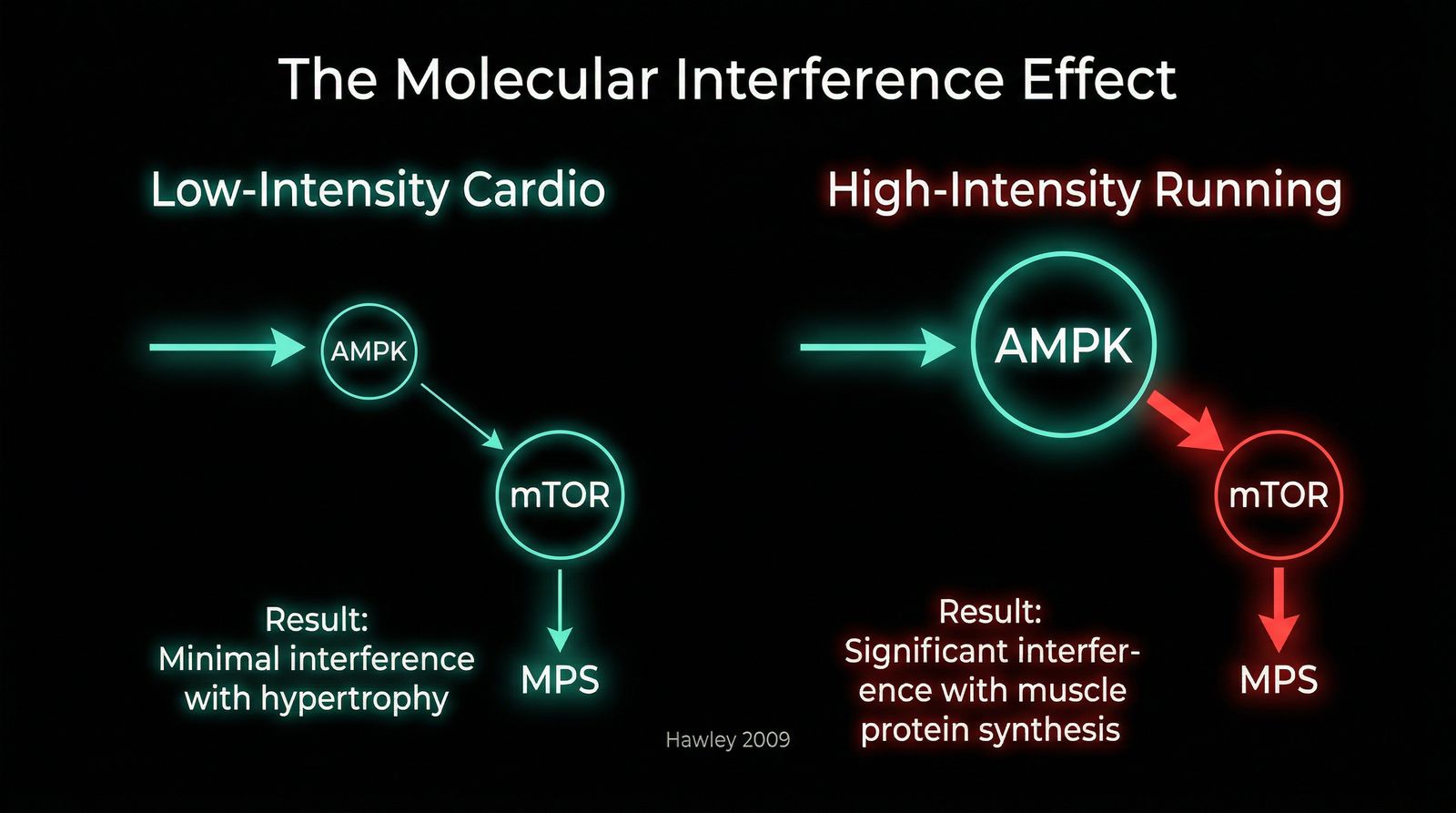
The proposed molecular mechanism (Hawley, 2009) is that aerobic training activates the AMPK pathway, which can suppress mTOR-driven muscle protein synthesis, the signalling cascade responsible for hypertrophy. This is real but dose-dependent. Walking barely activates AMPK. Sustained hard running activates it significantly. Thirty minutes of easy cycling after a squat session sits at the low end of AMPK activation and is unlikely to meaningfully blunt adaptation.
The interference effect is a description of which variables produce interference rather than a blanket condemnation of cardio, which means controlling those variables eliminates most of the cost. Murach and Bagley (2016) reviewed hypertrophy outcomes with concurrent training and found that when cardio volume is managed and modality is low-impact, hypertrophy outcomes are not meaningfully compromised.
Zone-by-Zone Placement Rules
Not all cardio carries the same interference risk. Zone determines the placement rules. The gap between Zone 1 and Zone 5 in recovery demand, AMPK activation, and eccentric muscle damage is substantial. Each zone needs its own placement logic.
Zone 1-2 (walking, easy cycling, 50-70% HRmax): Zero placement restrictions. No meaningful AMPK activation, no eccentric muscle damage from ground contact, negligible CNS demand. Zone 1-2 work can be done on any day, including immediately before or after lifting. Walking 8,000 steps on squat day costs nothing from a recovery or adaptation standpoint. This is the cardio modality with the highest cost-benefit ratio for strength athletes: it delivers cardiovascular maintenance and metabolic health without touching the strength adaptation machinery.
Zone 3 (moderate steady state, 70-80% HRmax): Moderate restriction. Avoid placing Zone 3 in the same session or the same half-day as heavy lower body lifting. It is acceptable on upper body days or with 6+ hours of separation from heavy lower body work. Zone 3 is the grey zone of concurrent training: high enough to create some interference, low enough that the cardiovascular benefit is modest. It is the zone most likely to cause unintentional interference when used without structure. Use it deliberately or not at all.
Zone 4 (hard tempo, lactate threshold, 80-90% HRmax): Significant restriction. Treat Zone 4 work like an additional training session with its own recovery footprint. Minimum 24 hours separation from heavy squat or deadlift sessions. Running in Zone 4 carries the highest eccentric overlap due to ground contact forces. Cycling and rowing in Zone 4 are better tolerated because eccentric loading is minimal, but the metabolic demand is equivalent and still requires separation from heavy lower body sessions.
Zone 5 (sprinting, all-out intervals, 90-100% HRmax): Treat exactly like a heavy lower body lifting day. Zone 5 requires a minimum of 48 hours separation from heavy squats and deadlifts, in both directions. Full CNS demand, full metabolic demand, high eccentric loading (especially in acceleration and deceleration phases). A Zone 5 session the day before heavy deadlifts is the single fastest route to a strength plateau. Never programme Zone 5 within 48 hours of a heavy lower body session.
Cardio Zones Explained gives the full physiological breakdown of each zone, including heart rate calculation methods and modality-specific guidance.
Three Practical Weekly Templates
Three athlete profiles, three structures. Pick the one closest to your current goal and use it for a full four-week block before assessing.
(a) Strength-First Athlete Adding Conditioning
Goal: protect strength progress, add minimum viable conditioning work.
``` Mon — Lower (Squat focus) Tue — Zone 1-2 walk/bike (30 min) + Upper Wed — Zone 5 sprint session or rest Thu — Lower (Deadlift focus) Fri — Zone 1-2 walk + Upper Sat — Zone 2 easy bike (35-40 min) Sun — Rest ```
The sprint session on Wednesday sits 48 hours from both the squat session on Monday and the deadlift session on Thursday. No Zone 3-4 running appears anywhere in this template. The interference risk is not worth the marginal cardiovascular benefit for a strength-primary athlete. Zone 1-2 on lifting days is cost-free and keeps metabolic activity high on recovery days.
(b) Powersthetics Athlete — Lifting and Sprint Conditioning Balanced
Goal: equal priority for strength development and sprint conditioning performance.
``` Mon — Lower Power (Squat) Tue — Sprint Session A: Acceleration Wed — Upper Power (Bench) Thu — Sprint Session B: Speed intervals Fri — Lower Volume (Deadlift + accessories) Sat — Upper Volume (OHP + accessories) Sun — Zone 1-2 walk (active recovery) ```
Sprint sessions on Tuesday and Thursday sit between lower body lifting days. Each sprint session has at least 24 hours of separation from the adjacent lifting day, with the Monday-to-Tuesday and Thursday-to-Friday gaps being the critical windows. No additional Zone 3-4 work is needed. The sprint sessions deliver a complete Zone 5 stimulus. Adding Zone 3-4 on top of this template would create recovery debt without meaningful additional adaptation.
(c) Speed Athlete — Sprint Primary, Lifting for Support
Goal: maximise sprint adaptation, use resistance training to build the posterior chain engine that powers the sprint.
``` Mon — Sprint Session A: Acceleration mechanics Tue — Lifting A: Squat + posterior chain Wed — Sprint Session B: Max velocity Thu — Lifting B: Accessory Fri — Sprint Session C: Speed-endurance Sat/Sun — Zone 1-2 walking only ```
This template is sprint-led. Heavy lifting sessions are positioned to support sprint adaptation, not compete with it. Forty-eight hours between sprint sessions and heavy lower body lifting is maintained where possible. No additional Zone 3-4 cardio is programmed. The three weekly sprint sessions cover the high-intensity demand entirely, and additional Zone 3-4 work would compromise recovery for sprint quality on the next session.
Deload Week — What to Keep, What to Drop
Deload weeks require specific decisions about cardio. The default rule is to reduce CNS and mechanical load. Apply that principle to each zone.
Zone 1-2 (walking): Keep. Walking promotes blood flow and clearance of metabolic waste without adding any meaningful recovery demand. During a deload week, increasing daily steps is a net positive: it accelerates tissue recovery without adding fatigue. This is the one cardio category that does not need to be reduced during a deload.
Zone 5 (sprinting): Drop completely. Sprint sessions create full CNS demand and significant mechanical load. A deload week means neither of those is acceptable. Remove all Zone 5 work entirely.
Zone 4: Drop. Same logic as Zone 5, slightly less acute. The recovery cost is high enough that Zone 4 undermines the purpose of a deload.
Zone 3: Optional. One 20-25 minute session at Zone 3 intensity (down from the typical 40-50 minutes) can maintain aerobic base without impeding recovery. It is not essential. For most strength athletes, Zone 3 is already the lowest-priority zone, and dropping it for a deload week costs very little.
Putting It Together
The simplest version of this entire guide: the more intense the cardio, the more it must be treated like a training session: separated from heavy lifting, recovered from deliberately, and placed in the week with intent. Walking needs none of this. Sprinting needs all of it. Everything between those two poles scales accordingly.
The programming error most athletes make is undifferentiated cardio (no zone tracking, no placement logic, no separation rules) sitting in a training week alongside heavy squats and deadlifts without any structural thought. That is where the interference effect does its damage. With zone-aware placement, concurrent training is a coherent athletic development strategy, not a compromise.
Sprint Biomechanics & Technique: The Complete Technical Reference covers the mechanics of making Zone 5 sprint work count.
Key Takeaways
- Hickson (1980) identified concurrent training interference; Wilson et al. (2012) showed it is largest with running, same-session placement, and high cardio volume — all three are manageable with the right structure.
- Zone 1-2 (walking, easy cycling) has zero placement restrictions and no meaningful interference with strength or hypertrophy.
- Zone 5 (sprinting) must be treated like a heavy lifting session — 48h separation from lower body work, in both directions.
- Zone 3 is the grey zone: moderate interference cost, moderate cardiovascular benefit, highest likelihood of unintentional programming errors — use it deliberately or not at all.
- Deload means dropping Zones 4-5 entirely; walking stays or increases; Zone 3 is optional at reduced duration.
Put It Into Practice
This week: Audit your current cardio sessions. For each session, assign it a zone using heart rate or perceived effort. Check whether any Zone 3-4 work is happening within 6 hours of heavy lower body lifting. If yes, shift it to a different day or replace it with Zone 2.
This training block: Choose the weekly template closest to your goal. Run it for four weeks unchanged — do not add or shift sessions mid-block. Assess strength progress and cardio quality at week four before making any adjustments.
Long term: As sprint fitness builds, Zone 5 sessions demand more recovery. As strength accumulates, Zone 2 capacity grows and those sessions become easier to absorb. The templates are not permanent structures — they evolve with your fitness. Revisit placement every 8-12 weeks and adjust zone volumes and separation windows accordingly.
Analysed by FINAL FORM AI. Your form, perfected.
References
- Hickson, R. C. (1980). Interference of strength development by simultaneously training for strength and endurance. European Journal of Applied Physiology and Occupational Physiology, 45(2-3), 255-263. PMID: 7193134
- Wilson, J. M., et al. (2012). Concurrent training: a meta-analysis examining interference of aerobic and resistance exercises. Journal of Strength and Conditioning Research, 26(8), 2293-2307. PMID: 22002517
- Hawley, J. A. (2009). Molecular responses to strength and endurance training: are they incompatible? Applied Physiology, Nutrition, and Metabolism, 34(3), 355-361. PMID: 19448698
- Murach, K. A., & Bagley, J. R. (2016). Skeletal muscle hypertrophy with concurrent exercise training: contrary evidence for an interference effect. Sports Medicine, 46(8), 1029-1039. PMID: 26932769
- Fyfe, J. J., Bishop, D. J., & Stepto, N. K. (2014). Interference between concurrent resistance and endurance exercise: molecular bases and the role of individual training variables. Sports Medicine, 44(6), 743-762. PMID: 24728927
- Coffey, V. G., & Hawley, J. A. (2017). Concurrent exercise training: do opposites distract? Journal of Physiology, 595(9), 2883-2896. PMID: 27506998
- Schumann, M., Feuerbacher, J. F., Sünkeler, M., et al. (2022). Compatibility of concurrent aerobic and strength training for skeletal muscle size and function: an updated systematic review and meta-analysis. Sports Medicine, 52(3), 601-612. PMID: 34757594
- Seiler, S. (2010). What is best practice for training intensity and duration distribution in endurance athletes? International Journal of Sports Physiology and Performance, 5(3), 276-291. PMID: 20861519