Walking for Fat Loss: The Underrated Pillar
Walking is a fat-burning tool that costs nothing in recovery, operates in the fat oxidation zone, and contributes more to your daily energy expenditure than most people realise.
By Dhiren Dunraj MSc

Key Insight
“The most effective fat loss tool available to most people is not the treadmill programme or the calorie-burning class. It is the accumulated steps they take every day, and almost no one takes enough of them.”
There is a hierarchy of conditioning tools for the lifter seeking fat loss. Sprinting sits at the high end: intense, hormonally powerful, time-efficient, recovery-costly. Walking sits at the other end: gentle, metabolically accessible, infinitely repeatable, and almost universally underestimated.
The underestimation is a mistake. Walking is nowhere near as intense as sprinting, but its contribution to total daily energy expenditure, its operation in the fat oxidation zone, and its complete absence of recovery cost make it one of the highest-leverage fat loss tools available. When combined with a serious lifting programme and occasional sprint sessions, it is the third pillar of the powersthetics body composition stack.
The Metabolic Truth About Zone 1-2
Understanding why walking burns fat requires understanding how substrate utilisation changes with exercise intensity. At low intensities (roughly 50–70% of maximum heart rate, which corresponds to a brisk walk for most people) the body derives a higher proportion of its energy from fat oxidation rather than carbohydrate.
This is the fat oxidation curve: fat oxidation peaks somewhere in the low-to-moderate intensity range (often referred to as FATmax) and declines as intensity increases. At maximal sprint intensities, the body is almost exclusively burning carbohydrates. The demand for rapid energy overwhelms the slower aerobic fat oxidation pathways. At walking intensities, fat oxidation is the dominant fuel source.
This does not mean you burn more total fat calories at low intensities than at high intensities. You almost certainly do not, because the total caloric expenditure per unit of time is much lower. But it does mean that walking draws directly from the fat stores you are trying to deplete, without placing meaningful demands on carbohydrate stores or the recovery systems required to replenish them.
You can walk every day, all year round, without interfering with the lifting and sprint work that is building your physique. This is its most undervalued property.
NEAT and TDEE: The Step Count Advantage
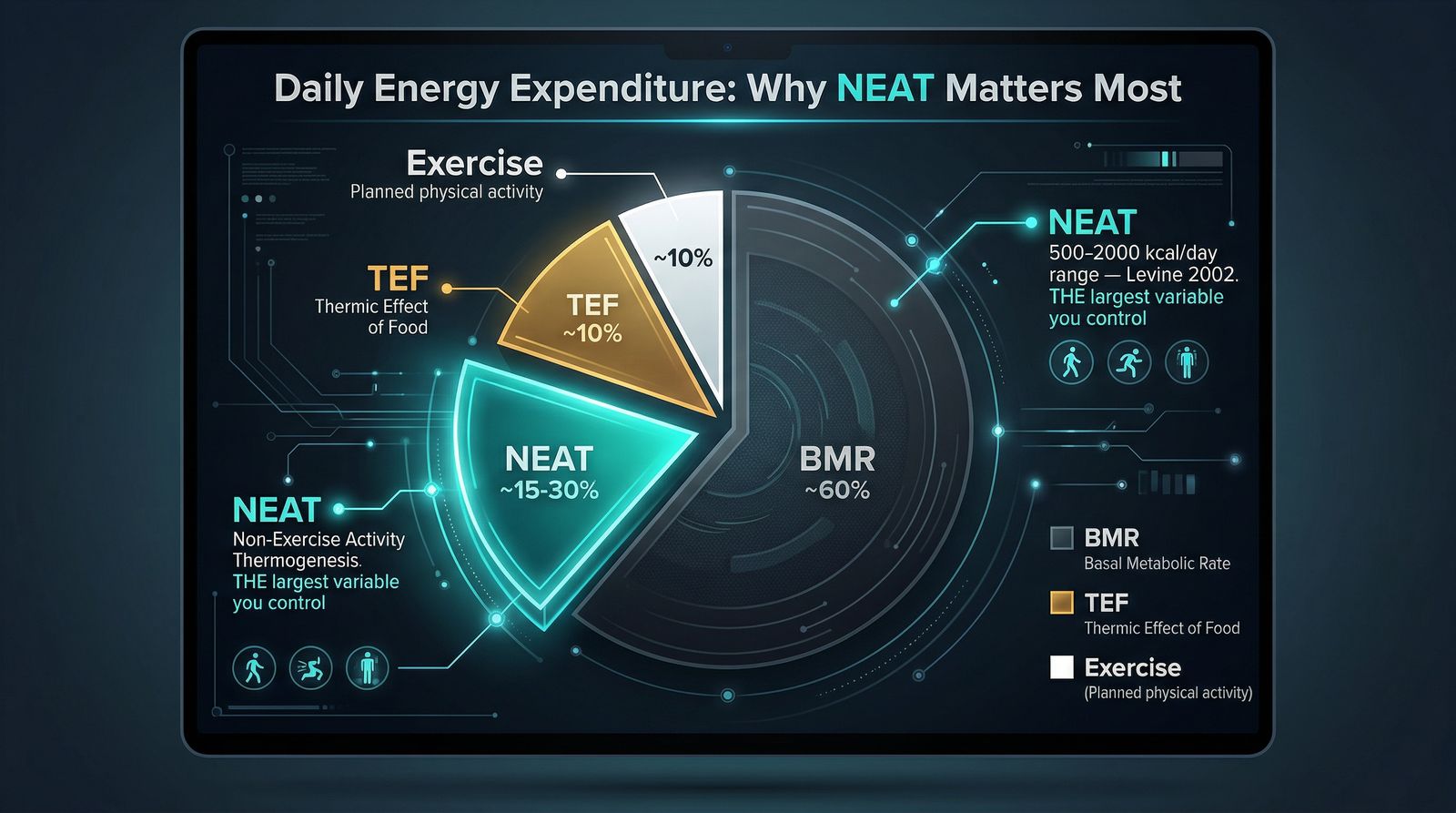
Levine (2002) published the foundational paper on non-exercise activity thermogenesis (NEAT), the category of energy expenditure that encompasses all physical activity outside structured exercise: standing, walking, fidgeting, manual labour, and every other movement that is not a planned workout.
NEAT differences between individuals can account for 500 to 2,000 calories per day. Two people of similar size and body composition, eating similar diets, living similar lives, can have total daily energy expenditure that differs by up to 2,000 calories, primarily driven by differences in low-intensity physical activity throughout the day.
Walking is the single most accessible and controllable lever within NEAT. Step count is the proxy metric: it captures accumulated low-intensity locomotion across the entire day and is measurable on any smartphone or cheap fitness tracker.
Hall et al. (2012), modelling energy balance and body weight regulation, showed how sustained changes in energy expenditure drive body weight change over time. The most tractable component of total energy expenditure for most people is physical activity: not structured exercise, which occupies perhaps 60–90 minutes of the day, but the accumulated activity of the remaining 14–16 waking hours.
The target range of 7,000 to 10,000 steps per day represents a meaningful increase in NEAT for most sedentary to moderately active individuals. At approximately 80–100 calories per 2,000 steps, the caloric contribution of moving from 3,000 steps per day to 10,000 steps per day is roughly 280–350 calories, the equivalent of a substantial additional meal, compounded daily, with zero recovery cost.
Why Walking Does Not Blunt Recovery
This is the specific property that makes walking uniquely valuable in a programme built around heavy lifting.
High-intensity endurance work (running, cycling, rowing at moderate-to-high intensities) activates AMPK (AMP-activated protein kinase), a cellular energy-sensing enzyme that promotes fuel breakdown and inhibits anabolic processes. AMPK activation conflicts with mTOR (mechanistic target of rapamycin), the primary driver of muscle protein synthesis. This is the proposed molecular basis of the interference effect: significant volumes of moderate-to-high intensity cardio conflict with the anabolic signalling of resistance training.
Walking does not produce meaningful AMPK activation. The mechanical and metabolic demands are too low to trigger the signalling cascade that creates interference. There is no eccentric muscle damage of the kind produced by running, no significant central nervous system fatigue, no meaningful glycogen depletion. Borsheim and Bahr (2003) confirmed that low-intensity exercise produces negligible EPOC, which also means it does not create a significant metabolic debt that competes with recovery.
A lifter performing four heavy sessions per week can also accumulate 10,000 steps daily without measurably reducing their performance on the platform. The walking and the lifting occupy completely separate physiological lanes. Running is different: even moderate jogging volumes begin to compete with recovery resources in a heavy training block.
For a lifter who wants to maximise fat loss without compromising strength progress, walking is a uniquely non-interfering tool.
Walking vs Running for Fat Loss
The common comparison is made incorrectly. Walking and running burn similar numbers of calories per unit of distance, not per unit of time. A 5km walk and a 5km run burn roughly comparable total calories, because both involve moving body mass through the same distance against gravity.
The time investment is obviously different: the run takes perhaps 25 minutes, the walk perhaps 50 minutes. But the comparison changes when you account for recovery cost. The 25-minute run carries a non-trivial recovery debt for a lifter already training four times per week: some degree of systemic fatigue, leg muscle soreness, and potential AMPK-mTOR interference. The 50-minute walk carries none of these costs.
For a strength athlete who is already near their recovery ceiling from lifting, adding running is expensive. Adding walking is essentially free. The correct comparison is not "which burns more calories per minute" but "which creates the best net fat loss effect when integrated with a complete training programme." When framed correctly, walking wins for anyone who is already lifting seriously.
The Walking + Lifting + Sprinting Stack
The powersthetics approach to body composition treats walking, lifting, and sprinting as complementary tools operating at different points on the intensity spectrum, each contributing what the others cannot.
Lifting builds and preserves muscle mass, the metabolically active tissue that raises your resting metabolic rate and defines the physique. Sprinting creates hormonal conditions for fat mobilisation, develops athletic capacity, and produces significant EPOC. Walking contributes the daily accumulated caloric expenditure that, over time, represents a more substantial total energy contribution than most people realise.
The stack operates cleanly. Lift 3–4 times per week. Sprint 1–2 times per week, treating sprint sessions as training days with adequate recovery after them. Walk every day. Hit your step count as a non-negotiable baseline. The lifting and sprinting are the high-intensity interventions. The walking is the background metabolic engine running continuously, drawing from fat stores without interfering with the work that builds the physique.
Practical: Steps, Timing, and Progression
The step target is the only metric that matters for walking. Everything else (pace, route, incline) is secondary.
Starting target: If your current average is below 5,000 steps per day, begin by targeting 7,000. Add 500 steps per week until 10,000 is achieved consistently.
Sustained target: 8,000–12,000 steps per day. Research on all-cause mortality and metabolic health suggests meaningful benefits begin around 7,000–8,000 steps and plateau somewhere above 10,000 for most people.
Timing: Walking after meals (particularly dinner) has a modest beneficial effect on blood glucose management and digestive comfort, but the aggregate daily step count is what drives the metabolic benefit. Walk when it fits your schedule.
Integration with lifting: Walking before a lifting session is appropriate. Walking immediately after a heavy session, if fatigue permits, is a useful strategy for accelerating early recovery and adding to step count. On rest days from lifting, walking is the primary conditioning activity.
Incline walking: Adding incline on a treadmill substantially increases caloric expenditure per step without meaningfully increasing recovery cost. A 10–15% grade at 5–6 km/h combines the recovery friendliness of walking with caloric expenditure approaching a light jog.
Sprinting for Fat Loss: The Superior Tool covers the complementary high-intensity tool for the opposite end of the conditioning spectrum.
Cardio Zones Explained: Which Zone Actually Burns Fat gives the physiological framework for understanding where walking and sprinting each fit.
Key Takeaways
- NEAT differences between individuals can account for 500–2,000 calories per day; walking is the most controllable lever within NEAT, making step count one of the highest-impact variables in daily energy expenditure (Levine, 2002).
- Walking operates in the fat oxidation zone (Zone 1–2) and draws directly from fat stores without depleting carbohydrate reserves or creating recovery debt.
- Unlike running or moderate-intensity cardio, walking does not produce meaningful AMPK activation, so it does not interfere with mTOR-driven muscle protein synthesis — it can be performed daily without compromising lifting performance.
- Walking and running burn similar calories per unit of distance, not per unit of time; for a lifter near their recovery ceiling, walking costs nothing while running carries a non-trivial recovery price.
- The walking + lifting + sprinting stack is the powersthetics body composition framework: muscle-preserving lifting, hormonally powerful sprinting, and continuously accumulated low-intensity caloric expenditure through walking.
Put It Into Practice
This week: Check your current average daily step count. If it is below 7,000, set a daily target of 7,500 and hit it every day for the next seven days. Use a phone or cheap tracker. Treat it as a non-negotiable, the way you treat your planned training sessions.
This training block: Build to 9,000–10,000 steps daily by adding one short walk per day — 15–20 minutes at any pace. On rest days from lifting, use longer walks as your primary conditioning activity. Track your step count weekly and confirm progress.
Long term: Treat daily step count as a permanent lifestyle metric alongside your training programme. It does not replace lifting or sprinting. It is the background engine running every day, compounding a substantial caloric contribution that, across weeks and months, makes a decisive difference to body composition outcomes.
Analysed by FINAL FORM AI. Your form, perfected.
References
- Levine, J. A. (2002). Non-exercise activity thermogenesis (NEAT). Best Practice & Research Clinical Endocrinology & Metabolism, 16(4), 679-702.
- Hall, K. D., et al. (2012). Energy balance and its components: implications for body weight regulation. American Journal of Clinical Nutrition, 95(4), 989-994.
- Borsheim, E., & Bahr, R. (2003). Effect of exercise intensity, duration and mode on post-exercise oxygen consumption. Sports Medicine, 33(14), 1037-1060. PMID: 14599232
- Levine, J. A., Lanningham-Foster, L. M., McCrady, S. K., et al. (2005). Interindividual variation in posture allocation: possible role in human obesity. Science, 307(5709), 584-586. PMID: 15681386
- Tudor-Locke, C., Craig, C. L., Brown, W. J., et al. (2011). How many steps/day are enough? For adults. International Journal of Behavioral Nutrition and Physical Activity, 8, 79. PMID: 21798015
- Pontzer, H., Durazo-Arvizu, R., Dugas, L. R., et al. (2016). Constrained total energy expenditure and metabolic adaptation to physical activity in adult humans. Current Biology, 26(3), 410-417. PMID: 26832439
- Donnelly, J. E., Blair, S. N., Jakicic, J. M., et al. (2009). American College of Sports Medicine Position Stand. Appropriate physical activity intervention strategies for weight loss and prevention of weight regain for adults. Medicine & Science in Sports & Exercise, 41(2), 459-471. PMID: 19127177