Sprinting, Longevity, and the Injury Paradox
The counterintuitive truth: sprinting has real injury risk, but progressive sprint training builds the exact tissue resilience that protects against it.
By Dhiren Dunraj MSc

Key Insight
“The unprepared body is the fragile body. The athlete who never sprints is not protecting themselves — they are preserving a liability.”
The logic feels airtight: sprinting is one of the most mechanically demanding things the human body can do. Hamstring tears, Achilles ruptures, calf strains: the sprint-related injury list is long and painful. Therefore, to protect yourself from these injuries, you should avoid or at least minimise sprint training.
This logic is precisely wrong. It is one of the most consequential errors in athletic self-management, and understanding why requires looking at what sprint training actually does to the tissues it supposedly puts at risk.
The Paradox Stated
The fundamental error in the avoidance logic is conflating acute risk with chronic risk. Yes, sprinting creates acute mechanical demands that, without preparation, can produce injury. The high-speed hip extension stroke of late swing phase places the hamstring at long muscle length under high eccentric load, precisely the configuration in which untrained tissue fails.
But chronic exposure to sprint training (progressive, well-managed, and built up over weeks and months) transforms the tissue rather than merely exposing it to this risk again and again. Tendons thicken and stiffen. Muscle architecture shifts toward greater fascicle pennation angle and longer optimum lengths for eccentric force production. The nervous system learns the timing and coordination of the high-speed stride cycle. The athlete who trains sprinting progressively becomes, at the tissue level, a different organism from the one who avoids it.
The unloaded hamstring, the one that has not been subjected to the high-speed eccentric demands of sprint training, is the one that tears. When the demand inevitably arrives (in a sport, in a recreational setting, in an emergency), it meets tissue that has never adapted to that specific mechanical signature.
Gabbett (2016), writing in the British Journal of Sports Medicine, framed this as the training-injury prevention paradox: the preparation that creates short-term risk is the same preparation that generates long-term resilience. Avoiding the stimulus avoids the adaptation.
What Sprint Training Does to Tissue
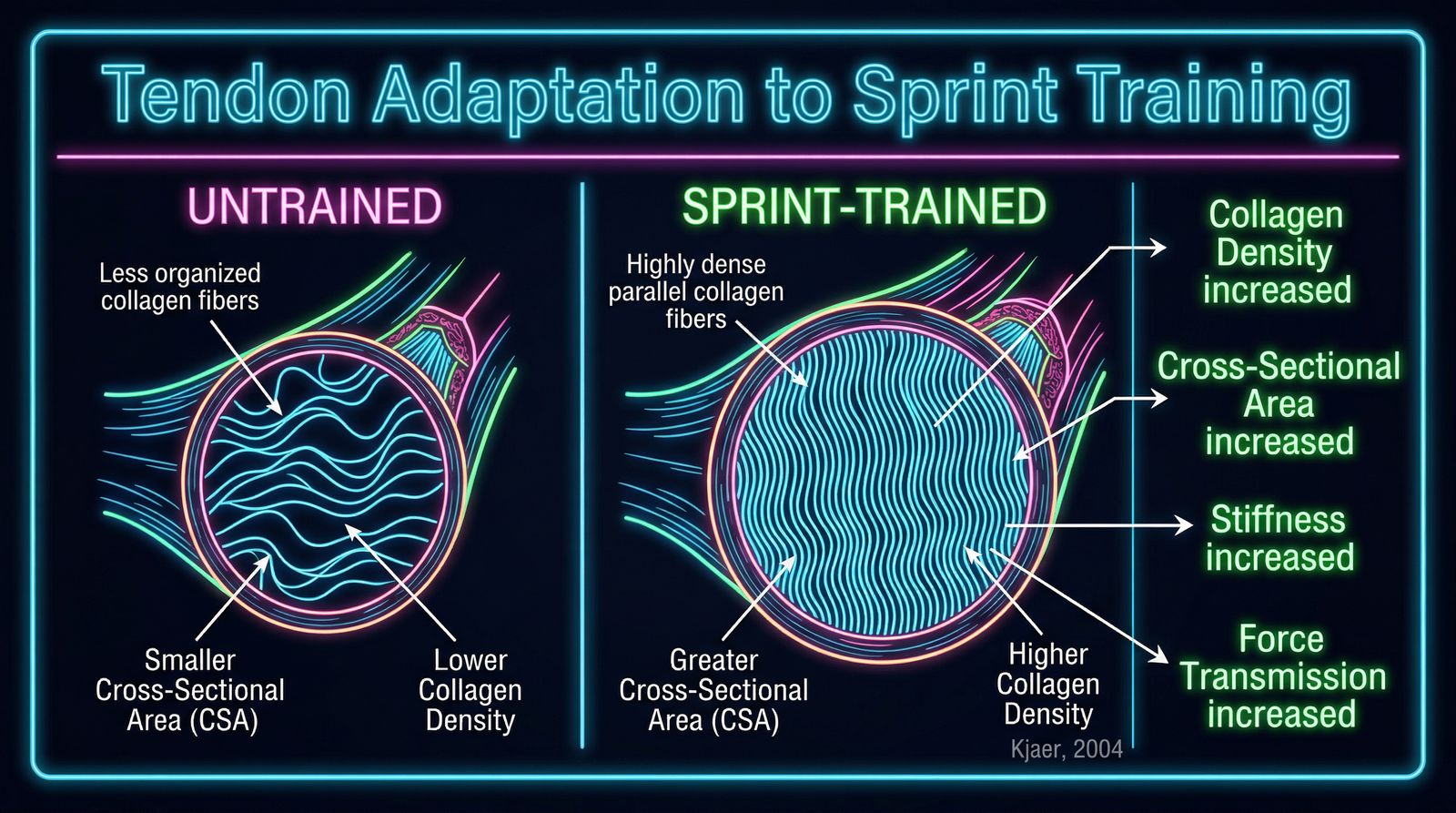
Kjaer (2004) reviewed the role of the extracellular matrix in tendon and skeletal muscle adaptation to mechanical loading and documented the structural changes that occur in response to repeated high-load mechanical stimulation. The findings are directly relevant to understanding why sprint training protects rather than damages.
Tendons subjected to progressive mechanical loading respond by increasing collagen synthesis. Type I collagen, the structural protein responsible for tendon tensile strength, is upregulated. Tendon cross-sectional area increases. Tendon stiffness (the rate at which force is transmitted through the structure per unit of elongation) increases substantially with training.
Increased tendon stiffness has a direct performance and injury-protection consequence: stiffer tendons transmit force from contracting muscle to bone more rapidly and with less energy loss. The explosive force of a contracting muscle reaches the ground sooner. The elastic recoil during the stretch-shortening cycle is more efficient. The tendon is also less likely to elongate catastrophically under sudden high loads because its capacity to absorb force before failure is higher.
This is the exact opposite of the intuitive picture. Sprint training makes tendons more resilient, not more fragile. The Achilles tendon that ruptures in the middle-aged recreational squash player is, in virtually every case, an Achilles tendon that has not been progressively loaded at high intensities for years, not one that has been overtrained.
The same principle applies to muscle architecture. Repeated high-speed eccentric loading shifts hamstring optimal length (the muscle length at which maximum force is produced) toward longer lengths. This matters for injury prevention because hamstring tears during sprinting occur at long muscle lengths, during the late swing phase when the muscle is already near-maximally elongated. An adapted hamstring can produce more force at that length. An unadapted one cannot.
The Acute-to-Chronic Workload Ratio
The mechanism by which sprint training causes injury is the inappropriate application of sprint loads to unprepared tissue. Gabbett (2016) formalised this as the acute-to-chronic workload ratio (ACWR): the ratio between the workload of the current week (acute) and the average workload of the preceding four weeks (chronic).
When the ACWR rises above approximately 1.5 (that is, when the current week's load exceeds the four-week rolling average by more than 50%), injury risk rises sharply. This occurs when an athlete who has been doing no sprint work suddenly performs a high volume of high-intensity sprint sessions. The tissue, having had no adaptive stimulus to prepare it, cannot tolerate the acute demand.
The prescription from this finding is progressed sprint training, not less of it. Begin with short, sub-maximal accelerations. Build volume gradually over weeks. Allow the ACWR to remain close to 1.0 during the loading phase. Give the tendons, muscles, and nervous system time to adapt before increasing intensity or volume further.
An athlete who follows this progression will, after eight to twelve weeks, have tissue that is meaningfully more resilient than it was at baseline. They will have built the structural adaptation that makes high-speed demands tolerable, and eventually routine.
The Integrated S&C Approach: Barbell and the Track — how sprint training fits into a complete strength and conditioning macrocycle.
Hamstring Protection: The Two-Pronged Defence
Hamstring injuries during sprinting represent one of the most persistent problems in athletic medicine. The epidemiology is consistent: the majority of acute hamstring tears during high-speed running occur to athletes who do not regularly perform sprint training at high intensities. The tissue has not been prepared for the specific mechanical demands of terminal swing.
Petersen et al. (2011) conducted a landmark study on the preventive effect of eccentric hamstring training (specifically the Nordic hamstring curl) in professional soccer players. The group performing Nordic curls saw a 51% reduction in new hamstring injuries and a 70% reduction in re-injuries compared to the control group.
The mechanism is directly aligned with the tissue adaptation argument. Nordic hamstring curls load the hamstring eccentrically at long muscle lengths, precisely the configuration of injury risk during high-speed running. Progressive exposure to this stimulus shifts the optimal length and increases eccentric force capacity at the lengths where tearing occurs.
Askling, Karlsson and Thorstensson (2003) found complementary results from sprint-specific eccentric overload training during a preseason strength programme: a significant reduction in hamstring injury incidence compared to a previous season, with the reduction attributed to the eccentric adaptation from high-speed sprint work.
The two-pronged defence emerges from this evidence: Nordic hamstring curls to develop eccentric strength at long muscle lengths, combined with progressive sprint training to condition the neuromuscular system to the specific timing and coordination demands of high-speed running. Neither alone is as effective as both together. The baseline (zero sprint training and no eccentric hamstring work) is the configuration most likely to produce injury when high-speed demands inevitably arrive.
Neuromuscular Patterning: The Prepared Nervous System
Beyond the structural tissue adaptations, sprint training produces a neuromuscular adaptation, motor pattern consolidation, that is invisible in the training room but critical in protecting against injury.
The stride cycle of maximal sprinting is an extremely complex, high-precision movement. Foot strike must occur with the foot dorsiflexed and landing below the centre of mass. Hip extension through the drive phase must be powerful and coordinated. Knee recovery must be rapid. Arm drive must counter-rotate the upper body with correct timing. Each of these elements must occur within hundredths of a second, coordinated across dozens of muscle groups.
An athlete who has never trained these patterns at high speed has a nervous system that has never rehearsed the coordination sequence under high-velocity, high-force conditions. When that athlete is forced to move at high speed (in a sport, in a recreational setting, in an emergency), they are attempting a complex, high-stakes motor task for the first time under pressure. The probability of a coordination error that loads tissue in an unintended configuration is high.
The athlete who sprints regularly has a consolidated motor programme. The movement is automatised. The sequencing is reliable. Under high-speed demands, they execute the rehearsed pattern. The risk of the uncoordinated stride that produces a diaphyseal hamstring avulsion or an Achilles rupture is substantially lower.
This neuromuscular argument extends beyond injury prevention into the longevity picture.
The Longevity Argument: Capacity Must Be Maintained
A body that never sprints progressively loses the capacity to do so safely. The tissues degrade toward a baseline state that is increasingly ill-adapted to high-speed demands. The nervous system's pattern for high-velocity movement becomes rusty and imprecise. The tendons, unloaded at high forces for years, lose the stiffness and collagen density that sprint training builds.
This creates a compounding risk over time. At fifty, the individual who has not sprinted for twenty years faces a situation where their risk of injury from a high-speed demand (chasing a child, avoiding an obstacle, running for a bus) is higher than it was at thirty, because the biological capital built in youth has been drawn down without replenishment.
The individual who has maintained progressive sprint training, even at modest volumes and sub-maximal intensities, has maintained that capital. Their tendons are stiffer. Their hamstrings are eccentrically prepared. Their nervous system still has the motor programme. When high-speed demands arrive, as they will, they are met by tissue and neural architecture that has been prepared for them.
The powersthetics approach treats this as non-negotiable. Building a body for the long game means building the tissue qualities that keep athletic capacity sustainable at a level that is genuinely capable, rather than the diminished capacity of the person who avoided every demanding stimulus in the name of safety.
Sprinting for Fat Loss: The Superior Tool — the body composition case for adding sprinting to your programming.
Key Takeaways
- The athlete who never sprints is not protecting themselves — they are preserving tissue that has not been prepared for high-speed demands, which is precisely the tissue that tears when those demands arrive.
- Progressive sprint training stimulates tendon collagen synthesis, increases tendon stiffness, and shifts hamstring optimal length toward longer lengths where injury occurs during high-speed running (Kjaer, 2004).
- The acute-to-chronic workload ratio (ACWR) is the key variable: sprint training causes injury when loads spike rapidly on unprepared tissue; progressive loading is the solution, not avoidance (Gabbett, 2016).
- Nordic hamstring curls have reduced hamstring injury rates in soccer cohorts (Petersen et al., 2011). They are one tool for building eccentric capacity, not a guarantee.
- A body that never sprints progressively loses the capacity to do so safely — the risk from sudden high-speed demands to unprepared tissue compounds over decades.
Put It Into Practice
This week: Begin with sub-maximal accelerations. 6 x 30m at 70% effort on grass or track, full recovery between each. This is the entry point — not because 70% is the target, but because the tissue needs the pattern before it can handle the load.
This training block: Add Nordic hamstring curls to your programme twice per week: 3 sets of 5–8 reps at controlled eccentric tempo. Concurrently, build sprint volume from 6 reps to 8–10 reps over four weeks, and begin pushing intensity toward 85–90% on the final 2–3 reps.
Long term: Treat sprint training as a permanent feature of your conditioning programme, not a seasonal addition. Even 1–2 sprint sessions per month at low volume helps keep the tissue adaptations and neuromuscular patterns that make high-speed work usable across decades.
Analysed by FINAL FORM AI. Your form, perfected.
References
- Gabbett, T. J. (2016). The training-injury prevention paradox: should athletes be training smarter and harder? British Journal of Sports Medicine, 50(5), 273-280. PMID: 26758673
- Kjaer, M. (2004). Role of extracellular matrix in adaptation of tendon and skeletal muscle to mechanical loading. Physiological Reviews, 84(2), 649-698. PMID: 15044685
- Petersen, J., et al. (2011). Preventive effect of eccentric training on acute hamstring injuries in men's soccer. American Journal of Sports Medicine, 39(11), 2296-2303. PMID: 21825112
- Askling, C., Karlsson, J., & Thorstensson, A. (2003). Hamstring injury occurrence in elite soccer players after preseason strength training with eccentric overload. Scandinavian Journal of Medicine & Science in Sports, 13(4), 244-250. PMID: 12859607
- Bourne, M. N., Timmins, R. G., Opar, D. A., et al. (2018). An evidence-based framework for strengthening exercises to prevent hamstring injury. Sports Medicine, 48(2), 251-267. PMID: 29116573
- Opar, D. A., Williams, M. D., & Shield, A. J. (2012). Hamstring strain injuries: factors that lead to injury and re-injury. Sports Medicine, 42(3), 209-226. PMID: 22239734
- Timmins, R. G., Bourne, M. N., Shield, A. J., et al. (2016). Short biceps femoris fascicles and eccentric knee flexor weakness increase the risk of hamstring injury in elite football (soccer): a prospective cohort study. British Journal of Sports Medicine, 50(24), 1524-1535. PMID: 26675089