Sprinting for Fat Loss: The Superior Tool
EPOC, growth hormone, catecholamines, and muscle preservation — sprinting creates a hormonal environment that chronic cardio cannot match.
By Dhiren Dunraj MSc

Key Insight
“Twenty minutes of all-out sprint intervals or forty-five minutes of jogging — both will burn calories. Only one will remodel your hormonal environment while doing it.”
The standard advice for fat loss has not changed much in thirty years: do more cardio. Log more time on the treadmill, the elliptical, the stationary bike. Keep your heart rate in the fat-burning zone. Be patient.
This advice does produce a caloric deficit. Where it fails is in treating all caloric expenditure as equivalent, as if the mechanism of burning calories were irrelevant to the outcome. The hormonal environment created by your conditioning work determines whether your body composition shifts toward leanness and muscularity or toward the tired, flat physique of the chronic cardio athlete.
Sprinting creates a fundamentally different physiological environment from steady-state jogging. The difference is qualitative, not merely quantitative.
The Efficiency Argument
A 20-minute sprint session consisting of 8–10 all-out efforts with full recovery creates a caloric deficit. So does a 45-minute jog at a steady pace. From a pure energy accounting perspective, the jog likely burns more calories during the session itself. But the comparison does not end when the session ends.
Tremblay, Simoneau and Bouchard (1994) examined the impact of exercise intensity on body composition and skeletal muscle metabolism in a landmark study comparing endurance training and high-intensity interval training over a longer period. Despite the high-intensity group expending far fewer calories during their sessions, they showed significantly greater reductions in subcutaneous fat. When the researchers adjusted for energy cost, the high-intensity group showed a nine-fold greater reduction in skinfold thickness per calorie burned.
Caloric expenditure remains the fundamental driver of fat loss. The conclusion is that high-intensity work, including sprinting, creates additional metabolic effects that extend well beyond the duration of the session itself. Efficiency here means more total fat loss for a given time investment, driven by mechanisms that steady-state cardio cannot access.
EPOC: The Afterburn Effect
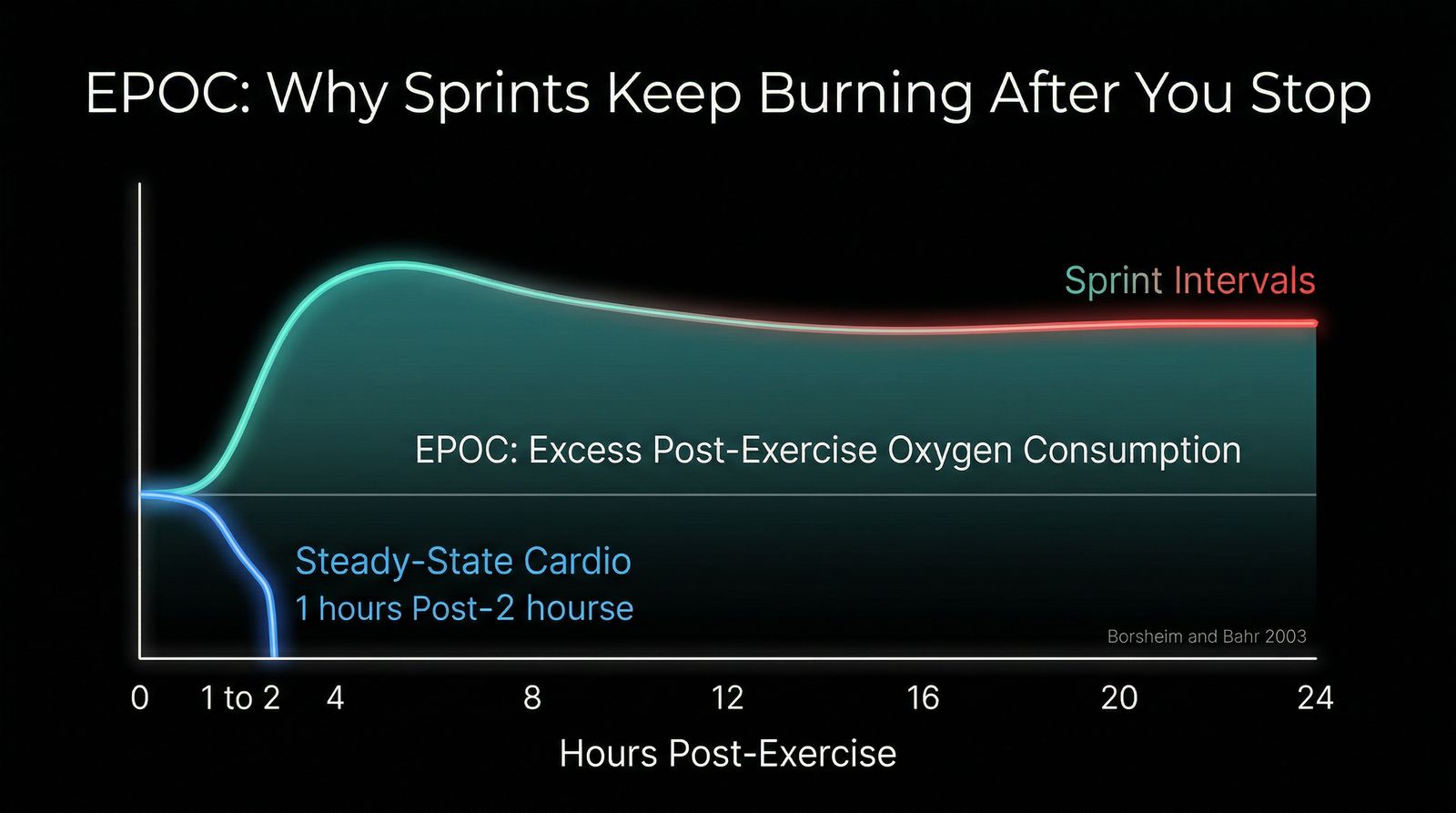
The primary mechanism is excess post-exercise oxygen consumption, universally known as EPOC. After high-intensity exercise, the body's oxygen consumption remains elevated above resting baseline for an extended period, sometimes up to 24 hours after a true maximal sprint session.
Borsheim and Bahr (2003) conducted a comprehensive review of the determinants of EPOC and found that exercise intensity is the dominant predictor of EPOC magnitude. Low-to-moderate intensity exercise produces minimal EPOC. Oxygen consumption returns to baseline within minutes to an hour. High-intensity exercise produces substantial EPOC, with the magnitude and duration scaling directly with how hard the bout was.
Maximal sprint efforts create large oxygen deficits and generate significant metabolic disturbances: elevated body temperature, altered pH, depleted phosphocreatine stores, elevated circulating lactate, hormonal surges. Restoring homeostasis requires sustained metabolic work that continues long after the sprint session has ended. That elevated metabolic rate represents real additional caloric expenditure, occurring primarily through fat oxidation as the body's preferred fuel at rest.
A 45-minute jog produces its caloric expenditure during the 45 minutes and then stops. A 20-minute sprint session produces caloric expenditure during those 20 minutes and then continues producing it for the next 12–24 hours. The effective caloric cost of the sprint session, integrated across the full recovery period, is substantially higher than the session duration alone suggests.
Hormonal Response: The Decisive Difference
The hormonal environment created by sprinting is the most compelling argument for its superiority as a fat loss tool, and the area where the comparison with steady-state cardio is most stark.
Stokes et al. (2002) examined the growth hormone (GH) response to 6-second and 30-second maximal cycle ergometer sprints and found substantial GH secretion in response to both, with the 30-second sprint producing a pronounced GH pulse. Growth hormone is the primary lipolytic hormone. It mobilises stored fat for use as fuel and simultaneously signals for protein synthesis and muscle preservation. A training method that produces an acute GH spike is directly activating the hormonal machinery of fat mobilisation.
Steady-state aerobic exercise at moderate intensity produces minimal GH secretion. The hormonal environment of a 45-minute jog is characterised by elevated cortisol (the primary stress hormone, which at chronically elevated levels promotes fat storage and muscle catabolism), modest sympathetic activation, and minimal anabolic hormone response.
Sprint training, by contrast, produces large acute spikes in catecholamines (adrenaline and noradrenaline) that directly mobilise free fatty acids from adipose tissue into circulation for use as fuel. The sympathetic drive of an all-out sprint triggers a hormonal cascade that is fundamentally oriented toward mobilising and burning stored energy. Coupled with the GH pulse, the result is an acute hormonal environment that is actively favourable for fat loss.
Muscle Preservation: The Long-Term Advantage
This is where the comparison with chronic steady-state cardio becomes most consequential for the powersthetics athlete. High-volume low-intensity endurance training, performed consistently over months, sends an adaptation signal that is fundamentally in conflict with maintaining metabolically expensive fast-twitch muscle mass.
The body is ruthlessly efficient. Muscle tissue is metabolically costly, requiring calories just to exist. If the primary training signal you send is "sustain low-power output for long durations," the body will eventually adapt by shedding the high-output, fast-twitch muscle fibres that are metabolically expensive and unused during steady-state work. Wilson et al. (2012) conducted a meta-analysis of concurrent training research and found that high volumes of endurance training interfere with strength and hypertrophy adaptations. The interference is real, and the mechanism involves competing molecular signals, particularly the conflict between AMPK activation from endurance work and mTOR activation from resistance training.
Sprinting sends the opposite signal. Maximal sprint efforts recruit fast-twitch Type II muscle fibres to a greater degree than any other conditioning modality. The body does not shed fast-twitch mass when it is being consistently recruited at maximal output. Sprinting preserves, and can help develop, the muscle mass that defines the powersthetics physique.
The chronic cardio athlete and the sprint athlete can both be in a caloric deficit. The chronic cardio athlete will, over time, lose disproportionate amounts of muscle along with fat. The sprint athlete will shed fat while preserving the muscular base. The resulting physiques, at similar body weight, are not comparable.
The Physique Argument
The comparison of physiques that emerges from different training methodologies is illustrative rather than a controlled experiment. Individual genetics, training history, nutrition, and a hundred other variables confound direct comparisons. But the general pattern is observable enough to be worth stating clearly.
Athletes who combine heavy lifting with sprint conditioning (the programme that sprinting advocates have followed for decades) tend to display physiques that are lean, muscular, and powerfully built. The physical capacity is visible in the body. This is the powersthetics aesthetic: strength that shows, capability that is real.
Athletes who combine lifting with high volumes of steady-state cardio tend, over time, to show the trade-offs of the conflicting adaptation signals: reduced muscle mass, reduced strength at a given body weight, and a physique that reflects the interference of competing training demands.
Neither assessment is absolute. Both are generalisations. But the physiological mechanisms support the general direction: sprinting preserves what you have built in the weight room, while chronic cardio progressively erodes it.
Walking for Fat Loss: The Underrated Pillar covers the complementary tool that operates at the opposite end of the intensity spectrum with zero recovery cost.
Practical Protocols: How Much Sprinting for Fat Loss
Sprint training is a high-intensity stimulus. It must be treated like one: it replaces lower-quality conditioning work rather than being added on top of everything else as an afterthought, and it is planned with recovery in mind.
Two sprint sessions per week is the working recommendation for a lifter seeking fat loss benefits without compromising recovery. Session structure should be kept simple, especially for beginners:
Session format (15–25 minutes total, excluding warm-up):
- Thorough warm-up: 5–8 minutes of progressive movement, leg swings, light acceleration runs at 50–70% effort
- Sprint efforts: 6–10 repetitions of 20–40 metre efforts at 85–100% intensity (scale to fitness level)
- Full recovery between efforts: 2–3 minutes minimum. This is not a conditioning circuit. The goal is maximum output on each rep.
- Cool-down: 5 minutes of walking
The non-negotiable is recovery. Sprint efforts performed into accumulated fatigue, with insufficient rest between reps, produce neither the peak output required for the hormonal response nor the EPOC magnitude that makes sprinting effective. If the fourth sprint looks like the first, the rest periods are appropriate. If the fourth sprint is visibly slower and more laboured, extend the rest.
Progression over weeks: add one to two reps per session, or increase sprint distance by 5–10 metres. Intensity should trend toward maximum. Brief, all-out efforts are the signal the physiology responds to. Progressively longer, slower efforts at moderate intensity gradually erode the distinction between sprinting and jogging and produce diminishing returns.
Cardio Zones Explained: Which Zone Actually Burns Fat shows where sprinting sits in the zone framework and how to use all zones intelligently.
Key Takeaways
- Despite burning fewer calories per session, sprint interval training produced nine times greater reduction in subcutaneous fat per calorie burned compared to endurance training in controlled comparisons (Tremblay et al., 1994).
- EPOC from high-intensity sprint work keeps metabolic rate elevated for 12–24 hours post-session; steady-state cardio returns to baseline within an hour (Borsheim & Bahr, 2003).
- Sprinting produces acute growth hormone spikes and catecholamine surges that directly mobilise stored fat — hormonal responses that moderate-intensity steady-state cardio does not generate.
- Chronic high-volume low-intensity cardio interferes with muscle mass retention through competing molecular signalling; sprint training preserves fast-twitch muscle by recruiting it maximally (Wilson et al., 2012).
- Two sprint sessions per week of 15–25 minutes each, with full recovery between efforts, is the practical starting point for a lifter adding sprint training for fat loss.
Put It Into Practice
This week: Replace one of your existing cardio sessions with a sprint session. 6 x 30m on grass or track, full recovery between efforts. Keep the intensity honest — these should feel like genuine all-out efforts, not jogs.
This training block: Build sprint volume from 6 to 10 reps over four weeks. Add a second session in week three. Track your performance on a reliable marker — a fixed 40m time, or a measured distance covered in 5 seconds — to confirm adaptation is occurring.
Long term: Treat sprint training as a permanent conditioning category alongside lifting, not a temporary fat-loss intervention. The hormonal environment, muscle preservation, and EPOC advantages compound over time. The physique that emerges from years of lifting plus sprinting is fundamentally different from one built on lifting plus chronic cardio.
Analysed by FINAL FORM AI. Your form, perfected.
References
- Borsheim, E., & Bahr, R. (2003). Effect of exercise intensity, duration and mode on post-exercise oxygen consumption. Sports Medicine, 33(14), 1037-1060. PMID: 14599232
- Tremblay, A., Simoneau, J. A., & Bouchard, C. (1994). Impact of exercise intensity on body fatness and skeletal muscle metabolism. Metabolism, 43(7), 814-818. PMID: 8028502
- Stokes, K. A., et al. (2002). The time course of the human growth hormone response to a 6 s and a 30 s cycle ergometer sprint. Journal of Sports Sciences, 20(6), 487-494.
- Wilson, J. M., et al. (2012). Concurrent training: a meta-analysis examining interference of aerobic and resistance exercises. Journal of Strength and Conditioning Research, 26(8), 2293-2307. PMID: 22002517
- Trapp, E. G., Chisholm, D. J., Freund, J., & Boutcher, S. H. (2008). The effects of high-intensity intermittent exercise training on fat loss and fasting insulin levels of young women. International Journal of Obesity, 32(4), 684-691. PMID: 18197184
- Keating, S. E., Johnson, N. A., Mielke, G. I., & Coombes, J. S. (2017). A systematic review and meta-analysis of interval training versus moderate-intensity continuous training on body adiposity. Obesity Reviews, 18(8), 943-964. PMID: 28513103
- Wewege, M., van den Berg, R., Ward, R. E., & Keech, A. (2017). The effects of high-intensity interval training vs. moderate-intensity continuous training on body composition in overweight and obese adults: a systematic review and meta-analysis. Obesity Reviews, 18(6), 635-646. PMID: 28401638
- Gibala, M. J., Little, J. P., Macdonald, M. J., & Hawley, J. A. (2012). Physiological adaptations to low-volume, high-intensity interval training in health and disease. Journal of Physiology, 590(5), 1077-1084. PMID: 22289907