Progressive Overload: The Iron Law
The single principle that underpins every strength gain ever made.
By Dhiren Dunraj MSc

Key Insight
“"The adaptation is the inevitable consequence of the system. Your job is to trust it, follow it, and never confuse effort with progress."”
Milo of Croton was the greatest wrestler in the ancient world. Six-time Olympic champion. Multiple-time Pythian, Isthmian, and Nemean champion. His name became synonymous with physical invincibility in the ancient Greek world, a figure so far beyond ordinary human capacity that mythology eventually caught up with history and declared him the son of a god.
The legend of how he built that strength is one of the oldest training stories in existence. It's also one of the most perfect illustrations of a principle that sports science would not formally name for another two millennia.
As a boy, Milo found a newborn calf on his family's farm. He lifted it onto his shoulders and carried it. Then he came back the next day and lifted it again. And the day after that. Every single day, Milo carried the calf. Every single day, the calf grew a little heavier. And every single day, Milo's body adapted to the slightly greater demand.
By the time the animal had become a full-grown bull (a creature weighing several hundred kilograms) Milo was carrying it.
He had not trained specifically to carry a bull. He had trained consistently with a progressively heavier load. The adaptation was the inevitable consequence of the system.
Two and a half thousand years before the phrase "progressive overload" appeared in a sports science journal, Milo of Croton was doing it.
The calf didn't know it was a training tool. Milo, in all likelihood, didn't think of himself as executing a training methodology. He was simply responding to a daily reality: the thing he was carrying got heavier, so he got stronger. The principle is that clean. The application, for a powerlifter with a barbell and a training log, is not much more complicated.
But understanding why it works (what is actually happening inside the body when load increases incrementally over time) separates the lifter who follows the principle blindly from the lifter who can manage it intelligently across years of training.
The Science of What Milo's Body Was Doing
Three primary mechanisms drive the adaptation that results from progressive overload. They operate simultaneously and reinforce each other. Understanding them explains why the principle works.
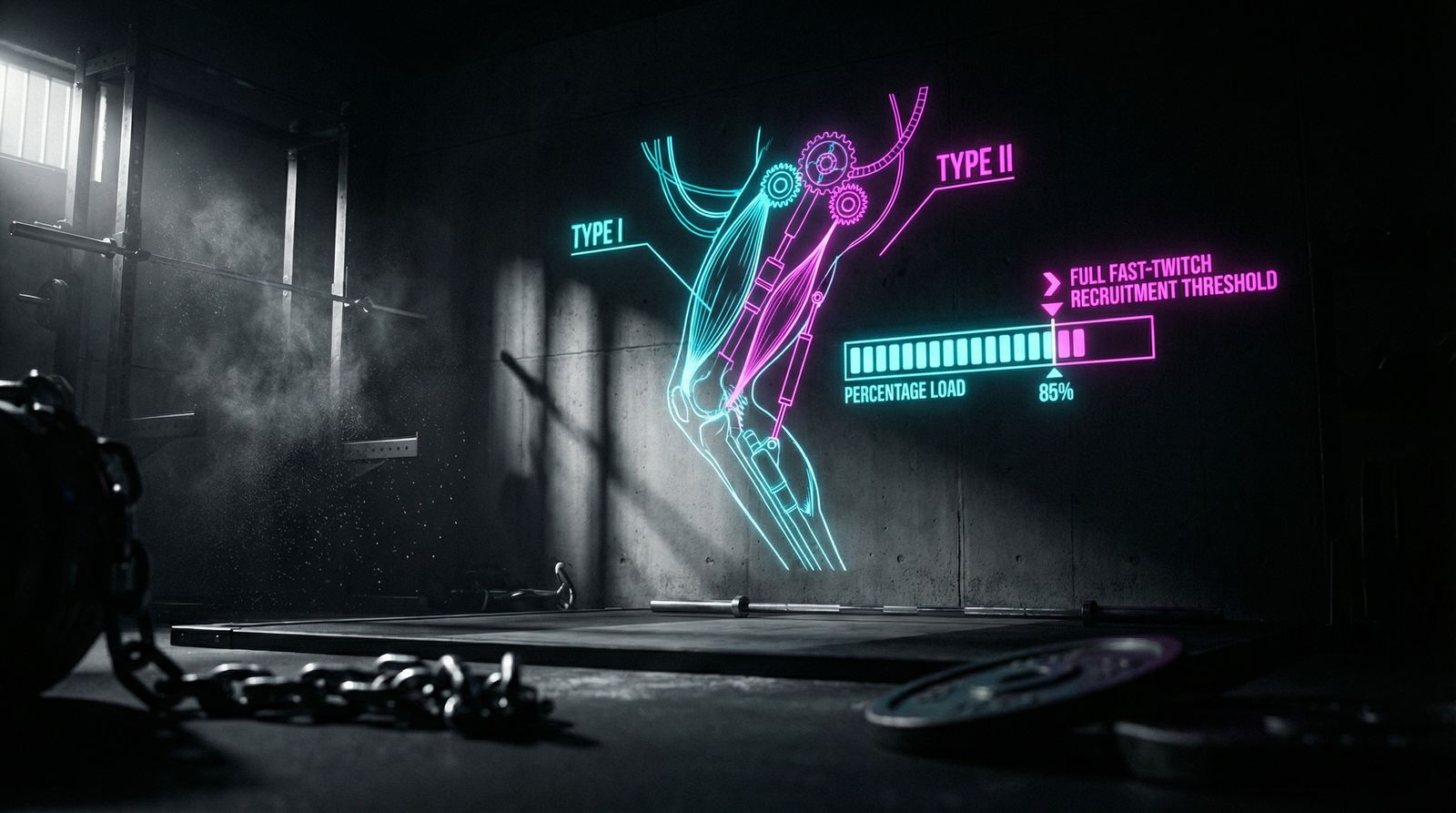
Mechanical tension is the primary driver. Near maximal loads fully recruit the largest and most force-capable muscle fibres (type II, or fast-twitch fibres). They're also the most resistant to recruitment: the body recruits them last, only when the load demands it.
At moderate loads (say, 60% of your maximum) the body can produce the required force without fully recruiting type II fibres. The training stimulus reaches the slow-twitch fibres but largely bypasses the fast-twitch ones. The muscles you most want to develop for strength and size are not significantly challenged. As load increases toward the maximum, recruitment increases. At or near maximal loads, full recruitment is required. The mechanical tension across the muscle at full recruitment is the primary signal for strength adaptation and muscle growth.
Milo's body recruited more motor units every day because the load demanded it. The bull was involuntarily programming him toward full motor unit recruitment.
Metabolic stress is the secondary mechanism. During sustained muscular effort, metabolic by-products accumulate within the muscle cell: lactate, hydrogen ions, inorganic phosphate. This metabolic environment (the burning sensation of a hard set, the pump that signals a muscle has been thoroughly worked) generates a secondary signal for adaptation. It's particularly relevant to muscle growth. Metabolic stress-driven adaptation is different from tension-driven adaptation, but the two work together in productive training.
Muscle damage, the third mechanism, is more complex than it first appears. Microscopic disruption at the myofibrillar level (the structural proteins that make up muscle fibres) occurs with high-tension exercise, particularly eccentric loading (the lowering phase of a squat, bench press, or deadlift). The repair process that follows involves the satellite cells surrounding the muscle fibre rebuilding the disrupted proteins, slightly larger and slightly stronger than before.
Muscle damage is a component of the adaptation process. It's not the goal of training. A session is not more productive because you're sorer afterwards. Soreness is an indicator of novel or high-eccentric stimulus, not of adaptive quality.
Density vs. Fluff
Not all hypertrophy is created equal, and most lifters and coaches miss the distinction.
There are two types of muscle growth:
Myofibrillar Hypertrophy is the growth of actual contractile tissue, the actin and myosin filaments that generate force. This is what happens when you train heavy, progressively, and with mechanical intent. The muscle gets denser, harder, and more capable. It looks different because it is different.
Sarcoplasmic Hypertrophy is the expansion of the fluid and glycogen content surrounding the muscle fibres. It produces the pump. It produces transient size. It photographs well on a Saturday after a carb load. By Monday, it's mostly gone.
Bodybuilding programmes optimise almost exclusively for sarcoplasmic response. High rep, high volume, moderate load. The pump is real. The long-term density is not.
The Powersthetics approach is pro-specificity, not anti-volume. Build your foundation on mechanical tension: heavy, progressive loading of the Big 3. Layer intelligent accessory volume on top. The result is muscle that is both dense and full, strong and aesthetic.
Here is the simplest proof in existence:
Key Insight
“*A 140kg bench presser never has a small chest.*”
That is not a coincidence. That is physics. The mechanical stress required to move that load over months and years forces myofibrillar adaptation that no amount of cable flyes can replicate. Chase the strength. The physique follows.
How to Apply Overload Across Dimensions
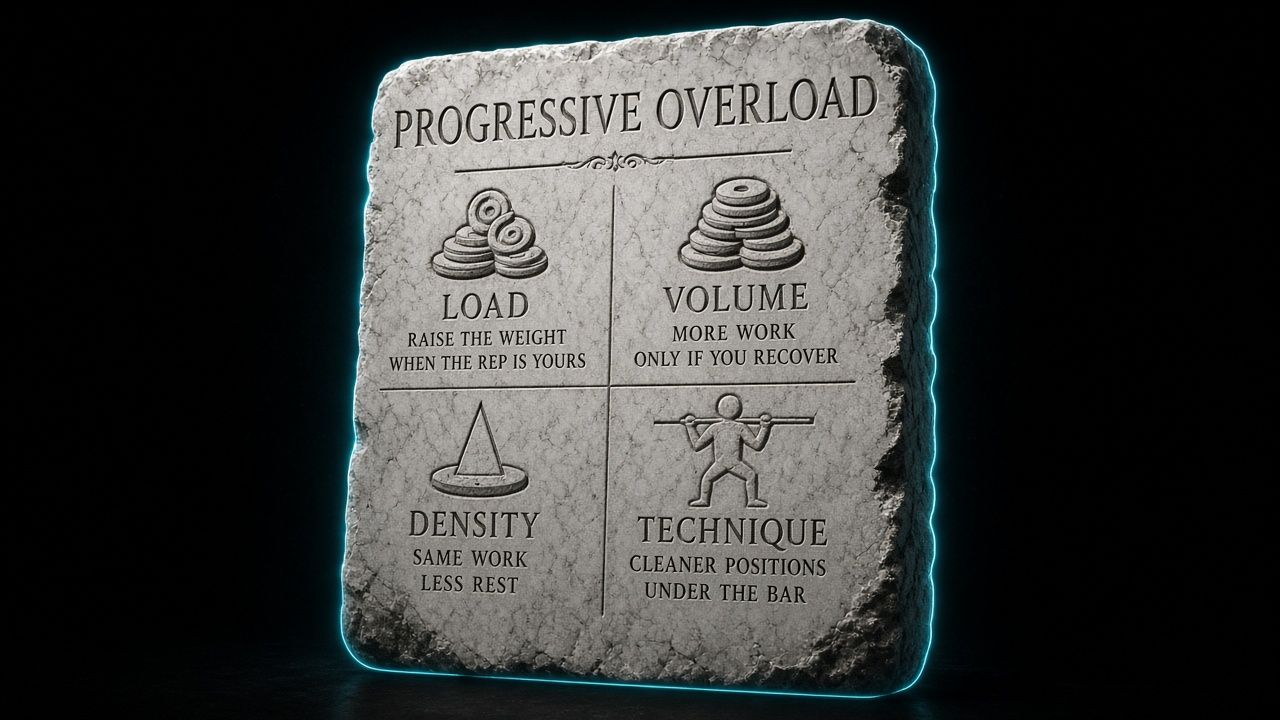
The Milo story makes overload appear simple: add load. That's the most obvious application, and for beginners, it's essentially the only application required. But overload has multiple dimensions, and understanding all of them is what allows you to continue progressing when the simplest dimension runs out.
Load progression is the first and most direct form. Add weight to the bar. The linear application of progressive overload. For a beginner, this works session to session: 2.5kg added to the squat every session, 1.25kg to the bench. For an intermediate lifter, the increment shrinks and the timeframe extends: 2.5kg per week, or per fortnight. For an advanced lifter, a 5kg increase in a training cycle of 12 weeks is significant progress. The amount of load progression available decreases as training age increases. It never disappears entirely. It just requires more patience.
Volume progression is the second dimension and an often underused one. If you cannot add weight to the bar (either because your programme doesn't call for it yet or because you're at the ceiling of your current recovery capacity) you can add work. Three sets of five reps at 100kg represents less total stimulus than four sets of five at 100kg. Adding one working set per session over the course of a training block is a form of progressive overload that produces genuine adaptation, particularly hypertrophic adaptation.
Volume progression is the primary lever for intermediate lifters between load milestones. When the weight doesn't go up this week, ensure the total work does. Progress is not always on the bar. Sometimes it's in the log.
Density progression is overload through time efficiency. The same volume of work (the same sets, reps, and load) completed in a shorter session represents higher training density. The body experiences this as greater training stress and adapts accordingly. A lifter who takes three minutes of rest between sets and progressively reduces that to two minutes is performing density progression. This is particularly relevant for lifters whose schedules limit session length.
Technique progression is the most underrated dimension. A lifter who improves their squat mechanics (deepens their depth, eliminates a compensatory forward lean, improves their bar path) has effectively applied progressive overload without touching the weight. A cleaner movement pattern produces greater force expression from the same muscle mass. It places stress more precisely on the targeted muscles. It allows greater loads to be used safely in subsequent training. Technical improvement is genuine progress, quantifiable in the training log if you film yourself consistently.
The "More Is Always Better" Trap
Progressive overload does not mean always do more. This is the most common misapplication of the principle, and it leads directly to overtraining, stalled progress, and injury.
The principle is: always provide a stimulus your body isn't yet adapted to. That is different from "always do more than last time."
Consider a lifter who has been squatting 100kg for 5 reps, 3 sets, for four weeks. Their body is fully adapted to that stimulus. Doing five sets of that same session produces no additional overload: the body has already adapted to the load, and adding two more sets of an adapted stimulus produces primarily fatigue, not adaptation. The overload principle requires a stimulus beyond the current adaptation. If the body has adapted to 100kg for 5 reps, the overload might be 102.5kg for 5 reps, or 100kg for 6 reps. Not 100kg for 7 sets.
More total volume is only more overload when the body hasn't yet adapted to the current stimulus. Volume beyond the current adaptation ceiling is junk volume: it produces fatigue without driving adaptation. Managing the distinction between productive volume and junk volume is one of the most important skills in programme design.
The lifter who adds volume reactively (because they feel they didn't "do enough" in a session) is operating without this understanding. The training log, reviewed honestly, reveals the truth. If you're adding volume without measurable progress in load, reps, or technique, the volume isn't producing overload. It's producing fatigue.
Tracking: The Non-Optional Element
You cannot manage what you don't measure.
Milo didn't need a training log. His training instrument grew heavier every day whether he tracked it or not. A barbell does not grow. The weight on it stays exactly where you left it unless you change it deliberately and record that change.
A training log is not optional for a lifter who wants to apply progressive overload systematically. It's the feedback mechanism through which the entire system operates, not bureaucracy.
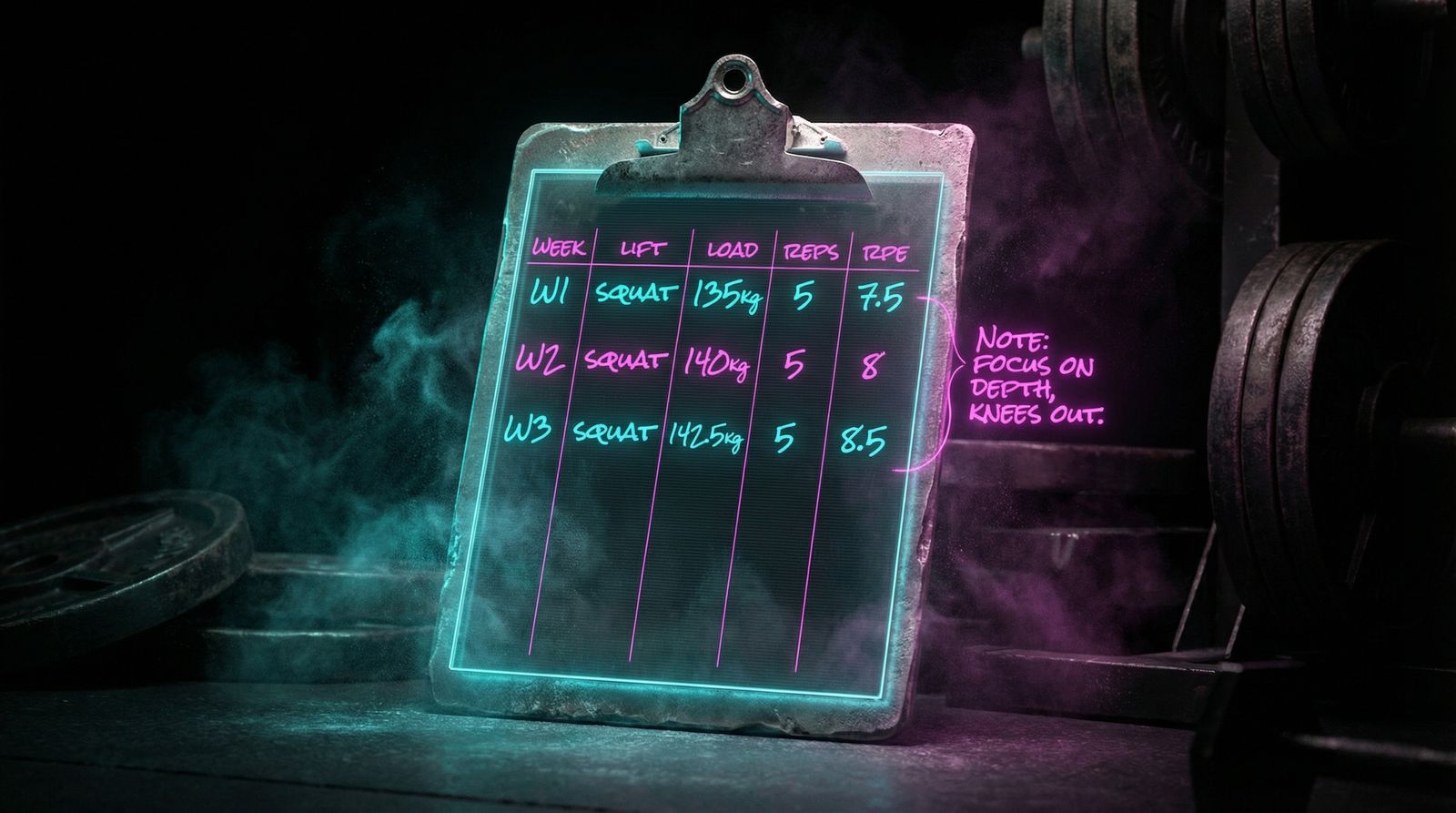
Track every working set: the exercise, the weight, the reps completed, and the RPE or RIR. Nothing else matters initially. With that data, you can see exactly where you're progressing (load going up on the squat, an additional rep on the bench) and where you're stagnating.
Stagnation deserves investigation. If the bench press hasn't moved in three weeks, the cause is identifiable from the log. Has volume increased without load progression, suggesting the stimulus is volume-adapted but load-limited? Has RPE been consistently high, suggesting the programme's intensity is beyond current recovery capacity? Has the weight been consistent but the rep quality deteriorating, suggesting a technique issue or muscular weakness? The log answers these questions. Without it, you're guessing.
Review your log weekly. At the end of each training session, note not just the numbers but the quality of movement. At the end of each week, look at the trend. Consistent progress, however small, means the system is working. Stagnation means something requires adjustment. The log tells you which.
The System Requires Consistency Above All Else
Milo didn't miss a day, out of understanding rather than obsession. He knew that every day he didn't carry the calf, the calf got heavier in proportion to his strength. The incremental progress of the system required uninterrupted participation.
The translation to the barbell is direct. Progressive overload requires consistent, sustained participation across months and years. A session missed is not catastrophic. A week of missed training is recoverable. But the lifter who trains inconsistently (who follows a programme for three weeks, takes two weeks off, starts a different programme, misses a week) has denied the system the one thing it requires above all others: time to work.
Adaptation is slow. Meaningful strength gains in intermediate and advanced lifters occur across training cycles of 12 weeks or more. The full expression of a year of consistent progressive overload is not visible after a month. It requires the patience to trust the system through the sessions where progress is invisible, through the weeks where everything feels stagnant, through the phases where the numbers stop moving and the work continues regardless.
The incremental nature of overload is also its strength. A lifter who adds 2.5kg to their squat per month (a rate that requires no heroics, no extraordinary effort) adds 30kg in a year. In three years, 90kg. That's the compounding of a system applied consistently, not the consequence of occasional bursts of intensity.
Milo didn't carry the bull in a single day of peak effort. He earned it one daily increment at a time.
Build the system. Trust it.
Key Takeaways
- Progressive overload is the only mechanism through which lasting strength adaptations are produced. The body adapts beyond its previous baseline only when given a stimulus it isn't yet adapted to.
- Mechanical tension, metabolic stress, and muscle damage are the three physiological mechanisms; mechanical tension is the primary driver of both strength and hypertrophy.
- Overload has four dimensions: load, volume, density, and technique. When one dimension plateaus, progress through another.
- More is not always more: volume beyond current adaptive capacity produces fatigue, not adaptation.
- The training log is the feedback mechanism for the entire system; without it, progressive overload is guesswork.
Put It Into Practice
This week: Open a training log if you don't already have one: a notebook, a spreadsheet, an app. Record every working set this week: exercise, weight, reps, RPE. Start there. The act of recording is the act of taking the system seriously.
This training block: Identify the single overload dimension you have been neglecting. If you have been adding load consistently without tracking RPE, add RPE tracking this block. If you have been ignoring volume progression, plan a systematic one-set increase over the next 4 weeks. Apply overload deliberately, not reactively.
Long term: Review your training log at the end of every training cycle. Note the total load progress on each competition lift. Calculate the annual rate of progress. A consistent, modest rate of progress (1 to 2% per month on primary lifts) compounds into serious strength over a multi-year training career. The system works. Your job is to follow it long enough to see it.
Analysed by FINAL FORM AI. Your form, perfected.
References
- 1Kraemer WJ, Ratamess NA. 'Fundamentals of resistance training: progression and exercise prescription.' Med Sci Sports Exerc. 2004. PMID: 15064596
- 2American College of Sports Medicine. 'American College of Sports Medicine position stand. Progression models in resistance training for healthy adults.' Med Sci Sports Exerc. 2009. PMID: 19204579
- 3Plotkin D, Coleman M, Van Every D, et al.. 'Progressive overload without progressing load? The effects of load or repetition progression on muscular adaptations.' PeerJ. 2022. PMID: 36199287
- 4Schoenfeld BJ. 'The mechanisms of muscle hypertrophy and their application to resistance training.' J Strength Cond Res. 2010. PMID: 20847704
- 5Taber CB, Vigotsky A, Nuckols G, et al.. 'Exercise-induced myofibrillar hypertrophy is a contributory cause of gains in muscle strength.' Sports Med. 2019. PMID: 31016546