Volume vs Intensity: Finding Your Sweet Spot
The eternal tension in programming — and how to resolve it for your goals.
By Dhiren Dunraj MSc

Key Insight
“"More weight. More sets. More reps. More, more, more. The result is more fatigue, not more progress. Volume and intensity are not synonyms. They're levers, and they pull in opposite directions."”
The most common programming mistake is misunderstanding the relationship between volume and intensity, and defaulting to more of both simultaneously. More weight. More sets. More reps. More, more, more. The result is more fatigue, not more progress.
Volume and intensity are not synonyms. They're two distinct variables that interact with each other in a mathematically inverse way. The lifter who doesn't understand this inverse relationship will spend years chasing progress that keeps moving just out of reach, buried under fatigue they created by applying both levers at maximum force.
Get this right and your programming decisions become dramatically clearer. You'll know why your current approach is or isn't working. You'll know which lever to pull when progress stalls. And you'll stop doing more of both when the answer is doing less of one.
Precise Definitions
This distinction must be explicit, because the confusion between these terms is responsible for a significant portion of poor programming decisions.
Volume is total tonnage lifted in a session or training week. The calculation is simple: sets multiplied by reps multiplied by load. Five sets of 3 reps at 150kg produces 2,250kg of volume. Ten sets of 3 reps at 150kg produces 4,500kg. Volume drives hypertrophy and work capacity. It's the quantity variable. More volume means more total mechanical stress applied to the muscles: more signal for growth.
Intensity is load as a percentage of one-rep maximum, or expressed as an RPE value. Training at 85% of your 1RM is high intensity. Training at 65% is moderate intensity. Intensity drives strength specificity and neural adaptation. It's the quality variable. Higher intensity means greater recruitment of high-threshold motor units, greater specificity to competition demands, and greater nervous system stimulus.
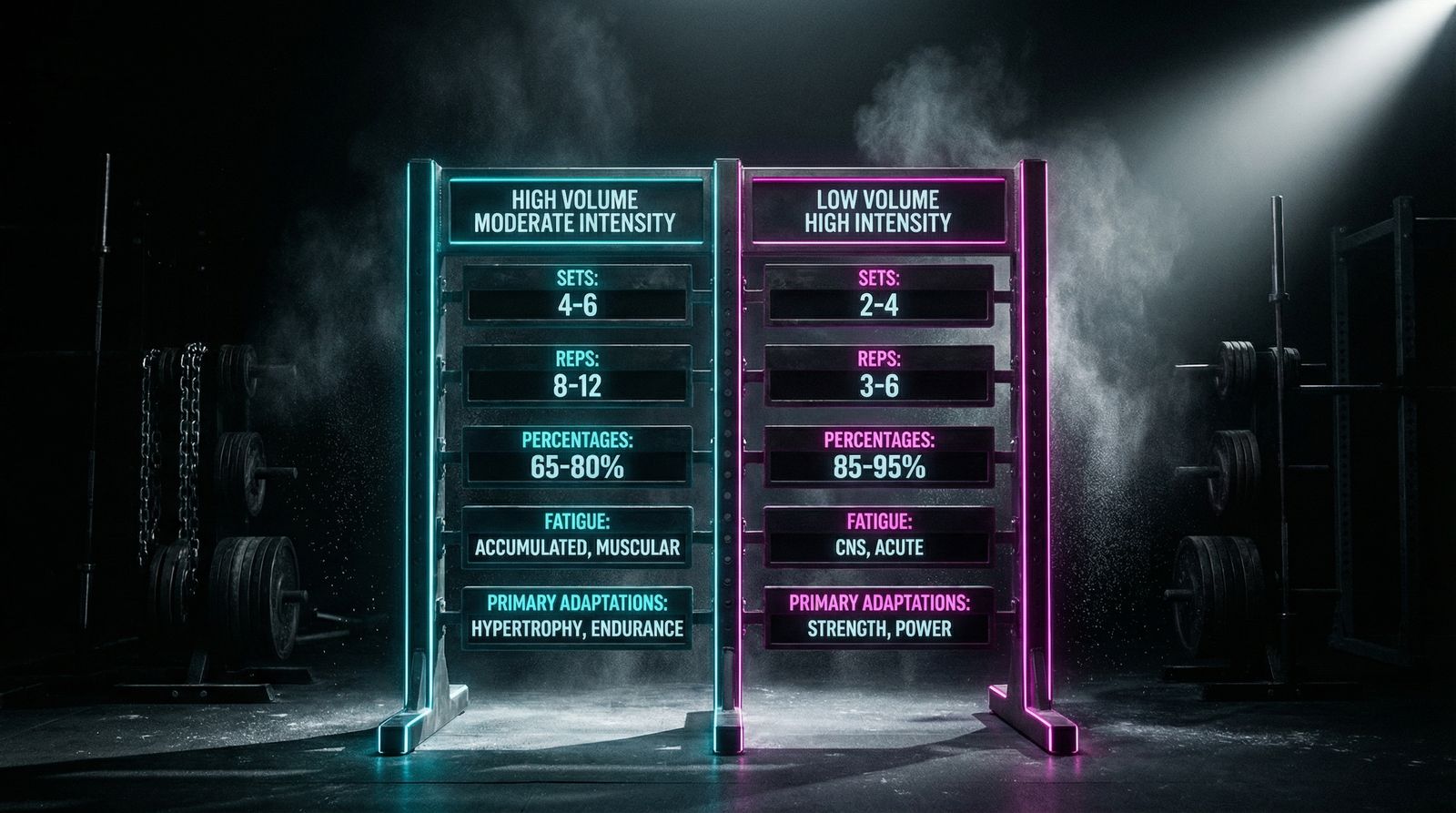
Practically, a session can be high volume and moderate intensity, or low volume and high intensity, or any combination across the spectrum. These are genuinely different sessions with different recovery demands and different adaptive outcomes. They're not the same thing at different "hardness" levels.
Consider an example. A lifter completes 8 sets of 4 reps at 120kg on the squat. That's 3,840kg of volume at approximately 75% intensity (assuming a 160kg 1RM). Now consider the same lifter completing 4 sets of 2 reps at 150kg. That's 1,200kg of volume at approximately 94% intensity. The first session is far higher volume. The second session is far higher intensity. Neither session is simply "harder": they're different stimuli with different adaptive targets.
A session that makes you sweat and feel destroyed is not necessarily "high intensity" in the technical sense. Metabolic fatigue from high-rep work at moderate loads can be extraordinarily uncomfortable while remaining far from the loads that drive maximum strength adaptation. Discomfort is not intensity.
The Inverse Relationship
The inverse relationship between volume and intensity is a mathematical reality, not a guideline or a preference.
At very high intensities (above 90% of 1RM) the recovery demand per set is extremely high. The nervous system is taxed heavily under this load. The muscles are operating near their mechanical limits. The body cannot tolerate large volumes at these intensities without accumulating fatigue faster than it can clear it. A set at 95% requires significantly more recovery time than a set at 75%: not proportionally more, but disproportionately more. Intensity compounds the recovery cost non-linearly.
This is why elite powerlifters, when training at or near their competition maxes, may perform only singles or doubles. The reason isn't that additional sets would be "too hard" in a subjective sense. Additional sets at that intensity compound the CNS fatigue non-linearly, extending recovery to a point that compromises the next session and the sessions after it. The biology of maximal-effort lifting limits sustainable volume at high intensities.
Conversely, at moderate intensities (65–75% of 1RM) the body can tolerate much larger volumes. The recovery demand per set is lower. More total work can be done within a session, and the training week can accommodate multiple sessions at these loads without compromising recovery. This is why accumulation blocks (high volume, moderate intensity) look so different from realisation blocks (low volume, very high intensity). They differ because the biology of recovery demands it, not because one phase is easier.
The practical implication is direct: when intensity goes up, volume must come down. That isn't conservatism. The system cannot function otherwise. A lifter who increases both simultaneously (heavier weights and more sets) is accumulating fatigue at a rate that exceeds their recovery capacity. The progress they're chasing is being buried by the fatigue they're creating.
How the Balance Shifts Across a Training Career
The volume-intensity balance optimal for a lifter changes as training age increases. Understanding this shift explains why beginner programmes look so different from advanced ones, and why applying an advanced programme to a beginner is as inappropriate as applying a beginner programme to an advanced lifter.
Beginners can make progress on almost any combination of volume and intensity. The stimulus of barbell training is so novel that the nervous system responds rapidly to almost any structured exposure. The first months of training produce the fastest adaptations a lifter will ever see, because the baseline is genuinely untrained. Three sets of five, three times per week, at whatever load the beginner can handle with acceptable technique, will produce consistent, measurable progress across 6–18 months. The beginner doesn't need sophistication. They need consistency and a simple progression. Any combination of volume and intensity that's more than they were previously doing creates overload.
Intermediate lifters require more deliberate management. The body has adapted to barbell training as a general stimulus. Simple linear progression has stopped working: adding weight weekly is no longer possible because the recovery demand has grown. Progress requires distinguishing between phases that prioritise volume (to drive further hypertrophy and work capacity development) and phases that prioritise intensity (to drive strength expression). Running high volume and high intensity simultaneously typically produces stalled progress and overtraining at this stage. The lifter must learn to periodize: to alternate the emphasis.
Advanced lifters live in a narrow, precisely calibrated window. They have maximised much of their hypertrophic potential through years of high-volume training. Progress comes from refinement rather than accumulation. Very high intensities, precisely managed volumes, and careful recovery are the dominant characteristics of advanced programmes. What looks like "low volume" to a beginner who sees an advanced lifter doing 4 sets per session is actually a precisely calibrated stimulus: not insufficient volume, but optimal volume for someone whose recovery capacity is being maximally taxed by very high intensities. A beginner who attempts to replicate an advanced programme will be undertrained. An advanced lifter who attempts to replicate a beginner programme will be insufficiently stimulated.

High Frequency, Low Volume vs Low Frequency, High Volume
This is one of the most persistent debates in powerlifting programming, and it has a definitive answer: neither approach is universally superior.
High-frequency, low-volume-per-session training distributes the weekly stimulus across more sessions. Squatting four times per week at two working sets per session provides the same weekly squat volume as squatting twice per week at four working sets per session. The difference is in recovery and skill practice. Lower volume per session means less fatigue per session: recovery between sessions is easier. Higher frequency means more practice repetitions on the competition lifts per week: motor learning and technique development benefit. Lifters who recover quickly, who tolerate frequency well, and whose primary limiter is technique often thrive with higher frequency.
Low-frequency, high-volume-per-session training concentrates the weekly stimulus into fewer sessions. Larger individual training doses, longer sessions, greater inter-session recovery time. This suits lifters with physically demanding jobs or lifestyles that don't support frequent training. It also suits lifters who find their performance is higher when fully recovered rather than frequently exposed, and lifters who thrive psychologically on the greater stimulus of a high-volume session.
The determining factors are individual: recovery capacity, life schedule, training history, psychological response to different session structures, injury history, and access to training facilities. Trial the approach that fits your life most naturally, run it consistently for 6–8 weeks, and evaluate progress against the log. Switch the approach and repeat if the first didn't produce clear progress. The log, not conventional wisdom, tells you which approach is right for you.
RPE and RIR: Governing Intensity by Feel
Rate of Perceived Exertion (RPE) is a 1–10 scale where RPE 10 represents absolute maximum effort (no additional repetitions possible) and RPE 1 represents trivial effort. In powerlifting programming, the working range is typically RPE 6 through RPE 10.
RPE 8 means two reps remaining in the tank. RPE 7 means three reps remaining. RPE 9 means one rep remaining. These benchmarks allow a lifter to govern intensity relative to their actual readiness on any given day, rather than chasing a fixed percentage that may or may not match their capacity.
The practical power of RPE is in its adaptability. A squat that was RPE 7 last week at 150kg might be RPE 8 this week at the same weight, because of accumulated fatigue, poor sleep the night before, or elevated life stress. An RPE-governed programme responds to this: reduce the load to achieve the target RPE (7), rather than forcing the planned load and accumulating unnecessary fatigue. The training day's stimulus matches the day's actual capacity.
Lifters new to RPE-based training often find the self-assessment difficult initially. The tendency is to overestimate reps remaining: to rate a set as RPE 8 when it was actually closer to 9, because the effort felt manageable compared to genuine maximum-effort work. Push to genuine technical failure periodically in training to know what RPE 10 actually feels like, so that the lower RPE benchmarks are calibrated against something real.
Reps in Reserve (RIR) is a practical alternative that many lifters find more intuitive. Instead of a numerical scale, the lifter estimates how many more reps they could complete after stopping. "3 RIR" means they stopped with 3 reps still available. "1 RIR" is one rep from technical failure. "0 RIR" is technical failure. For lifters who struggle with the abstraction of a 1–10 scale, "three reps left in the tank" is a more tangible and actionable benchmark. The two systems are functionally equivalent: RPE 7 is approximately 3 RIR; RPE 8 is approximately 2 RIR; RPE 9 is approximately 1 RIR.
Neither system is more accurate. Use whichever produces more consistent self-assessment. Some lifters switch between them at different points in a training cycle depending on session type. What matters is the practice of self-monitoring, not the specific system used to do it.
Practical Volume Guidelines: MEV, MAV, and What They Mean
Research into training volume has produced two useful concepts: Minimum Effective Volume (MEV) and Maximum Adaptive Volume (MAV).
MEV is the minimum volume required to drive ongoing adaptation in a muscle group or movement. Below MEV, a lifter may maintain their current level (without deconditioning rapidly) but will not progress. MEV varies by individual and by training status. A beginner's MEV for the squat might be two working sets per week. An intermediate's MEV might be six. A commonly cited general range for MEV across muscle groups is approximately 10 hard sets per muscle group per week, though individual response varies significantly.
MAV is the maximum volume from which the body can recover while still driving adaptation. Above MAV, additional volume produces fatigue rather than adaptation. The body's recovery capacity is exceeded, and the marginal sets create a debt rather than a deposit. Commonly cited ranges put MAV for most muscle groups in the region of 20 hard sets per week, though again, individual variation is substantial.
The useful working zone (the range within which training volume drives ongoing adaptation without exceeding recovery) is somewhere between MEV and MAV for any given individual. These are starting points, not rules. The training log is the only reliable way to identify an individual lifter's actual MEV and MAV. Volume that consistently produces progress without excessive fatigue accumulation is within the adaptive window. Volume that produces stagnation despite consistent training suggests either insufficient stimulus (below MEV) or excessive fatigue accumulation (above MAV).
Adjust volume based on what the log tells you, not what a programme template suggests you should be doing.
Key Takeaways
- Volume (sets x reps x load) and intensity (% of 1RM or RPE) are distinct variables. A "hard" session is not necessarily a "high intensity" session.
- The inverse relationship between volume and intensity is biological: at very high intensities, large volumes are not recoverable; at moderate intensities, large volumes are manageable.
- The optimal volume-intensity balance shifts across a training career: beginners respond to almost anything; advanced lifters require precise calibration.
- RPE and RIR allow you to govern intensity relative to daily readiness, preventing the fatigue accumulation that fixed-percentage programming can produce on low-readiness days.
- MEV and MAV define the adaptive volume window. The training log, not general guidelines, identifies your individual range.
Put It Into Practice
This week: On your next squat or deadlift session, record both the load used and your RPE rating for every working set. Do this for four weeks. At the end of week four, look at the pattern: are your RPE values consistent at the same loads, or are they creeping up? Creeping RPE at the same loads signals fatigue accumulation, a sign that volume or intensity management needs adjustment.
This training block: Identify whether your current programme is volume-dominant or intensity-dominant. If it's volume-dominant (moderate loads, many sets) and you're not progressing in strength, try a block that reduces volume and increases intensity. If it's intensity-dominant and your strength gains have stalled, try a volume accumulation block. The problem and the solution are often the inverse of what you've been doing.
Long term: Stop treating "hard" as the goal. Hard is a consequence of appropriate loading, not a training quality in itself. A session that matches your adaptive capacity (that provides the right stimulus without exceeding recovery) is the goal. It may sometimes feel easy. That doesn't mean it isn't working. Trust the log, not the suffering.
Analysed by FINAL FORM AI. Your form, perfected.
References
- 1Schoenfeld BJ, Grgic J, Ogborn D, et al.. 'Strength and hypertrophy adaptations between low- vs. high-load resistance training: a systematic review and meta-analysis.' J Strength Cond Res. 2017. PMID: 28834797
- 2Lopez P, Radaelli R, Taaffe DR, et al.. 'Resistance training load effects on muscle hypertrophy and strength gain: systematic review and network meta-analysis.' Med Sci Sports Exerc. 2021. PMID: 33433148
- 3Schoenfeld BJ, Ogborn D, Krieger JW. 'Dose-response relationship between weekly resistance training volume and increases in muscle mass: a systematic review and meta-analysis.' J Sports Sci. 2017. PMID: 27433992
- 4Ralston GW, Kilgore L, Wyatt FB, et al.. 'The effect of weekly set volume on strength gain: a meta-analysis.' Sports Med. 2017. PMID: 28755103
- 5Zourdos MC, Klemp A, Dolan C, et al.. 'Novel resistance training-specific rating of perceived exertion scale measuring repetitions in reserve.' J Strength Cond Res. 2016. PMID: 26049792
- 6Helms ER, Cronin J, Storey A, et al.. 'Application of the repetitions in reserve-based rating of perceived exertion scale for resistance training.' Strength Cond J. 2016. PMID: 27531969