Peaking: The Science of the Taper
Express the strength you have already built by removing the fatigue hiding it.
By Dhiren Dunraj MSc

Written for a meet. Every principle here applies to a gym max day. Swap "meet" for "max day" and the taper is the same.
Key Insight
“"A properly executed peak removes the fatigue and reveals the fitness. It's counterintuitive. It requires discipline. It works."”
Most lifters go into a meet fatigued. Not because they trained too hard in the final weeks, but because they didn't stop training hard early enough. They arrive at the platform with weeks of accumulated fatigue sitting on top of months of accumulated fitness, and they wonder why they don't feel strong. The numbers they're hitting in the warm-up room are lower than what they hit in training three weeks ago. The bar feels heavy. Something is wrong.
Nothing is wrong. Everything is exactly as predictable as the science says it should be. A properly executed peak removes that fatigue and reveals the fitness underneath. It's counterintuitive: reducing training to get stronger feels backwards. It requires discipline, because the instinct is to add more training when performance feels off, which is precisely the wrong response. But it works, consistently, for any lifter willing to follow it with precision.
The peak is a systematically engineered window in which the fatigue that has been masking your fitness is cleared before the competition. The strength doesn't appear from nowhere. It was always there, hidden under the load of hard training. The peak uncovers it.
What Peaking Actually Is
You don't get meaningfully stronger in two to four weeks, and that's not what the peak is for.
A peak is a period where you systematically remove the accumulated fatigue that has been masking the strength you've already built. The fitness is already there. It was built across the training block, across weeks of squats, pulls, and pressing at progressively higher loads and volumes. The peak doesn't create strength. It reveals it.
The fitness-fatigue model makes this explicit. Both fitness and fatigue increase during a training block. They don't increase at the same rate or dissipate at the same rate, but at any given moment during hard training, both are elevated. Your expressed strength (what you can actually demonstrate on the platform) is your fitness minus your current fatigue.
During a training block, fatigue often outpaces the expression of fitness. You're stronger than you perform, because the fatigue of accumulated training is suppressing your nervous system's ability to fully express the strength it has built. This is why the final weeks of a hard training block often feel like you're getting weaker. You're not getting weaker. You're getting more fatigued.
During a peak, fatigue dissipates faster than fitness decays. Reduce the training stress, and fatigue clears. Fitness (built on weeks of consistent progressive work) persists. The gap between your actual fitness and your expressed performance narrows rapidly. In the final days before a meet, the gap closes. You arrive at the platform with your highest expressed strength in months.
Fatigue removal is the only purpose of the peak.

The Physiology of Fatigue Dissipation
Different fatigue types clear at different rates. A well-designed peak accounts for all of them, which is why the taper needs to begin earlier than most lifters expect.
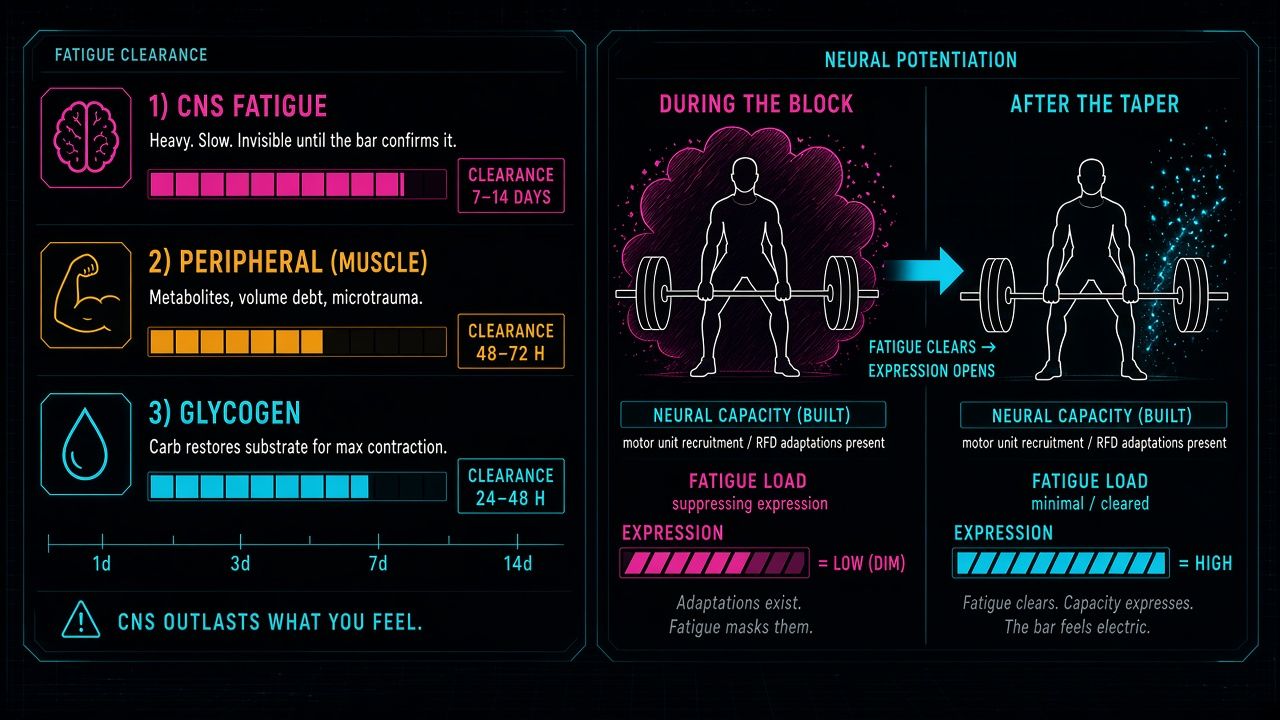
Central nervous system fatigue is the most impactful and the most insidious. High-intensity, low-rep training (the dominant mode of late-cycle intensification and realisation blocks) taxes the CNS heavily. The neural patterns that coordinate movement become less precise. Motor unit synchronisation degrades. Rate of force development (the speed at which you can produce maximum force) slows. CNS fatigue doesn't announce itself the way muscular fatigue does. You don't feel it acutely. You just feel heavy and slow, and the bar confirms it.
CNS fatigue can require 7–14 days to fully clear. This is the number that surprises most lifters. They expect to feel fully recovered 48 hours after their last heavy session. For CNS fatigue from a sustained high-intensity block, two weeks is not unusual. This is why the peak must begin before you feel like you need it.
Peripheral fatigue (muscular fatigue) is the more familiar type. Metabolite accumulation, glycogen depletion, and the microtrauma from high-volume training all contribute. Peripheral fatigue clears faster than CNS fatigue in most lifters: 48–72 hours for a single hard session, longer for the accumulated fatigue of a multi-week block. High volume, in particular, creates a peripheral fatigue debt that requires a meaningful volume reduction, not just a week, to clear.
Glycogen depletion is a third, often overlooked factor. Muscle glycogen (the primary fuel source for high-intensity lifting) is depleted during hard training and requires dietary carbohydrate to restore. Full glycogen restoration with adequate carbohydrate intake requires 24–48 hours. The point is ensuring the energy substrate required for maximal muscular contraction is available when you need it, not carb-loading for strength gains. Low-carbohydrate periods in the final weeks before a meet (including overly aggressive weight cuts) compromise this and suppress performance independent of any training variable.
Neural Potentiation: The Adaptation That Peaks
There is a documented phenomenon in well-timed peaks that experienced lifters describe viscerally but often struggle to explain mechanistically. In the final days of a well-executed taper, the bar feels electric. Weights that were grinding just weeks ago move explosively. Speed returns. The whole system feels dialled in in a way that training never quite reveals.
This is neural potentiation, and it's real.
After weeks of high-intensity training, the nervous system builds adaptations specific to maximal force production: improved motor unit recruitment, better inter-muscular coordination, faster rate of force development. These adaptations are present during the training block but are functionally suppressed by the fatigue accumulation that accompanies them. Attempting to fully express motor unit recruitment through a CNS that's also managing significant fatigue is like trying to run at full speed with a weighted vest. The capacity is there. Expression is limited.
When fatigue clears during the peak (and the timing matters, which is why following the taper structure matters), these neural adaptations express fully. The weighted vest comes off. The capacity that was always there is now available without the suppressive overlay of accumulated fatigue.
This is what lifters describe as feeling "electric" in a well-timed peak. It's the mechanical result of full neural capacity expressing through a recovered system, not a psychological effect.
The 4–6 Week Peak Structure
The specific structure of the taper will vary based on individual recovery capacity, training age, and the volume of the preceding training block. What follows is a framework, not a prescription. Adjust the volume reductions based on what the log tells you about your individual recovery.
Six weeks out: Begin reducing volume by 20–30%. Maintain intensity. The reduction in total work starts clearing peripheral fatigue while the continued high-intensity sessions preserve the neural adaptations built during intensification. This is not a dramatic change: sessions look similar but slightly shorter. The reduction is subtle enough that it doesn't alarm a lifter who doesn't know the plan.
Five weeks out: Volume reduced by 30–40% from the training block peak. Intensity maintained, or slightly elevated; this is often where the last genuinely heavy singles of the cycle appear. The body is beginning to clear peripheral fatigue while still receiving a strong strength signal. At this stage, many lifters start to feel better than they did mid-block, which is confirmation that the taper is working.
Four weeks out: Volume at 40–50% of the training block peak. Intensity at competition percentages. The focus shifts from output to quality: every rep is executed with competition specificity. Sets are kept short. Rest periods are generous. Movement quality is the metric, not total work completed.
Three weeks out: Significant volume reduction. Intensity at or near competition weights. Sets of 1–3 reps, executed at full competition intention. This week often includes opener-weight sets (the first attempt you will open with on meet day) with a focus on making them feel routine rather than effortful. An opener should feel like a statement, not a struggle.
Two weeks out: Volume substantially reduced. Openers or near-openers practiced. The body is in a significant recovery state by this point. Some lifters feel flat here: sluggish, heavy, as though they've lost fitness. This is the most dangerous moment in the peak. Resist all instinct to add volume. The flatness is a phase. It passes.
Meet week (one week out): Minimal training. Light movement to maintain motor pattern sharpness without accumulating any meaningful fatigue. Some lifters do a brief activation session 48–72 hours before the meet: a handful of light, fast sets on the competition lifts. Its purpose is neural priming, not training. The primary job this week is to arrive at the platform rested, glycogen-replete, and confident.
Attempt Selection: The Maths That Matter
Attempt selection is where meet strategy becomes concrete, and it's where many lifters make the most consequential errors of their competitive career.
The opener is the most important lift of the day. Make it. Full stop.
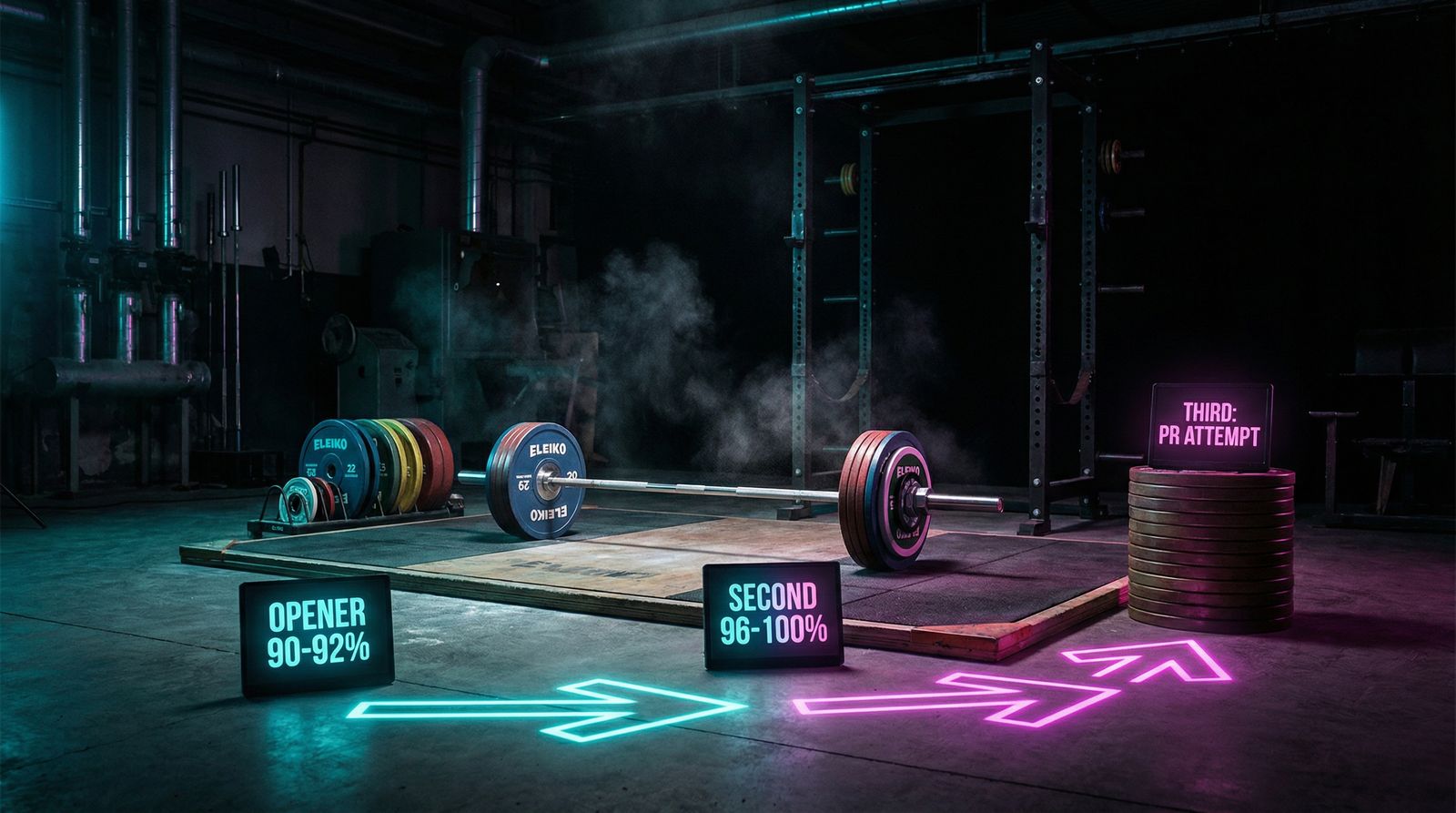
Your opener should be a weight you could make on your worst possible day: after a poor night's sleep, under-caffeinated, slightly ill. Typically 90–92% of your current training maximum. It should look easy. It should feel controlled. The opener's purpose is to get on the board, confirm your readiness, and set up the second attempt, not to impress. A bombed opener creates a zero total on that lift. A successful opener, even a conservative one, allows two more attempts to build toward a total you're proud of.
The second attempt is where you establish your competitive performance. Typically 96–100% of your current best. A weight you're confident of completing on a good day. After a successful opener, your body is warm, your nervous system is activated, and you have competition momentum. The second attempt should feel hard but controlled: a lift that demonstrates your training cycle's result without requiring a heroic effort.
The third attempt is controlled aggression. A competition PR: a weight you can achieve on a good day when everything has gone well. Not a dream attempt that needs extraordinary circumstances, but a weight that's achievable given the day you've actually had so far, taking into account your warm-up quality, how your opener and second attempt moved, and your energy levels.
Reserve hero attempts (maximum possible weights, unlikely to be made under normal circumstances) for meets where you have already secured a total you're satisfied with and are lifting with nothing to lose. Walking in with a hero attempt as your third lift in every event produces bombs and missed attempts, not PRs.
The maths are unambiguous: a missed lift scores zero. A successful lift at a modest weight beats any number of failed attempts at an ambitious one. Understand this before you walk into the warm-up room.
The Psychological Reality of the Taper
The hardest part of the peak is the week two flatness: the period when the volume has dropped, the body feels sluggish, and weights that should feel easy feel heavy.
Every coach who has prepared multiple lifters for competition will tell you the same thing: at some point in the second week of taper, a lifter will contact them convinced the peak has failed. The bar is slow. The weights feel heavy. They feel detrained. Something must have gone wrong.
Nothing has gone wrong. The body prioritises recovery over performance during significant rest periods. The body redirects energy toward cellular repair, glycogen restoration, and CNS recovery rather than toward maximal force production. The system is doing exactly what it should be doing. It simply doesn't feel like that from inside it.
The adaptation (the neural potentiation, the fatigue clearance, the restoration of full motor unit recruitment) is happening beneath the surface. It will not be apparent until the fatigue clears. Which it does, reliably, as the meet approaches.
Many lifters panic and add training back in at this point. This is the worst possible response. Adding training stimulus resets the fatigue clock. The carefully engineered fatigue clearance is interrupted, and the peak is compromised. The lifter arrives at the meet having partially undone the taper with a panic training week, and the result is exactly the fatigued performance they were trying to avoid.
Trust the structure. The flatness is temporary, and the electric feeling in the final days has been coming since you started the peak. Don't interrupt it.
Key Takeaways
- A peak removes fatigue; it does not add fitness. Expressed strength rises because fatigue clears faster than fitness decays.
- CNS fatigue can take 7–14 days to fully clear, which is why the peak must begin before it feels necessary
- Neural potentiation (improved motor unit recruitment and rate of force development) becomes fully expressible once fatigue clears
- The opener must be makeable on your worst day; the total is built on successful attempts, not ambitious misses
- The week two flatness during the taper is physiologically normal and predictable. Adding training at this point compromises the peak.
Put It Into Practice
This week: If you have a meet in the next 8 weeks, map your taper backwards from meet day. Identify when each reduction phase should begin. Write it into your programme now so that volume reduction is a planned event, not a reactive decision.
This training block: Begin tracking bar speed on your primary lifts during the peak. As fatigue clears, bar speed increases noticeably on the same loads. This is an objective measurement of the taper working, and it's more reliable than how you subjectively feel on any given day.
Long term: After every meet, review the taper in retrospect. Did the timing feel right? Did you feel optimal on meet day or still slightly fatigued? Adjust your next peak accordingly. The ideal taper duration and volume reduction is individual; only competition experience across multiple cycles tells you exactly where your window is.
Analysed by FINAL FORM AI. Your form, perfected.
References
- 1Mujika I, Padilla S. 'Scientific bases for precompetition tapering strategies.' Med Sci Sports Exerc. 2003. PMID: 12840640
- 2Pritchard HJ, Tod DA, Barnes MJ, et al.. 'Tapering practices of New Zealand's elite raw powerlifters.' J Strength Cond Res. 2016. PMID: 26670988
- 3Travis SK, Mujika I, Gentles JA, et al.. 'Tapering and peaking maximal strength for powerlifting performance: a review.' Sports (Basel). 2020. PMID: 32917000
- 4Murach KA, Bagley JR. 'Less is more: the physiological basis for tapering in endurance, strength, and power athletes.' Sports (Basel). 2015. DOI: 10.3390/sports3030209
- 5Williams TD, Tolusso DV, Fedewa MV, et al.. 'Comparison of periodized and non-periodized resistance training on maximal strength: a meta-analysis.' Sports Med. 2017. PMID: 28497285