How to Design Your Own Strength Programme
Build a programme that actually works — from principles, not templates.
By Dhiren Dunraj MSc

Key Insight
“"A programme built around you will always outperform a programme built for an average lifter. The average lifter doesn't exist. You do."”
There are thousands of powerlifting programmes available online, in books, and from coaches. Most lifters would get significantly better results writing their own, if they understood these principles. Existing programmes aren't bad. A programme built around you will always outperform a programme built for an average lifter.
The average lifter doesn't exist. Every lifter has a different training history, a different recovery capacity, a different set of weaknesses, a different life outside the gym. A programme that's making assumptions about you that might not be true will underperform. When you design your own programme, the assumptions disappear. You build for the person who will actually be running it.
This is not a licence to make arbitrary decisions. Programme design has principles. Violate them and the programme fails, regardless of how tailored it appears. Respect them and the programme works, because it's built on a foundation that the body cannot argue with.
The SRA Cycle: The Non-Negotiable Foundation
Stimulus → Recovery → Adaptation. This is the irreducible core of every training programme ever written. It's biology, not a framework.
Apply a training stimulus. Training taxes the muscles, loads the nervous system, and depletes glycogen. The body is temporarily weaker than it was before the session. Allow full recovery: adequate sleep, adequate nutrition, adequate time. The body repairs, restores, and then builds slightly beyond the previous baseline. This is adaptation.
Compress the recovery phase and you lose the adaptation. You accumulate fatigue rather than fitness. The next stimulus finds a body that hasn't completed its recovery from the previous one, and the adaptation signal is buried under the noise of chronic fatigue. This compounds. Weeks of compressed recovery produce an overtrained lifter who is weaker than when they started and confused about why.
The most common programming mistake is insufficient recovery, not insufficient stimulus. Most lifters (and most amateur programme designers) err toward adding more: more sessions, more sets, more exercises. The body doesn't respond to volume alone. It responds to volume it can recover from.
Write that into your programme before you write anything else: every training stimulus must be followed by sufficient recovery for adaptation to occur. Every single one.

Frequency, Volume, and Intensity: The Three-Way Trade-Off
These are the three primary variables in programme design. They're interdependent. You cannot adjust one without affecting the other two.
Volume is total training tonnage: sets multiplied by reps multiplied by load. Five sets of five reps at 100kg is 2,500kg of volume. Volume is the primary driver of hypertrophy (muscle growth). It's also a primary driver of work capacity. Higher volume means more total work, more mechanical stress on the muscles, more metabolic stimulus. For size and work capacity development, volume is the lever you pull.
Intensity is load as a percentage of your one-rep maximum, or expressed as an RPE value. Training at 85% of 1RM is high intensity. Training at 65% is moderate intensity. Intensity is the primary driver of strength specificity and neural adaptations. The neural patterns required to lift near-maximal weight are qualitatively different from the patterns used at moderate loads. High-intensity work trains the nervous system to recruit motor units at the rate and synchronisation required for maximum force production.
Frequency is how often you train a lift or muscle group per week. Frequency distributes volume and intensity across the week. A lifter squatting once per week might do six working sets in that single session. A lifter squatting three times per week might do two working sets per session. The total weekly volume could be similar, but the distribution (and therefore the recovery demand per session) is entirely different.
Increasing frequency without reducing volume per session doesn't add stimulus. It adds fatigue. Increasing volume without managing intensity produces size but not necessarily competition strength. Increasing intensity without managing volume produces strength in the short term but a recovery debt in the medium term. Programme design is managing all three simultaneously, with clarity about which quality you're prioritising in any given phase.
Exercise Selection: Every Movement Must Earn Its Place
The squat, bench and deadlift are the core. That fact should drive every exercise selection decision.
The squat, bench press, and deadlift are primary. They must appear in every training week. Train them at competition specificity regularly: at competition technique, at competition grip width, at competition depth. There is no substitute for specificity, and no accessory movement that replicates the neural demands of the main lift.
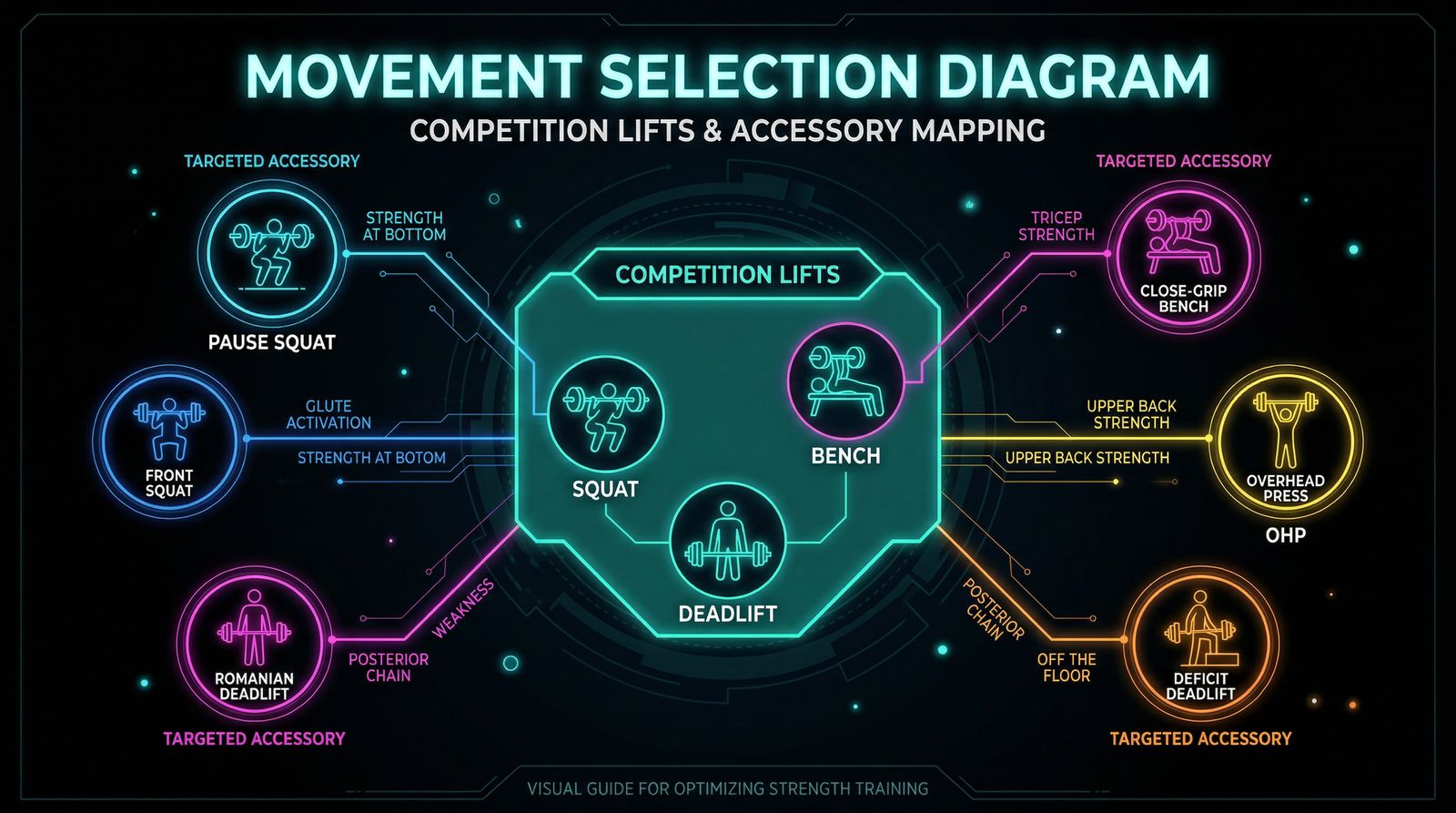
Accessories serve two masters. The first is structural: identifying and eliminating weak points in your Squat, Bench, and Deadlift. A sticking point at the chest in the bench press is a triceps problem. A fold at the bottom of the squat is a posterior chain problem. Accessories fix the leak.
The second master is aesthetic. And there is no shame in acknowledging it. A powerful physique is part of what we are building here. Intelligent accessory selection (lateral raises for shoulder width, bicep work for arm development, direct quad work for leg mass) does not compromise a powerlifting programme when programmed correctly. It completes it.
The rule is not "does this fix my main lift?" The rule is: "does this fix my main lift, OR does this build the physical armour that makes me both stronger and more impressive?" If the answer to either question is yes, it belongs.
Don't train for general fitness within a strength programme. Powerlifting and fitness are related but not identical. General fitness conditioning (circuits, metabolic work, high-rep multi-joint exercises at sub-maximal intensity) competes with recovery resources without driving the specific adaptations that improve a total. Build fitness through the powerlifts and their specific accessories. General fitness is a consequence of that training, not an additional goal.
Exercise Variation: Why the Same Is Never Quite the Same
The nervous system accommodates to repeated identical stimuli. After weeks of the same exercise at the same loads and the same rep ranges, the body learns to produce the required output with less physiological disruption. Adaptation slows. The training stimulus, once a significant challenge, becomes familiar. Familiar is not a training stimulus.
Exercise variation solves this without abandoning specificity. Variation doesn't require a fundamentally different exercise. It requires a variation of the same exercise that presents a meaningfully different demand.
Paused squats target the same muscles as competition squats. The stance, the bar position, the depth are identical. But the pause at the bottom eliminates the stretch reflex: the elastic energy stored in the tendons and fascial tissue that assists the ascent in a normal squat. The muscle must produce force from a dead stop. This is a different neural demand. The same muscles face a different challenge, so they don't accommodate.
Tempo bench press requires conscious control through the entire range of motion. A 3-second descent eliminates momentum and forces the muscles to produce sustained tension, particularly through the positions where most lifters are weakest. Competition bench typically allows a short descent with a brief pause; tempo work elongates both the loading phase and the positional demands. Different challenge, same specificity.
Close-grip bench, Romanian deadlift, Larsen press, deficit pulls, box squats: these are all variations of competition movements that target specific positions, specific muscular demands, or specific weaknesses while remaining clearly connected to the main lift they serve. They prevent accommodation. They remain specific. They belong in a powerlifting programme in a way that burpees and cable flys do not.
Structuring the Training Week
Two broad approaches dominate powerlifting programme design. Both work. The determining factor is the individual lifter.
Low frequency, high volume per session: Three days per week, with higher volume concentrated into each session. Monday, Wednesday, Friday, or similar. Each session contains more total work: more sets, potentially more exercises. Suitable for lifters who can handle larger training doses but require more recovery time between sessions. Often preferred by lifters with physically demanding jobs, older lifters with longer recovery requirements, or lifters whose sport demands larger individual training doses for psychological engagement.
High frequency, lower volume per session: Four to six days per week, with lower volume per session. Each individual session is shorter and less taxing, but the weekly total volume may be similar or higher. Suitable for lifters who recover quickly, who benefit from additional practice repetitions on the competition movements, and whose life schedule accommodates frequent shorter sessions more easily than fewer longer ones. Skill development is also better served by higher frequency: more repetitions of the movement pattern builds motor learning faster.
Neither is universally superior. The superior approach is the one that allows consistent progression without exceeding your individual recovery capacity. A three-day programme you can follow consistently for twelve weeks outperforms a six-day programme you abandon in week four. Consistency is the meta-variable. Build frequency around it.
Deload Strategy: Planned Rest Is Not Weakness
A deload is not "take it easy this week." It's a specific, planned reduction in training stress that allows the nervous system and musculature to clear accumulated fatigue while retaining the training adaptations that have been built.
During a deload, fatigue dissipates. Fitness, built over weeks of progressive work, does not disappear in a single week of reduced training. The lifter emerges from a deload with the same fitness but significantly less fatigue, and therefore higher expressed strength. The deload uncovers the adaptation that chronic fatigue had been masking.
Two common approaches serve different fatigue profiles. A volume deload reduces total sets by 40–50% while maintaining or slightly reducing intensity. The nervous system keeps its high-intensity adaptations (the motor patterns and recruitment patterns built through heavy work) while the body clears the muscular fatigue accumulated through high-volume sessions. This suits lifters whose primary fatigue is muscular.
An intensity deload reduces load by 10–20% while maintaining or reducing volume. The body receives significant muscular stimulus without the heavy neural demand of near-maximal weights. This suits lifters whose primary fatigue is central nervous system fatigue, characterised by sluggishness, poor bar speed even on moderate weights, and a general sense of exhaustion disproportionate to the training volume.
Plan deloads rather than reacting to them. Every 4–6 weeks is a common guideline, though individual recovery determines the precise frequency. If you're deloading because you feel wrecked, you're already behind. Plan the deload before you need it, and the training block leading up to it will be more productive because you're not managing fatigue in real time.

Autoregulation: Adjusting for Reality
Running a programme means following the numbers exactly. Session one calls for 5 sets of 5 at 120kg. You do 5 sets of 5 at 120kg. No more, no less. This works brilliantly when the programme numbers match your actual recovery: when you slept well, ate enough, and aren't carrying any life stress that affects your readiness.
But readiness fluctuates. Sleep varies. Work stress accumulates. Illness arrives. A session that calls for 120kg at RPE 7 might produce RPE 9 on a low-readiness day. Forcing the 120kg anyway isn't dedication, it's fatigue accumulated beyond what the programme planned.
Autoregulation replaces fixed loads with effort-based targets. Rather than "120kg for 5 sets of 5," the session calls for "5 sets of 5 at RPE 7." You select the load that produces RPE 7 on that specific day. On a high-readiness day, that might be 125kg: a bonus. On a low-readiness day, it might be 115kg: a reduction that prevents unnecessary fatigue accumulation. The session's stimulus matches your actual capacity. Adaptation is optimised relative to reality.
Beginners benefit from running fixed numbers. The decision fatigue of estimating RPE when you're still learning to listen to your body adds unnecessary complexity. Follow the numbers, learn the movements, let the recovery sort itself out. Intermediate and advanced lifters (who have the training history to accurately gauge their own readiness) benefit significantly from RPE-guided autoregulation. The programme accounts for the day-to-day variation that fixed percentages cannot.
Key Takeaways
- Every programme is built on the SRA cycle: Stimulus, Recovery, Adaptation. Compress the recovery and you lose the adaptation.
- Frequency, volume, and intensity are interdependent: adjusting one requires managing the other two.
- Every exercise must serve the main lifts specifically; "what weakness does this address?" is the only question that matters
- Plan deloads rather than reacting to them. Every 4–6 weeks is a common guideline, and they reveal fitness that fatigue has been masking.
- Autoregulation uses RPE or RIR to match training intensity to daily readiness: essential for intermediate and advanced lifters.
Put It Into Practice
This week: Audit your current programme against these principles. Does every accessory exercise have a clear connection to a specific weakness in one of your three main lifts? If you can't articulate it, consider removing or replacing it. Simplify before you add.
This training block: Write out your next training cycle in full before you begin. Include planned deload weeks. Know exactly which weeks are accumulation, which are intensification, and which are realisation. Walking into a training block with a complete plan changes how you execute each session, especially the hard ones. See also our guide on periodization for the full framework behind these phases.
Long term: Begin tracking RPE or RIR on every working set. The data builds a picture of your readiness patterns: which days you're typically higher or lower, how recovery responds to life stress, how fatigue accumulates across weeks. That information makes every subsequent programme more accurate.
Analysed by FINAL FORM AI. Your form, perfected.
References
- 1Schoenfeld BJ, Ogborn D, Krieger JW. 'Effects of resistance training frequency on measures of muscle hypertrophy: a systematic review and meta-analysis.' Sports Med. 2016. PMID: 27102172
- 2Grgic J, Schoenfeld BJ, Davies TB, et al.. 'Effect of resistance training frequency on gains in muscular strength: a systematic review and meta-analysis.' Sports Med. 2018. PMID: 29470825
- 3Ralston GW, Kilgore L, Wyatt FB, et al.. 'The effect of weekly set volume on strength gain: a meta-analysis.' Sports Med. 2017. PMID: 28755103
- 4Zourdos MC, Klemp A, Dolan C, et al.. 'Novel resistance training-specific rating of perceived exertion scale measuring repetitions in reserve.' J Strength Cond Res. 2016. PMID: 26049792
- 5Helms ER, Cronin J, Storey A, et al.. 'Application of the repetitions in reserve-based rating of perceived exertion scale for resistance training.' Strength Cond J. 2016. PMID: 27531969
- 6Kraemer WJ, Ratamess NA. 'Fundamentals of resistance training: progression and exercise prescription.' Med Sci Sports Exerc. 2004. PMID: 15064596