Squat Depth: What Counts, and What Each Inch Costs
Hip crease below the knee is the standard. Parallel is a shorthand. Here is what each inch of depth actually changes.
By Dhiren Dunraj MSc
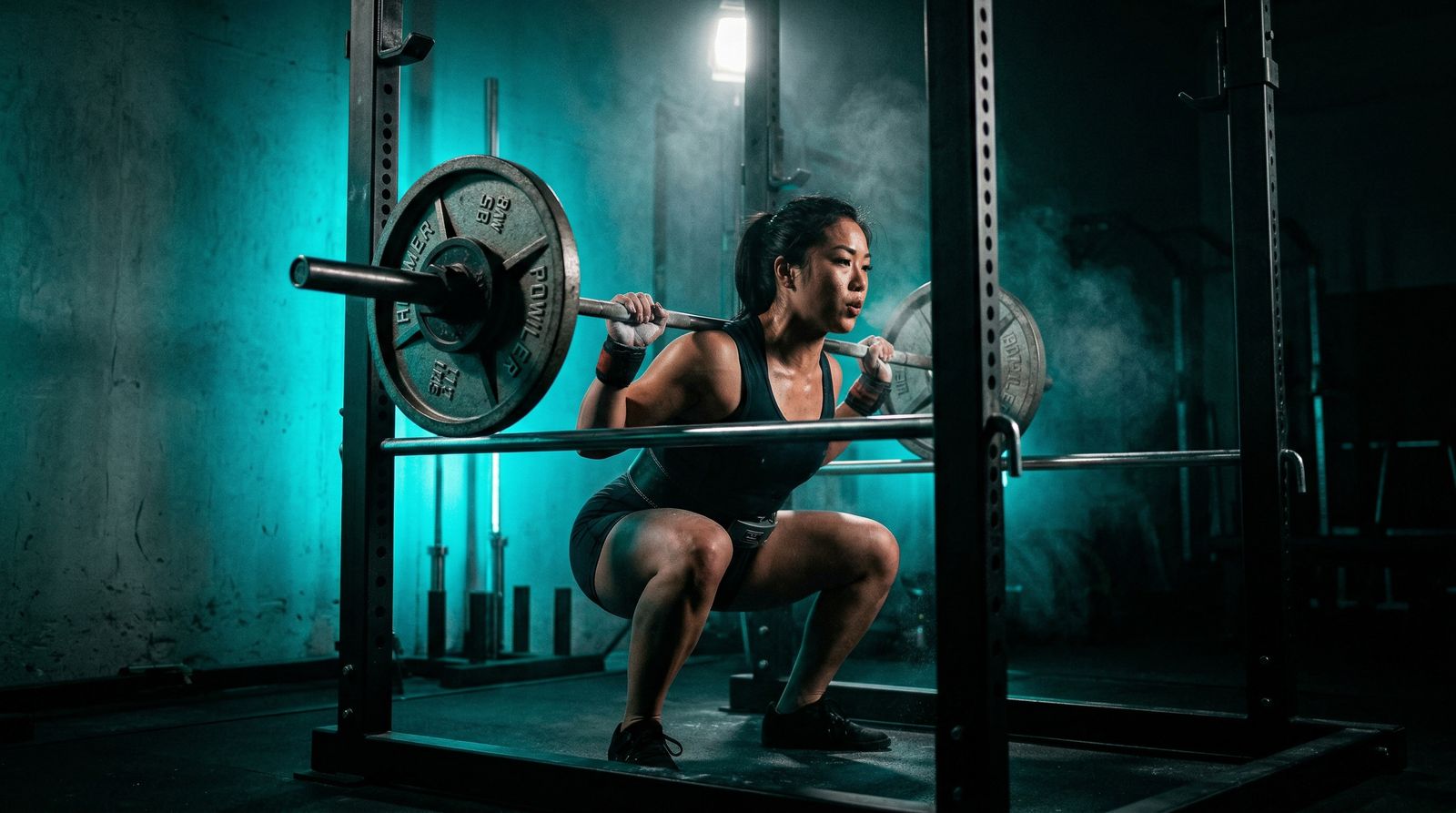
Key Insight
“Depth is not a vibe. It is a landmark. The inch you skip is the inch you never trained.”
Ask ten lifters what "to depth" means and you will get ten answers, most of them honest and most of them wrong. Some stop when the thighs look flat. Some chase the floor. Some call it deep because it felt deep. The camera, from the side, is less generous than any of those stories.
This article is about the standard that actually counts, what each additional inch of descent changes in the squat, and how to train the depth you claim to own. It is not a lecture on toughness. A squat that looks deep from the front and fails the landmark from the side is still a high squat. The cost is mechanical, not moral.
What Counts
In competition lifting, legal depth is a landmark, not a feeling. The hip crease must pass below the top of the knee. That is the line. Parallel — the thigh roughly level with the floor — is a gym shorthand that often sits above that line, depending on femur length, stance, and how the lifter's hip sits on the pelvis. Ass-to-grass is deeper still: useful for some anatomies and some goals, not a second legal standard.
The crease-below-knee rule exists because it is visible to a judge from the side and because it is repeatable. "Looks parallel" is not. A long-femured lifter can look well below parallel while the crease is still sitting on the knee. A short-femured lifter can hit the crease with a thigh that never looks dramatic. If you train to a look instead of a landmark, you are training a different lift than the one you will be asked to show.
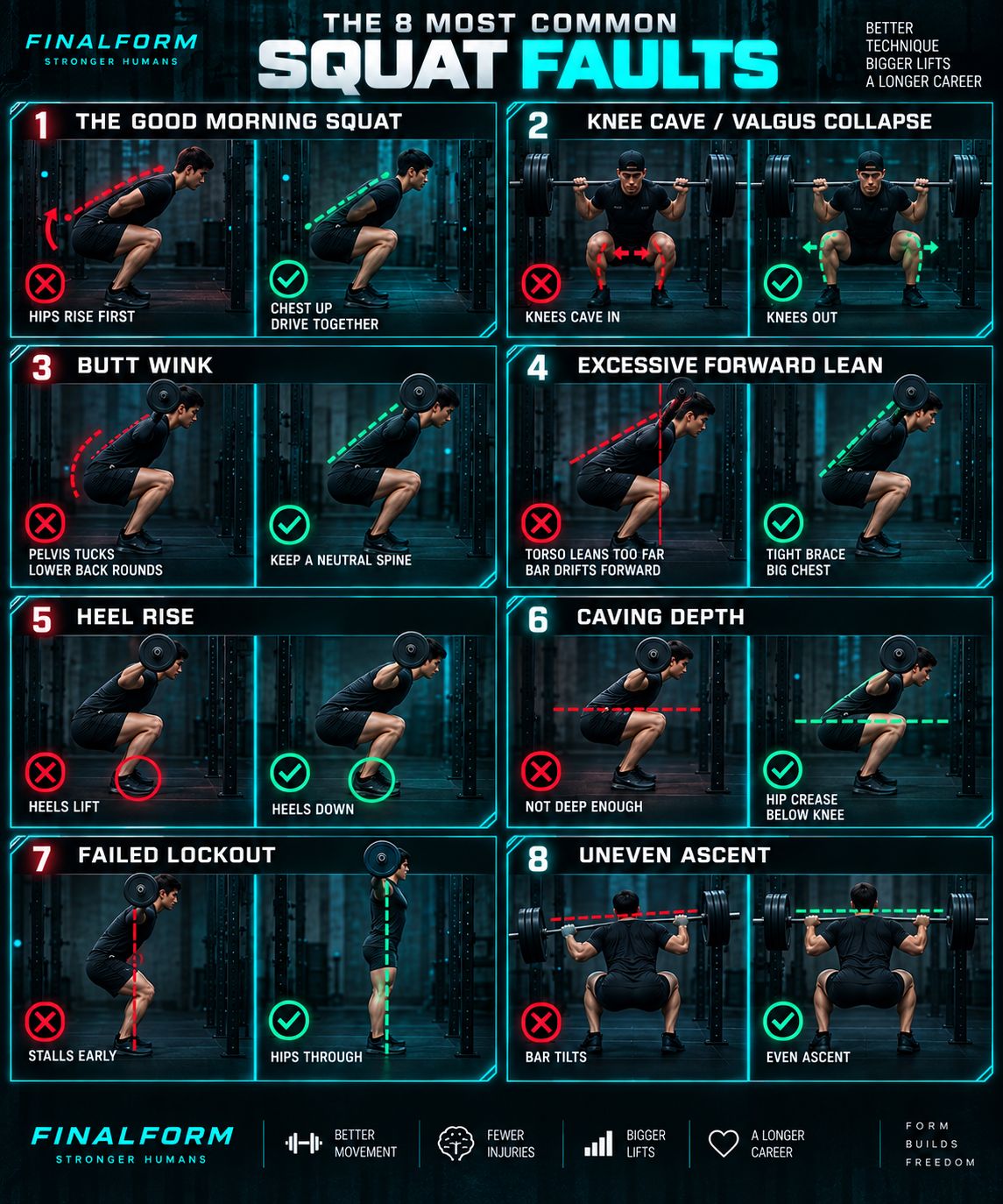
Film from the side, hip height, one body-width away. Pause the frame at the lowest point. Find the crease of the hip — the fold where the torso meets the thigh — and the top of the patella. If the crease is not clearly below that line, the rep is high. That is the whole diagnostic. Common squat faults covers the usual reasons a lifter stops short. This article is about what the missing inches were doing.
Parallel Is a Shorthand, Not a Standard
"Hit parallel" survives because it is easy to say and easy to fake. From the front, a high squat can look finished. From a three-quarter angle, the thigh can look level while the hip is still sitting high. The side-on crease check removes the argument.
Powerlifting squat technique — wider stance, more hip sit-back, often a lower bar — changes how parallel looks without changing the landmark. Swinton and colleagues compared a traditional squat, a powerlifting squat, and a box squat and found different joint demands and bar paths for the same general pattern. The takeaway for depth is simple: style changes the picture. It does not move the crease.
High-bar and low-bar setups change torso angle and the hip-versus-knee share of the work. Glassbrook's review of those two back-squat styles is the map for that trade. A more inclined torso can make a legal bottom look shallower than it is. A more upright torso can make a high squat look deeper than it is. Judge the crease, not the chest angle.
If you only ever check depth in the mirror, you are checking the wrong plane. The mirror is a front view. Depth is a side-view question. A training partner standing in front of the rack is standing in the same wrong plane. Put them to the side, or put the phone there, and argue with a still frame instead of a shrug.
What Each Inch Costs
Every extra inch of descent changes the joint geometry. The knees travel further forward or the hips sit further back — usually some of both — so that the bar can stay over the mid-foot. The muscles that produce those joint actions take a larger share of the work. The muscles that were already doing most of the work above parallel keep working, but they are no longer the whole story.
Escamilla's review of squat knee biomechanics is the baseline: knee flexion, tibial shear, and compressive demand all change as the knee angle closes. Cotter later measured knee-joint kinetics across commonly prescribed loads and depths, which is the more useful framing for a lifter. Load and depth are not separate sliders. A heavier quarter-squat and a lighter full squat are different problems. They are not "the same squat, less deep."
Fry, Smith, and Schilling showed how knee position itself — how far the knee is allowed to travel — changes hip and knee torques in the barbell squat. Restrict the knee to "protect" it and you dump demand onto the hip and the back. Chase the knee forward without a mid-foot bar and you dump demand onto the knee. Depth without a mid-foot bar is just a different error. The inch is not free, and it is not spent in one joint.
Hartmann, Wirth, and Klusemann analysed how load on the knee and the vertebral column changes with squatting depth and with weight. The paper is a load map, not a verdict. Deeper positions change the moment arms. Heavier loads change the absolute numbers. Training a depth you have not prepared is a loading decision, the same way jumping 20 kilograms is a loading decision. The article does not need a scare story on top of that.
Muscle: The Inches You Skip Are the Inches You Don't Build
Schoenfeld's review of squatting kinematics and kinetics is the practical summary: depth changes which tissues are loaded through a meaningful range. A squat that stops high is still a squat. It is a squat of a shorter muscle length for the hips and a shorter knee-flexion range for the quads.
Kubo, Ikebukuro, and Yata trained lifters at different squat depths and measured lower-limb muscle volumes. Deep squat training produced greater hypertrophy in the adductors and gluteus maximus than a shallower pattern. The quads grew in both. That is the inch you can see in a pair of shorts: the hip musculature that only gets a full-length stimulus when the crease actually drops.
This is why "I squat heavy, I just don't go that low" is a different programme than it sounds. You are getting very strong in the range you train. You are not automatically getting the same hip development, and you are not automatically getting the same strength at the bottom. Specificity is not a slogan. It is the reason a high-squat max does not turn into a legal max on command.
If your goal is a competition squat, train the competition landmark until it is boring. If your goal is muscle, the deep position is doing work the high position is not. If your goal is both, the legal bottom is the minimum, not a specialisation.
Strength: You Own the Depth You Rehearse
A one-rep max is a skill at a specific joint configuration. Cut the last three inches in training and you have never rehearsed the hardest part of the legal squat: the reversal at long muscle lengths, with the hips and knees both flexed, with the brace having to hold while the picture looks worst.
Lifters who only ever grind from a high hole often look explosive above parallel and slow, or stalled, when they are finally asked to go to the crease. That is not a mystery of courage. The stretch-shortening contribution, the groove, and the specific strength are all built in the range you actually visit. Visit it with lighter weight until the shape is automatic. Then bring the load up.
Box squats are a tool here, not a personality. Set the box so the crease is just below the knee, not so you can sit and relax three inches high and call it depth work. Sit, pause, stand. The box removes the guess. It does not forgive a high box.
Paused free squats do the same job without the box: two seconds at the legal bottom, no bounce, same brace you had at the unrack. If the pause turns the lift into a good morning, the depth is not the only thing you skipped. Squat technique essentials is the blueprint for the rest of the shape. Depth without a brace is just a deep collapse.
Anatomy Writes a Ceiling. It Does Not Move the Landmark.
Squat biomechanics is the article for sockets, femur length, and why two legal squats can look unrelated. The short version for depth: some lifters reach the crease with almost no pelvic change. Some need a stance and toe angle that finds the crease. A few have bony geometry that makes the last centimetre expensive — the pelvis starts to tuck because the femur has run out of socket, not because the lifter is lazy.
That last case is a stance problem first. Widen, narrow, flare, and film. The crease is still the target. The job is to find the stance that gets you there with the least compensatory tuck, not to invent a private definition of depth so the tuck never happens. A small posterior tilt in the last degrees is not the same picture as a lumbar collapse under a heavy bar. The faults article already draws that line. Do not treat every wink as a character issue, and do not treat every wink as a free pass to stay high.
Raised heels change the ankle demand and can make the legal bottom available to a lifter who was previously losing the heels or dumping the bar forward. That is equipment matching anatomy. It is not a cheat. It is also not a requirement. The landmark does not care whether the shoe has a heel.
How to Pay the Inches on Purpose
Depth work is programmed like any other quality. You do not "start going deep" at 90 percent. You own the position at a weight that lets you keep the bar over the mid-foot, the knees on their track, and the brace locked, then you add load.
A useful week looks like this. One session is your main squat: legal depth, filmed, working sets that you could still have done one more clean rep on. The other session, or the back-off, is the depth session: paused legal squats or a correctly set box, 60–70 percent, clean reversals. If a set is high, it does not count as a depth set. It counts as a reminder.
Do not chase ATG under a load you cannot steer. Extra depth past the crease is a range-of-motion choice, useful when the hips allow it and the bar stays over the mid-foot. It is not more legal. It is not automatically more productive. Past the landmark, you are buying muscle length and skill, and you are paying in fatigue and in the demand Hartmann and Cotter were measuring. Buy it when you can still squat the next session.
The lifters who look like they "just go deep" have made the bottom ordinary. That is the whole trick. Ordinary, filmed, repeated.
Key Takeaways
- Competition depth is a landmark: hip crease below the top of the knee. Parallel is a gym shorthand that often sits above that line.
- Film from the side. Front-view "looks deep" is not a standard.
- Each extra inch of descent changes knee and hip demand. Load and depth interact; a heavy high squat is not the same stimulus as a lighter legal squat.
- Deep squat training has been shown to grow the adductors and glutes more than a shallower pattern, while the quads still grow.
- You get strong at the depth you rehearse. A high-squat max does not automatically become a legal max.
- Anatomy can change how you get to the crease. It does not rewrite the crease.
- Train the legal bottom with weight you can steer, then add load. Extra depth past the landmark is a choice, not a second rule.
Put It Into Practice
This week: Film one working set from the side. Pause the lowest frame. Mark the crease against the top of the knee. If it is high, drop the load until the next session's working sets are clearly legal.
This training block: Add one paused or correctly boxed squat session per week at 60–70 percent, legal bottom, two-second pause, no bounce. Keep the main session at legal depth as well. High reps do not count.
Long term: Treat the crease as ordinary. When the bottom is no longer a special event, the load can come up without the landmark disappearing.
Analysed by FINAL FORM AI. Your form, perfected.
References
- 1Escamilla RF. 'Knee biomechanics of the dynamic squat exercise.' Med Sci Sports Exerc. 2001. PMID: 11194098
- 2Schoenfeld BJ. 'Squatting kinematics and kinetics and their application to exercise performance.' J Strength Cond Res. 2010. PMID: 20182386
- 3Kubo K, Ikebukuro T, Yata H. 'Effects of squat training with different depths on lower limb muscle volumes.' Eur J Appl Physiol. 2019. PMID: 31230110
- 4Swinton PA, Lloyd R, Keogh JWL, et al.. 'A biomechanical comparison of the traditional squat, powerlifting squat, and box squat.' J Strength Cond Res. 2012. PMID: 22505136
- 5Hartmann H, Wirth K, Klusemann M. 'Analysis of the load on the knee joint and vertebral column with changes in squatting depth and weight load.' Sports Med. 2013. PMID: 23821469
- 6Cotter JA, Chaudhari AM, Jamison ST, et al.. 'Knee joint kinetics in relation to commonly prescribed squat loads and depths.' J Strength Cond Res. 2013. PMID: 23085977
- 7Fry AC, Smith JC, Schilling BK. 'Effect of knee position on hip and knee torques during the barbell squat.' J Strength Cond Res. 2003. PMID: 14636100
- 8Glassbrook DJ, Helms ER, Brown SR, et al.. 'A review of the biomechanical differences between the high-bar and low-bar back-squat.' J Strength Cond Res. 2017. PMID: 28570490