Squat Biomechanics: Why Your Body Dictates Your Technique
Your hip anatomy, femur length, and torso proportions have already decided your technique.
By Dhiren Dunraj MSc
Key Insight
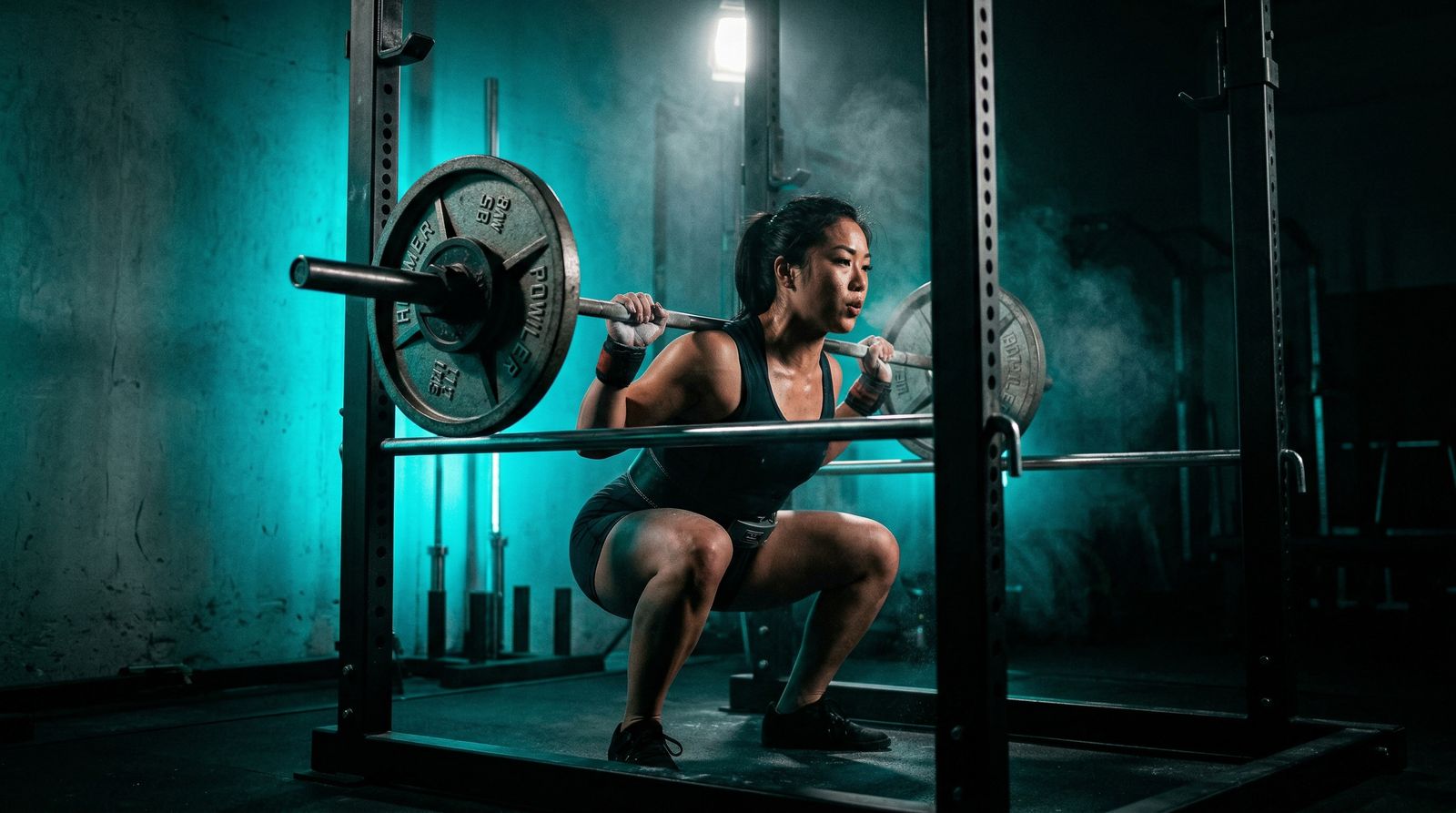
“Two lifters. Two different skeletons. Two technically perfect squats that look nothing alike. That's anatomy, not contradiction.”
Picture two strong lifters at the same gym. Both squatting well over 200 kilograms. Both technically perfect: every rep to depth, every ascent controlled, every brace locked. Now look at them side by side. One squats wide, toes flared dramatically, torso nearly horizontal. The other squats moderate width, more upright, knees tracking forward over the toes. From a coaching textbook written for a generic lifter, one of them looks wrong. From the perspective of biomechanics, from the perspective of how bodies actually work, both of them are exactly right.
The technique that's mechanically correct is the one that works with your anatomy, not against it. Every coaching instruction you have ever received (stance width, toe angle, forward lean, depth) is a default that exists because it works for an average anatomy that does not exist in any actual human being. What exists are real bodies, with real skeletons, with real variation. The job of serious technique work is to find the version of the squat that is mechanically optimal for the body doing it.
That starts with understanding what your body is.
The Hip Socket: The Foundation of Everything
The squat begins at the hip socket, where your femur meets your pelvis, not at the knees, the ankles, or the bar position.
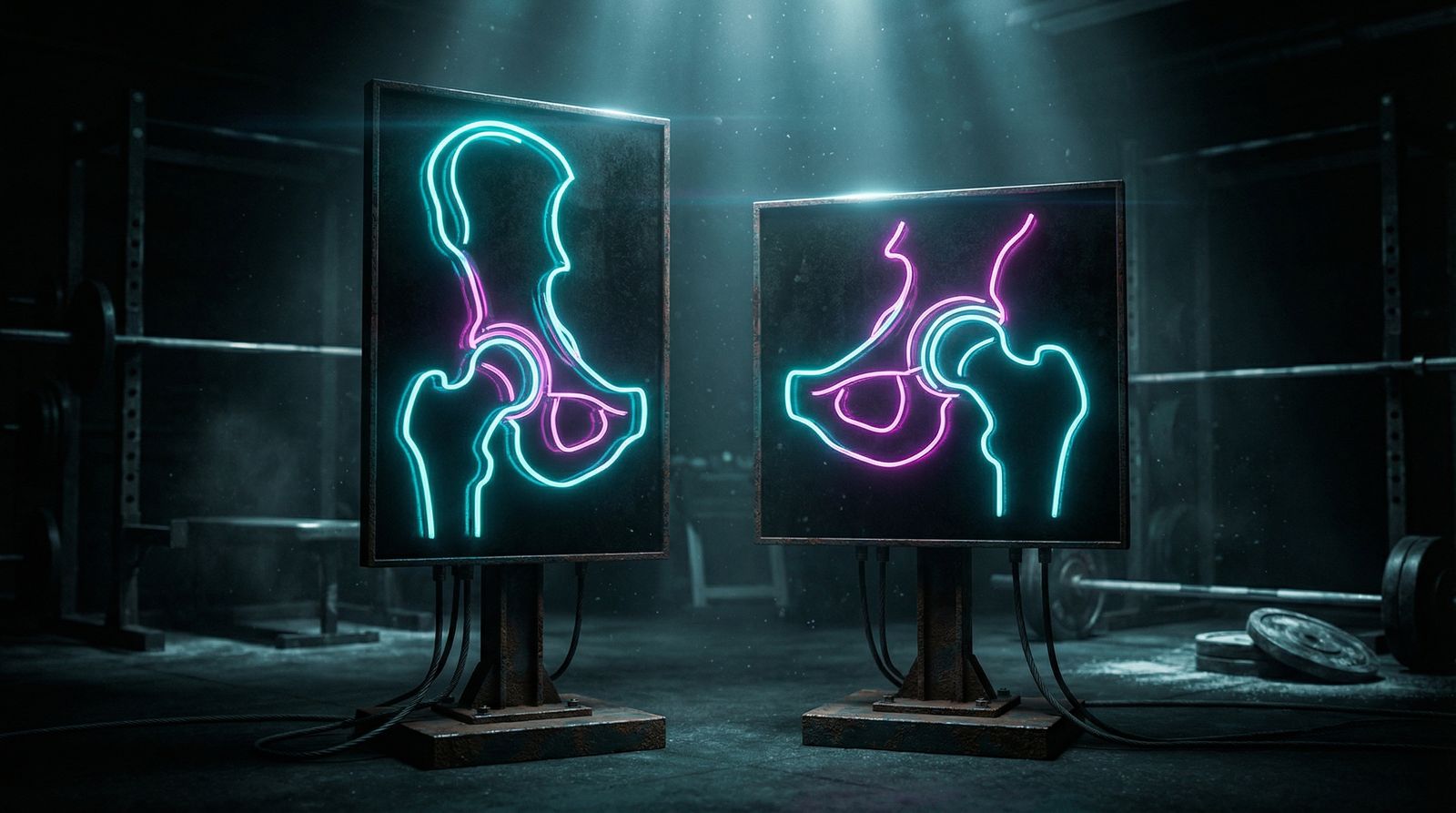
The hip is a ball-and-socket joint. The femoral head (the ball) sits inside the acetabulum (the socket). What varies enormously between human beings is where that socket is positioned on the pelvis, how deep the socket is, and how much of the femoral head the socket covers. The angle at which the femoral neck attaches to the femoral shaft adds another layer of individual variation entirely.
Two terms matter most here: anteversion and retroversion.
Anteverted hips: the femoral neck angles forward relative to the knee. From above, picture the femur as a clock hand pointing toward two o'clock rather than twelve. Anteverted lifters often feel most comfortable squatting with their toes flared significantly outward, sometimes 45 degrees or more, because flaring the toes out aligns the femur with the socket's natural opening direction. A wide, toes-out stance allows the femoral head to rotate comfortably within the acetabulum as depth increases.
Retroverted hips: the femoral neck angles backward relative to the knee. These lifters often squat best with more moderate toe-out angles and narrower stances. Too much flare in a retroverted hip produces hip impingement, where the femoral neck pinches against the acetabular rim before depth is reached.
Neither anteverted nor retroverted is better for squatting. They're different. The anteverted lifter squatting with toes forward is squatting in pain for no reason, not showing discipline. The retroverted lifter squatting dramatically wide is grinding through impingement, not exploring range. Work with the architecture, not against it.
Acetabular Coverage and Bony Depth Limits
Beyond the femoral neck orientation, the depth and direction of the acetabulum itself matters. Some lifters have deep sockets with high acetabular coverage, where the socket wraps significantly around the femoral head. Others have shallower sockets. The depth of the socket, combined with its orientation, determines how far and in which directions the femur can move before bony contact occurs.
Here is what bony contact means in practice: you descend, your hip feels blocked, and you cannot go further without your pelvis tilting under (posterior pelvic tilt, the butt wink). You stretch. You foam roll. You mobilise your hips for months. Nothing meaningfully changes, because this is a geometry problem, not a flexibility problem. The femoral head is making contact with the acetabular rim. There is no amount of stretching that moves bone.
The fix for bony impingement is stance, not stretching. A wider or narrower stance, or a different toe angle, changes the angle at which the femur enters the socket. That change determines whether bony contact occurs before or after you reach depth. This is why the wall squat and goblet squat stance-finding process described in squat technique is diagnostic work, not merely a warm-up exercise. The stance where you reach depth without posterior pelvic tilt is the stance where bony clearance exists.
For some lifters, no stance allows them to squat to full depth without some degree of posterior pelvic tilt. They can still squat. They have high acetabular coverage or socket depth that limits range of motion mechanically. The practical solution is finding the stance that minimises the tilt while still achieving legal depth. A small degree of pelvic tuck under load is a different problem than severe wink with significant lumbar flexion.
Femur Length: The Forward Lean Equation
Take two lifters. Same height. One has long femurs and a shorter torso. The other has short femurs and a longer torso. Put them both under a bar at the same stance width and tell them to squat to depth. The long-femured lifter will lean forward dramatically. The short-femured lifter will stay nearly upright.
Neither of them is doing anything wrong. They're doing what physics demands.
The barbell must remain over your mid-foot throughout the squat. That's the centre of gravity rule, and it's non-negotiable. Your body must arrange itself around that constraint. When you squat, you create a system of levers: your femur, your torso, your shin. As your femur rotates in the hip socket during the descent, your torso must lean to keep the bar over the mid-foot. The longer the femur, the more the torso must lean forward to maintain that balance.
A lifter with femurs that are long relative to their torso cannot squat upright. Telling them to "stay more upright" does not change their femur length. It moves the bar forward of their mid-foot, loads the lower back, reduces the weight they can safely move, and fights physics on every single rep. The correct coaching instruction for that lifter is "let your torso lean to where the bar stays over your mid-foot" and "own that position rather than fighting it," not "stay upright."
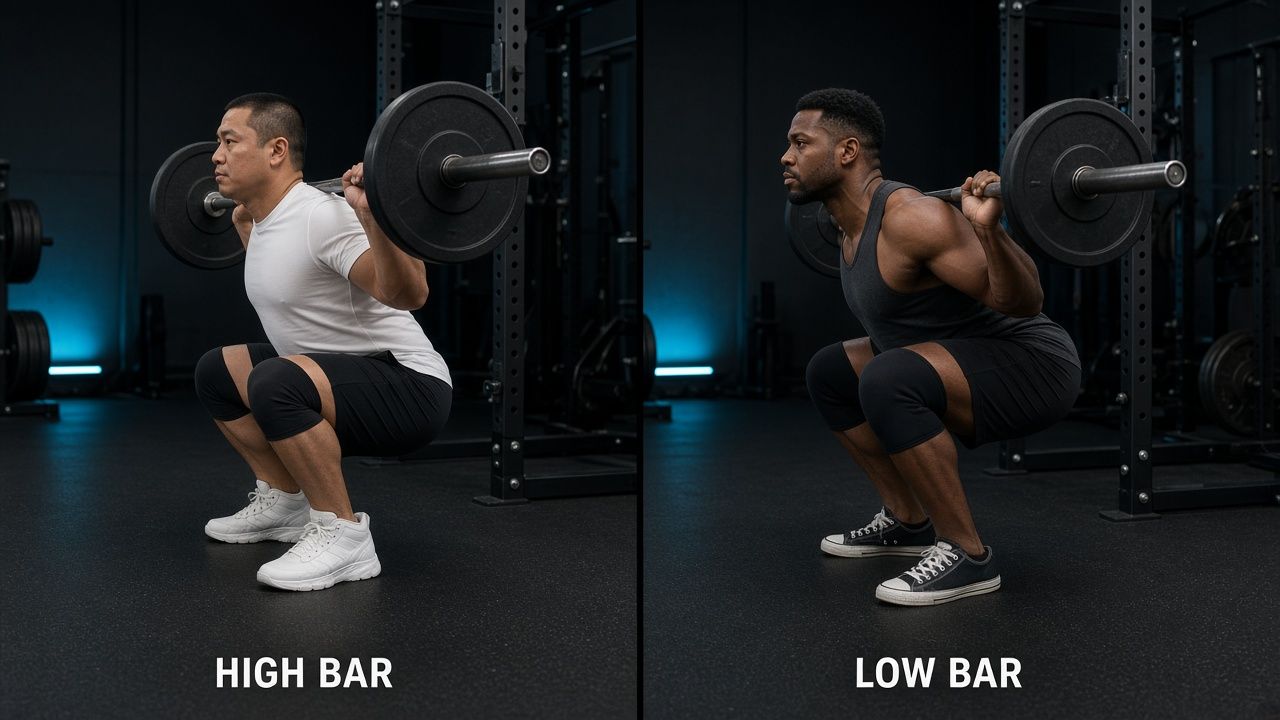
This is also why low bar squatting is mechanically advantageous for long-femured lifters. If forward lean is anatomically necessary, low bar position works with that lean, shifting load to the posterior chain rather than demanding more quad contribution at a mechanically disadvantaged torso angle.
Tibia Angle and Ankle Demand
Your shin angle in the bottom position of a squat is set by the relationship between your femur length, tibia length, and foot position. Shorter tibias relative to femurs mean the shin angles forward more aggressively in the bottom position. That forward shin angle demands more ankle dorsiflexion, where the ankle must flex further to allow the knee to track forward.
Ankle mobility is genuinely trainable. Dorsiflexion range of motion responds to consistent, targeted mobilisation work. But the underlying demand, how much dorsiflexion you need, is set by your tibial length and stance geometry. A lifter with short tibias and a forward knee travel will need more ankle mobility than a lifter with long tibias. Working on ankle mobility is valuable. Understanding that the target is anatomy-specific is equally valuable.
Raised heels, whether from a heeled lifting shoe or a heel wedge, solve the dorsiflexion problem from the other direction. By elevating the heel, you reduce the ankle dorsiflexion demand, allowing the shin to travel forward and the knee to track over the toes without requiring the same ankle range of motion. This is legitimate equipment use. Your specific anatomy and your goal determine whether to train ankle mobility, use heeled shoes, or both.
Torso Length: The Underrated Structural Advantage
A long torso is an underrated advantage in the squat.
The longer your torso relative to your femurs, the less forward lean you need to keep the bar over your mid-foot. A lifter with short femurs and a long torso can squat nearly upright even at full depth. Their position in the squat is exceptional. They're not fighting their body to maintain position at all.
This is why, in powerlifting, the body proportions that tend to produce the biggest squats often include shorter, stockier builds with shorter femurs. Not universally, since elite lifters of all proportions compete at the highest level, but the anthropometric advantage in the squat belongs to short femurs and long torsos.
If you're a long-femured lifter with a shorter torso, you're working with a different tool, not a disadvantage that technique can eliminate. The technique for your body is not the same as the technique for the short-femured lifter. Your forward lean, your wider stance, and your bar position (almost certainly low bar) are not faults or compromises. They're the architecture of your squat. Own it.
Moment Arms: The Wrench Analogy
Every joint in the body is a pivot point. The muscles crossing that joint create force. The distance between the joint (the pivot) and the line of action of the force (the barbell, gravity) determines how much muscular effort is required to move it. This distance is the moment arm.
Think of a wrench on a bolt. If you apply force close to the bolt (a short wrench), you need enormous muscular effort to generate sufficient torque. If you apply force far from the bolt (a long wrench), the same muscular effort generates far more torque, and the bolt turns more easily.
In the squat, your hip, knee, and ankle are all pivots. The barbell's gravitational line is the force. The horizontal distance from each joint to that gravitational line is the moment arm at that joint. Longer moment arm equals more muscular demand at that joint [1].
Anatomy determines where the long levers are in your squat. A long-femured lifter has a long moment arm at the hip. Their glutes and hamstrings work harder on every single rep. A lifter with long tibias and a forward shin angle has a long moment arm at the knee. Their quads are under significant demand. Understanding your moment arms helps you understand which muscles are working hardest in your squat, which directly informs your accessory work and your training emphasis.
Elite Squat Techniques: What the Best in the World Actually Do
Quad-Dominant vs Hip-Dominant: What You Are and What It Means
After training the squat for long enough, every lifter develops an awareness of where they feel the effort. Some lifters feel their squats primarily in the front of the thigh (the quads). Others feel them primarily in the glutes and hamstrings. That sensation reflects the moment arm geometry of their specific anatomy and stance.
A more upright torso, narrower stance, and more forward knee travel produces a quad-dominant squat pattern. The knee moment arm is long, the hip moment arm is shorter, and the quads carry more of the load. High bar squat, Olympic squat.
A more inclined torso, wider stance, and less forward knee travel produces a hip-dominant squat pattern. The hip moment arm is long, the knee moment arm is shorter, and the posterior chain carries more of the load. Low bar squat, powerlifting squat.
Knowing which pattern you naturally exhibit helps you train intelligently. Quad-dominant squatters often benefit from increased posterior chain accessory work (Romanian deadlifts, good mornings, hip thrusts) because their anatomy puts them at a relative disadvantage at the hip in heavier lifts. Hip-dominant squatters often benefit from targeted quad work (leg press, hack squats, front squats) to support the knee extension demand at depth and on the ascent.
Neither pattern is a flaw. It's information. Use it.
The Central Argument: Stop Squatting Someone Else's Squat
Chasing someone else's squat because it looks right is the most common technical error in the sport, ahead of valgus collapse, butt wink, and the good morning ascent. The error that underlies all three, for most intermediate lifters, is trying to replicate a technique built for a skeleton that's not theirs.
When you watch an elite lifter and think "I should squat like that," you're looking at the output of years of anatomical self-discovery. That technique has been refined to be optimal for their specific femur-to-tibia ratio, their hip socket orientation, their acetabular depth, their torso length. Every element of their technique is correct. For them.
Your technique (your stance, your lean, your bar position, your depth) must be optimal for you: mechanically correct for your body, not aesthetically pleasing by some external standard.
Film yourself. Analyse the data. Find the stance where your knees track naturally, your depth is achievable without posterior pelvic tilt, and your bar stays over your mid-foot. That technique, the one that emerges from working with your architecture, is your correct technique. Build it, own it, and stop apologising for the fact that it doesn't look like everyone else's.
Common Squat Faults & How to Fix Them
Key Takeaways
- Hip socket orientation (anteverted vs retroverted) determines your optimal toe angle and stance width. Bony impingement before depth is a geometry problem, not a flexibility problem.
- Acetabular coverage sets your depth ceiling at certain stances. The fix is stance adjustment, not more stretching.
- Femur length determines how much forward lean is mechanically required. Fighting it with an "upright squat" cue moves the bar forward of your mid-foot and loads your lower back.
- Moment arms at the hip and knee are set by your anatomy. They determine whether you're naturally quad-dominant or hip-dominant, and what accessory work you actually need.
- The technically correct squat for your body looks the way it does because of your skeleton. The goal is mechanical optimality for your specific architecture, not aesthetic conformity to an external standard.
Put It Into Practice
This week: Film your squat from the front and the side at your current stance. Identify whether your knees track naturally over your toes (front view) and whether the bar stays over your mid-foot throughout the descent (side view). If either is off, experiment with stance width and toe angle before adding any load.
This training block: Run the goblet squat stance-finding protocol for two weeks before your working sets. Start narrow, toes forward, and systematically widen and flare until you find the position of natural, unforced depth. Build your working stance from that position, not from an arbitrary standard.
Long term: Accept that your squat is yours, the product of your anatomy, your training history, and years of self-specific refinement. Measure your progress against your own previous bests, not against the technique of lifters with different bodies. The best version of your squat exists. Your job is to find it.
Analysed by FINAL FORM AI. Your form, perfected.
References
- 1Escamilla RF. 'Knee biomechanics of the dynamic squat exercise.' Med Sci Sports Exerc. 2001. PMID: 11194098
- 2Schoenfeld BJ. 'Squatting kinematics and kinetics and their application to exercise performance.' J Strength Cond Res. 2010. PMID: 20182386
- 3Glassbrook DJ, Helms ER, Brown SR, et al.. 'A review of the biomechanical differences between the high-bar and low-bar back-squat.' J Strength Cond Res. 2017. PMID: 28570490
- 4Glassbrook DJ, Brown SR, Helms ER, et al.. 'The high-bar and low-bar back-squats: a biomechanical analysis.' J Strength Cond Res. 2019. PMID: 28195975
- 5Lamontagne M, Kennedy MJ, Beaulé PE. 'The effect of cam FAI on hip and pelvic motion during maximum squat.' Clin Orthop Relat Res. 2009. PMID: 19034598
- 6Wretenberg P, Feng Y, Arborelius UP. 'High- and low-bar squatting techniques during weight-training.' Med Sci Sports Exerc. 1996. PMID: 8775157
- 7Kubo K, Ikebukuro T, Yata H. 'Effects of squat training with different depths on lower limb muscle volumes.' Eur J Appl Physiol. 2019. PMID: 31230110
- 8Swinton PA, Lloyd R, Keogh JWL, et al.. 'A biomechanical comparison of the traditional squat, powerlifting squat, and box squat.' J Strength Cond Res. 2012. PMID: 22505136