Competition Day: The Complete Playbook
From weigh-in to final lift — everything you need to execute on meet day.
By Dhiren Dunraj MSc

*For competitors. If you test maxes in the gym rather than on a platform, start with Peaking: The Science of the Taper.*
Key Insight
“"The lifter who peaks their programme and shows up unprepared to compete is leaving points on the platform. Competition day is a skill. Train it accordingly."”
The lifter who peaks their programme and shows up unprepared to compete is leaving points on the platform. Competition day is a skill. You can train it, practise it, and execute it with the same precision as your technique.
There are lifters who train beautifully for sixteen weeks and then implode on the day: bad openers, rushed warm-ups, missed commands, food choices that turn the last two hours into a gastric event. And there are lifters who are not the strongest person in the room but who post totals that reflect exactly what they prepared. The difference is preparation of a different kind, not talent.
This is what the prepared lifters are doing, every minute of the day, from the night before to the final attempt.
The Night Before
Sleep strategy. The night before a competition matters far less than the week before it. The adaptation is done. Your muscles don't grow in the twelve hours before weigh-in. Your nervous system doesn't become more efficient while you sleep the Thursday before a Saturday meet. The preparation that determines your performance happened months ago. The body you'll compete with was built in training.
What this means practically: if you sleep poorly the night before a meet, you still have full strength. One night of poor sleep has minimal impact on maximal strength performance. A single disrupted night does not measurably reduce one-rep-max performance in trained athletes. What it does is affect your mood, your perceived effort, and your anxiety about your mood and perceived effort. The performance is intact. The psychology takes the hit.
So the trap to avoid is the spiral. Lying awake at midnight trying to force sleep, becoming more agitated with every hour that passes, arriving at the meet on three hours' sleep and a head full of catastrophising. The attempt to force sleep makes sleep impossible.
Optimise the week before instead. Consistent bedtime for the five nights preceding the competition. Dark room, cool temperature, no alcohol. The night before, wind down. Read something that isn't about powerlifting. Watch something that doesn't make you want to train. Your body knows how to sleep. Get out of its way.
Equipment check. Pack your kit the night before, not the morning of. The morning of a meet, adrenaline is already elevated and rational thought is compromised. You will forget something if you pack in the morning. You will not forget something if you ticked it off a list at 9pm the night before.
The list: singlet (mandatory, check it fits within the current season's requirements). Belt (check it fits and the buckle works, a buckle that jams under load is not a problem you want to discover during warm-up). Shoes, appropriate footwear for each lift. Some lifters wear different shoes for squat and deadlift, keeping heel elevation for the squat and flat soles for the pull. Both pairs go in the bag. Wrist wraps, knee sleeves, chalk (check the venue rules, some meets provide chalk on the platform, others expect you to bring your own). Any supportive gear, knee wraps if you compete in equipped, elbow sleeves if you use them on bench. If you use it in training, it goes in the bag.
One addition: bring spares of the small items. A backup pair of wrist wraps. An extra set of knee sleeves. Equipment failures happen at meets and they happen at the worst possible moment.
Nutrition and hydration. The final evening before competition: eat a normal, familiar meal. This is not the time for a new restaurant, an experimental cuisine, or anything with a reputation for gastric unpredictability. The objective is simple: top up glycogen stores without introducing any digestive risk. Carbohydrate-based: pasta, rice, bread, potatoes. Foods you have eaten hundreds of times. Foods your digestive system has no opinion about.
Hydrate normally, not aggressively. Over-hydrating in the evening before a weigh-in is counterproductive. You're simply loading fluid your body will process overnight, and if you're making weight, that's weight you then need to lose again in the morning.

Weigh-In Morning
The scales clear. You've made weight. The recovery clock starts now.
If you've done a modest cut, up to 2% of bodyweight, the recovery window is short but manageable. The 2-hour weigh-in scenario (common in many competitions) doesn't allow for full restoration, but it allows enough. The sequence matters more than the volume.
Electrolytes first. Drink an electrolyte-rich solution containing sodium, potassium, and magnesium before anything else. Drinking plain water on a depleted electrolyte background results in the fluid passing through rather than being retained. Your body regulates fluid balance relative to plasma osmolarity. Without the electrolytes to draw the water in, you'll be visiting the bathroom repeatedly without rehydrating. Electrolytes first, then fluid stays where you need it.
Then fast-digesting carbohydrates. Fruit, a sports drink, white rice. Something that begins glycogen restoration quickly without requiring significant digestive effort. The digestive process diverts blood flow to the gut, blood you'd rather have in your muscles for the platform.
Then a proper meal, if timing allows. In the 24-hour weigh-in scenario, you have a full day between scales and first attempt. This allows aggressive cuts to be viable: a 4–6% bodyweight water cut is recoverable in 24 hours with a proper protocol, because you have time for a full meal, sustained rehydration, and sleep. The 24-hour window changes the entire calculation of what cuts are responsible.
The 2-hour scenario is different. Two hours is enough time for electrolyte-and-carbohydrate restoration of modest cuts. It's not enough for full plasma volume restoration from large cuts. If your competition runs a 2-hour weigh-in, the maximum viable cut is roughly 1.5–2% of bodyweight. Everything above that is a bet you will lose on the platform.
The Warm-Up Room
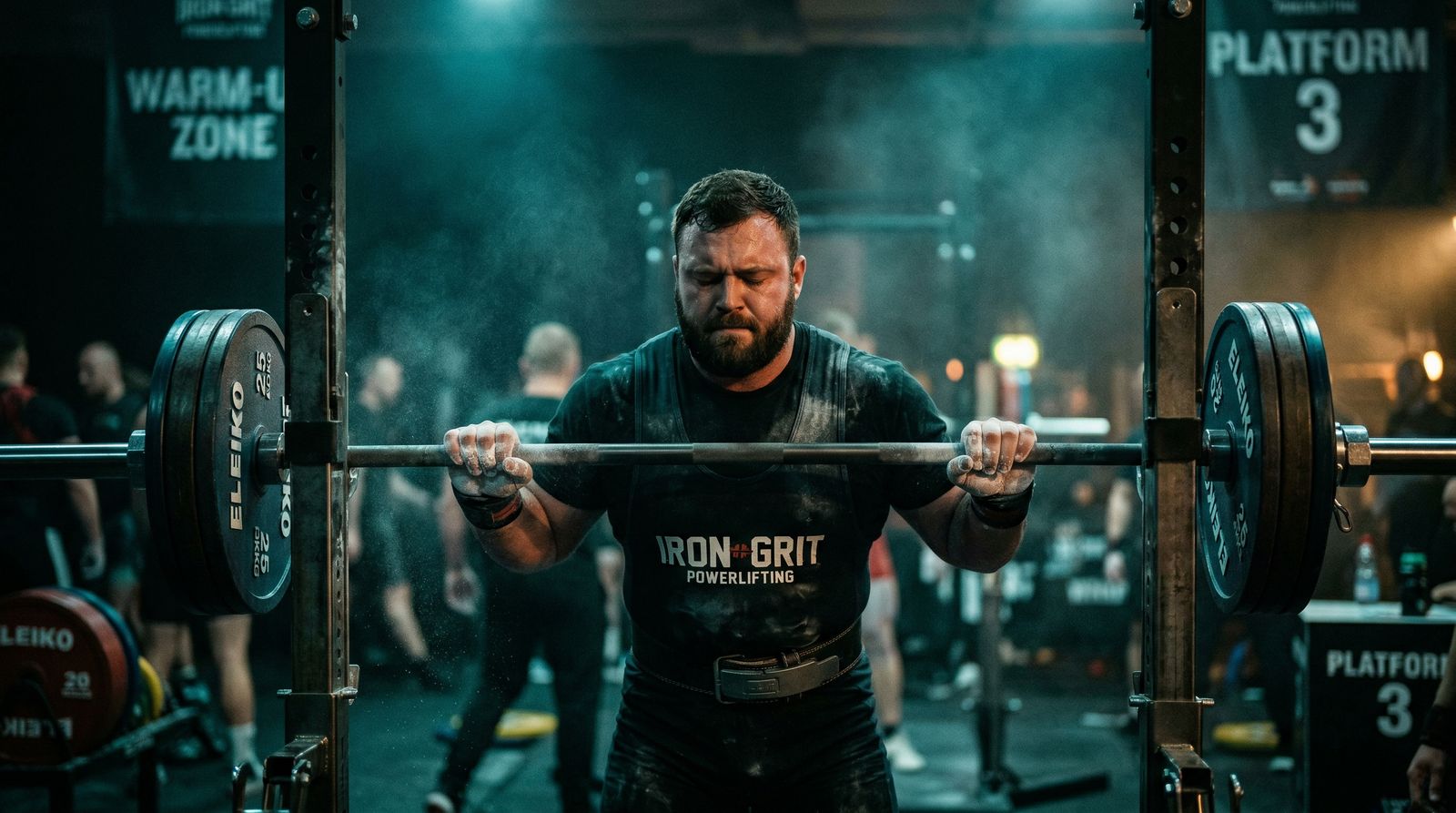
The warm-up room is one of the most psychologically charged environments in the sport. It's loud. It's crowded. There are lifters attempting weights that would terrify you. There are lifters who look like they've been competing since before you were born. There is a specific smell, chalk and sweat and adrenaline, that you will remember for the rest of your lifting life.
None of that is relevant to your warm-up.
When to arrive. Know your flight number before you arrive at the venue. Find out when your flight is expected to start: ask the meet director, check the posted order of events, ask an experienced lifter if you can't find the information. Arrive in the warm-up room 30–45 minutes before your first attempt. Two hours before, you're not warming up. You're performing in a theatre of anxiety and burning energy you need for the platform. Five minutes before is a disaster with weights. Thirty to forty-five minutes gives you enough time to work through your warm-up without rushing, and not so much that you're doing the same lift six times before you touch the competition bar.
The warm-up itself. Your warm-up should mirror your final heavy training sessions, not exceed them. You're not trying to set a gym PR in the warm-up room. You're priming the nervous system, increasing core temperature, and rehearsing the specific movement patterns you'll need in the next sixty minutes.
Work up to approximately 85–90% of your planned opener. That's enough weight to activate the motor patterns required for maximal effort. It's not so much weight that you've created meaningful fatigue before your name is called. The warm-up room is pre-activation for the platform. Treat it accordingly.
A practical structure: empty bar for technique and temperature. 50–60% of opener for three to five reps. 70% for two to three reps. 80% for a single or double. 85–90% for a final single. Stop there. Walk out, recover, listen for your name.
Managing the environment. Experienced lifters in the warm-up room appear, to the untrained eye, to be somewhere else entirely. They're not watching the other lifters. They're not commenting on the weights being done around them. They move from their bag to the bar and back, in their own world, executing their warm-up with the same focused attention they'd give a final training session.
This is competition competence, not antisocial behaviour. The warm-up room is full of stimuli that can compromise your performance if you let them in, other people's attempts, heavy weights that look terrifying, the general chaos of a multi-flight competition. The experienced lifter has learned to filter all of it. Their aperture narrows to their own lift, their own warm-up, their own cues. Nothing else gets in.
Learn this skill. It's trainable. Start by running your warm-up protocol in training as if it were a competition: consistent sequence, focused execution, deliberately ignoring what's happening around you.
The Platform
The commands structure the lift. They also change your timing, which is why you must practise with commands in the final weeks of competition prep. Have a training partner give commands during your heavy sessions. The interval between the "squat" command and the moment you initiate the descent is different from the moment you'd move without a command. The pause before the bench "press" command is longer than you expect the first time you encounter it. These differences affect your brace, your tension, your timing. They should be automatic before you step onto a platform for the first time.
Squat. Walk out, set your stance, brace. Once you're still and the bar is stable, the lift judge will give the command to squat. Descend, complete the lift, return to the rack. Wait for the rack command before lowering to the uprights. The rack command protects both you and the rack, a missed re-rack after a heavy squat is dangerous. Wait for it.
Bench. Lie down, set up your arch and leg drive, unrack or take the handoff. Once you're still with the bar over your chest, not moving, fully controlled, the press command is given. Press to lockout. Hold the lockout position. Wait for the rack command before returning the bar to the uprights.
Deadlift. Approach the bar, set up your position, pull. The down command is given when the bar is at full lockout and the lift judge has confirmed a legal lift. Lower the bar under the down command. Don't drop it. Don't lower it until the command comes.
The commands are the structure that makes the lift legitimate, not obstacles. Respect them, practise with them, and they become part of the rhythm of the lift rather than an interruption to it.
Attempt Selection
Attempt selection is where competitions are won and lost by lifters who have done everything else right. It's a strategic skill that requires honest self-assessment, basic arithmetic, and the willingness to sacrifice ego for performance.
The opener. The weight you would make on your absolute worst possible day. Sick. Sleep-deprived. Stressed. Coming off the worst training week of the block. If there is any doubt at all about the opener, it's not your opener. Lower it.
The opener's function is to get on the board, build confidence, and establish your total. It isn't for impressing anyone or demonstrating how strong you are. It's the foundation on which the second and third attempts are built. A missed opener is psychologically devastating. You've now gone from "building a total" to "needing two for two on the remaining attempts just to total." A missed opener changes the entire emotional architecture of your day. Don't miss openers.
The practical rule: your opener should be a weight you have made in training, easily, in the last three weeks. Not a weight you've hit once at the end of a peaking block. A weight you've made when tired, when the session wasn't going well, when conditions weren't optimal. If it passes that test, it's an opener.
Second attempt. A confident, strong lift. This should feel like a heavy but comfortable training day, challenging but well within your capacity on a normal day. Typically 96–100% of your current best. This is where you demonstrate what the training block built.
Third attempt. Controlled aggression. The maths of your total should guide this decision more than anything else. What do you need to beat a competitor? What does the total need to be for a qualifying standard? What's the PR? Calculate backwards from those numbers, not forwards from "I want to try this weight." If you have a specific strategic objective, the third attempt is determined by arithmetic before it's determined by how your second felt.
If your second felt smooth and you have capacity, push the third. If your second was a grind, be honest. A successful second attempt PR is a better outcome than a missed third attempt that ruins the day.
Handling the bomb-out. Missing all three attempts on a single lift means a zero total. No total at all, a bomb-out. This happens even to elite lifters. It happens to people who have been competing for decades, people who should know better. The preparation is the only insurance: opening conservatively is the primary protection, and it's nearly always sufficient protection.
If it happens to you: stay composed. Don't let the emotion of the moment leak into the remaining lifts. A bomb on squat with a strong bench and deadlift still produces data about your competition capacity. A bomb on squat followed by an emotional tailspin that tanks your remaining lifts produces nothing useful. One lift at a time.
Nutrition and Hydration Through the Day
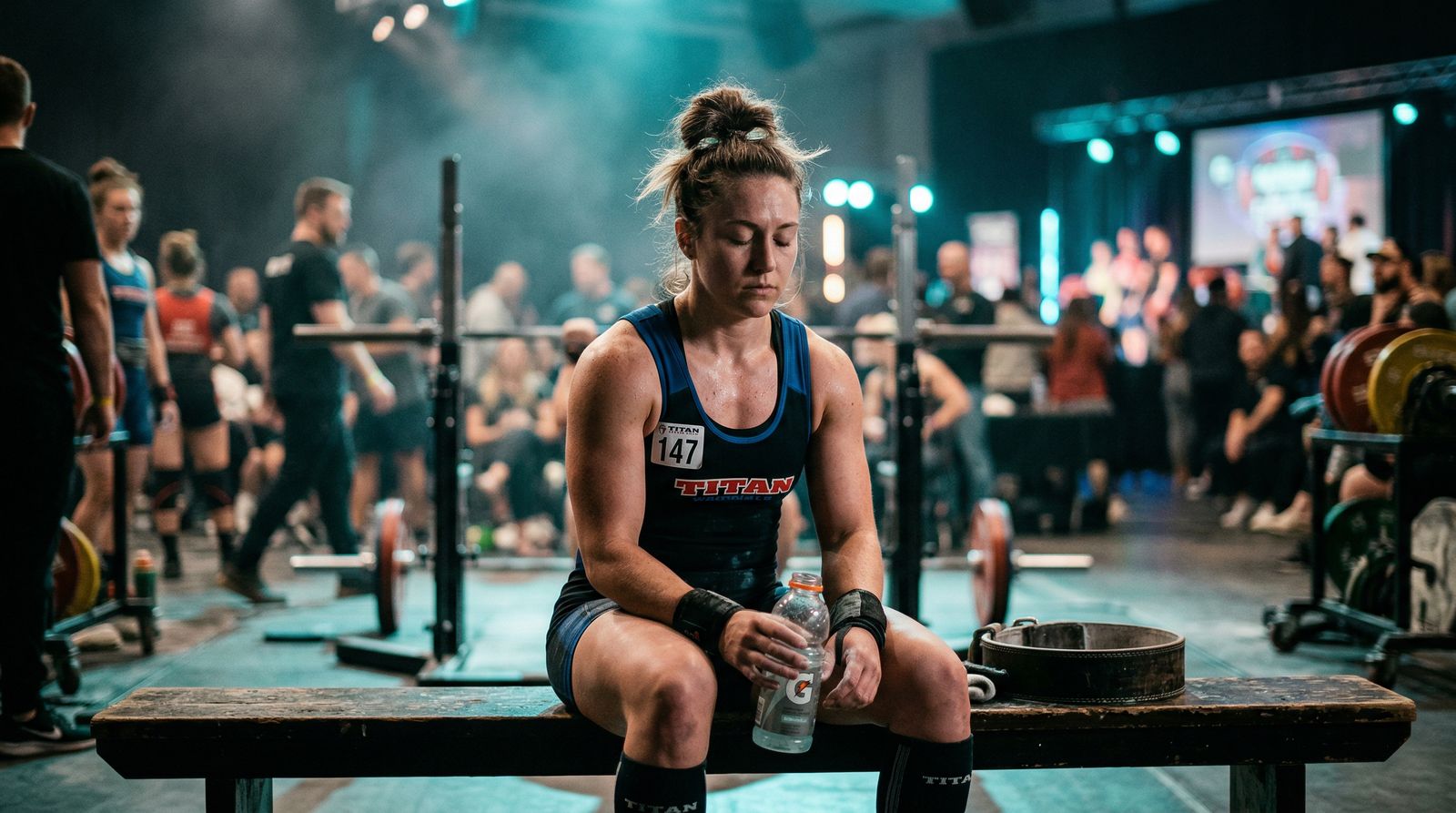
The day is long. Between flights, the interval between your attempts and the next round of lifting, you have twenty to sixty minutes depending on flight size. Use it.
Between flights: fast-digesting carbohydrates. Fruit, sports drinks, rice cakes, banana. Not a full meal thirty minutes before a heavy attempt: gastric discomfort under maximal intra-abdominal pressure is a variable you don't want to introduce. Light, fast, consistent fuel.
Hydration: sip throughout the day. Not gulping. Sipping. Overhydrating between flights means fluid moving through your gut when you want your blood in your muscles. Consistent small amounts maintain plasma volume without creating digestive competition.
Caffeine: if you use it, time it. The peak effect of caffeine occurs 45–90 minutes after consumption. If your most important lift, typically your heaviest third attempt, or whichever lift you most need to nail, is at 2pm, your highest caffeine intake should arrive at roughly 12:30–1pm. Keep the dose consistent with what you use in training. Competition day is not the time to discover that twice your normal caffeine turns you into a jittery mess under three hundred kilograms.
Key Takeaways
- One night of poor sleep has minimal impact on maximal strength. Optimise the week before, not the night before.
- Pack your kit the night before: singlet, belt, shoes, wraps, chalk, and spares of the small items.
- Arrive in the warm-up room 30–45 minutes before your first attempt; warm up to 85–90% of your opener and stop.
- Open conservatively every time. The opener's job is to establish your total, not demonstrate your strength.
- Practise with platform commands in the final weeks of your training block. They change your timing and must become automatic.
Put It Into Practice
This week: Write out your competition day timeline: weigh-in time, expected flight start, warm-up room arrival target, and the three attempts you're planning for each lift. Having this on paper before the day removes the cognitive load of making decisions under adrenaline.
This training block: Begin running your warm-up sessions with a training partner giving commands. Practise the squat, bench, and deadlift commands on every heavy single and near-maximal set. By the time you stand on the platform, the commands should feel like part of the lift, not an interruption to it.
Long term: Treat every competition as a data set. Log the attempts you selected, how they felt, what you'd change, what worked. After three or four meets, patterns emerge: the kinds of openers you consistently make easily, the jump sizes that serve you best on thirds, the foods that work between flights. The playbook becomes more specific the more data you collect.
Analysed by FINAL FORM AI. Your form, perfected.
References
- 1McGowan CJ, Pyne DB, Thompson KG, et al.. 'Warm-up strategies for sport and exercise: mechanisms and applications.' Sports Med. 2015. PMID: 26400696
- 2Guest NS, VanDusseldorp TA, Nelson MT, et al.. 'International society of sports nutrition position stand: caffeine and exercise performance.' J Int Soc Sports Nutr. 2021. PMID: 33388079
- 3Jentjens R, Jeukendrup A. 'Determinants of post-exercise glycogen synthesis during short-term recovery.' Sports Med. 2003. PMID: 12617691
- 4Travis SK, Mujika I, Gentles JA, et al.. 'Tapering and peaking maximal strength for powerlifting performance: a review.' Sports (Basel). 2020. PMID: 32917000
- 5Pritchard HJ, Tod DA, Barnes MJ, et al.. 'Tapering practices of New Zealand's elite raw powerlifters.' J Strength Cond Res. 2016. PMID: 26670988