Deadlift Biomechanics: Levers, Load, and the Hip Hinge
How lever arms, moment forces, and hip anatomy shape the perfect pull.
By Dhiren Dunraj MSc
Key Insight
“The deadlift does not injure people. Poor positions injure people, and understanding why those positions are dangerous is the beginning of never holding them under load.”
The deadlift has a reputation problem. People who have never studied the research consider it dangerous, and lifters who have been told by well-meaning but misinformed professionals to avoid it have absorbed that fear without examining the loading data. The data says something different. A deadlift performed with a braced, stacked spine produces compressive loads that healthy spinal tissue is built to tolerate. It develops the posterior chain under the loads and movement patterns that show up in real-world lifting. That is not a guarantee the lift cannot hurt you. It is a reason the technique rules exist.
This article explains why, using the actual science of how the lift works. Understand the mechanics and you understand why the technique details matter, not as arbitrary rules, but as logical consequences of physics applied to anatomy.
The Posterior Chain as a Cable System
Before you can understand the deadlift, you need to understand the system doing the work.
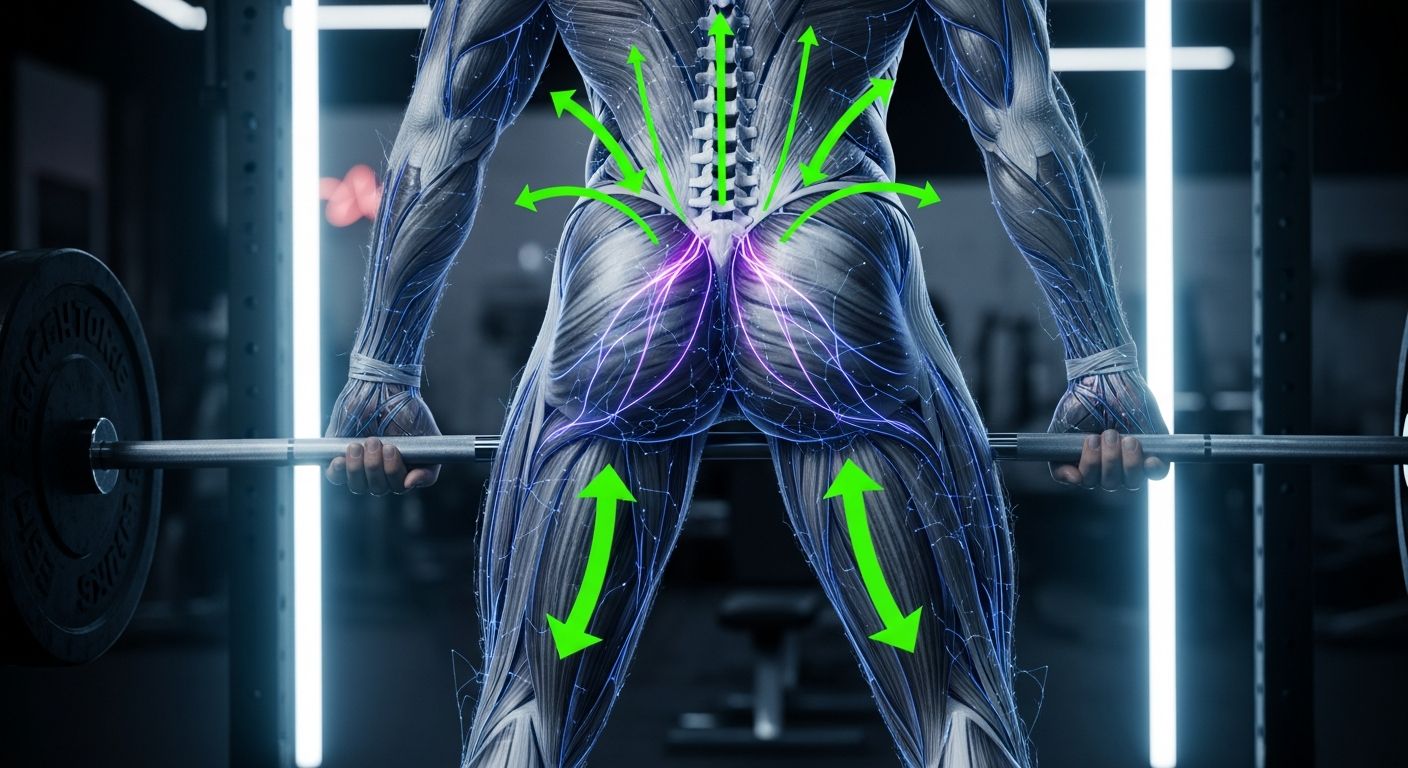
The posterior chain is the interconnected network of muscles along the back of the body, with the hamstrings, the gluteus maximus, and the erector spinae group being the primary players. Picture them as a tensioned cable system rather than isolated muscles contracting independently. When you stand up from a hip hinge, the hamstrings and glutes are shortening, contracting to pull the pelvis toward the femur, which extends the hip. The bar rises because the hips extend. That's the deadlift.
The hamstrings attach from the ischial tuberosity (the sit bone) to the top of the tibia. When they contract, they pull the pelvis downward at the back, which, with the femur held in position by the foot pressing into the floor, creates hip extension. The glutes attach from the posterior pelvis to the greater trochanter of the femur, and they're the most powerful hip extensors in the body. When the glutes fire, the hip drives forward. Together, hamstrings and glutes, they're the engine of the deadlift.
The erector spinae (the long column of muscles running alongside the spine) do a different job. They are isometric stabilisers, not primary force producers. Their job is to resist spinal flexion, to prevent the spine from bending forward under load, not to produce the lifting force.
The back does not lift the bar. The hips lift the bar. The back prevents the spine from folding.
Erector Spinae vs Glutes: The Common Misunderstanding
Most beginners feel the deadlift primarily in their lower back. They interpret this as evidence that the lower back is doing the work. This interpretation is understandable and wrong.
The erector spinae are under significant isometric tension throughout the deadlift. This is especially true in the early portion of the pull, when the back angle is most horizontal and the moment arm between the bar and the hip is longest. Working hard under isometric tension produces a very strong sensation of muscular effort. It also produces the delayed onset muscle soreness that makes beginners walk funny for three days after their first deadlift session.
Hard work is not the same as primary force production.
If the erectors are doing the majority of the work in your deadlift, if the lift feels predominantly like a lower back exercise, that's a technique signal, not a design feature. The technique errors that shift load to the lower back are specific and identifiable:
Hips rising before the bar moves. When the hips shoot up at the start of the pull, the lifter's legs have largely left the lift. The back takes the load the legs were supposed to carry. The erectors go from stabilisers to primary movers under a mechanically disadvantaged position. This is where deadlift lower back injuries originate.
Lat disengagement mid-pull. When the lats release, usually under genuine maximal effort, the bar drifts forward. The moment arm at the hip increases. The erectors must now resist a larger rotational force. Again, the back is doing more than its intended job.
A deadlift where the posterior chain is working correctly feels primarily like a leg and hip effort, with the lower back providing the rigid background against which that effort is applied. If it feels like a back exercise, the technique or the programming (too much weight, too soon) is the variable to adjust.
Sumo vs Conventional: Muscle Recruitment in Depth
These are genuinely different lifts in terms of which muscles bear the primary load. Understanding the differences helps you train each appropriately and make an informed decision about which suits your anatomy.
Erector spinae demand: Conventional deadlifts, particularly for lifters with longer torsos, produce a more horizontal starting back angle. A more horizontal back angle means a longer moment arm between the bar and the lumbar spine. The spine sits further from the line of force, and the erectors must resist greater torque to maintain position. That is a higher stabiliser demand on the erectors, not a danger in itself. For lifters with strong erectors relative to their glutes and hamstrings, conventional may feel mechanically natural.
Sumo deadlifts, with the more vertical starting back angle produced by the wider stance and more open hips, shorten the moment arm between the bar and the lumbar spine. The erectors are under somewhat lower relative demand. This is one factor that makes sumo potentially more back-friendly for lifters whose erectors are a limiting factor.
Adductor demand: This is the defining recruitment difference of the sumo stance. The hip abduction required to hold a wide sumo stance places the hip adductors (the muscles of the inner thigh) under a very specific and substantial load. In the sumo pull, the adductors are working both to maintain the hip abduction position and to assist hip extension. Sumo lifters who experience inner thigh fatigue or weakness as a limiting factor almost always have an adductor strength deficit. The fix is targeted adductor strengthening alongside sumo practice.
Quadriceps demand: Sumo places a higher quad demand than conventional for most lifters. The wider stance means the initial drive off the floor has a greater knee extension component. A sumo lifter with underdeveloped quads will feel the drive off the floor as a limiting factor. Conventional lifters also use the quads, but the knee extension component is typically smaller relative to the hip extension component.
Hamstring demand: Conventional places a higher hamstring demand for most lifters. The setup creates more hamstring pre-tension, since the hip hinge with narrower stance and longer back angle puts the hamstrings under greater stretch at the start position. A conventional lifter who feels the hamstrings as a limiting factor benefits from Romanian deadlifts and other hip hinge variations that specifically develop hamstring length and strength.
Neither stance is more difficult. They're difficult in different ways, for different muscles, for different proportions. An advanced lifter choosing between them is selecting the mechanical environment that best matches their muscular strengths and anatomical proportions.
Leverages and Hip Height: The Goldilocks Problem
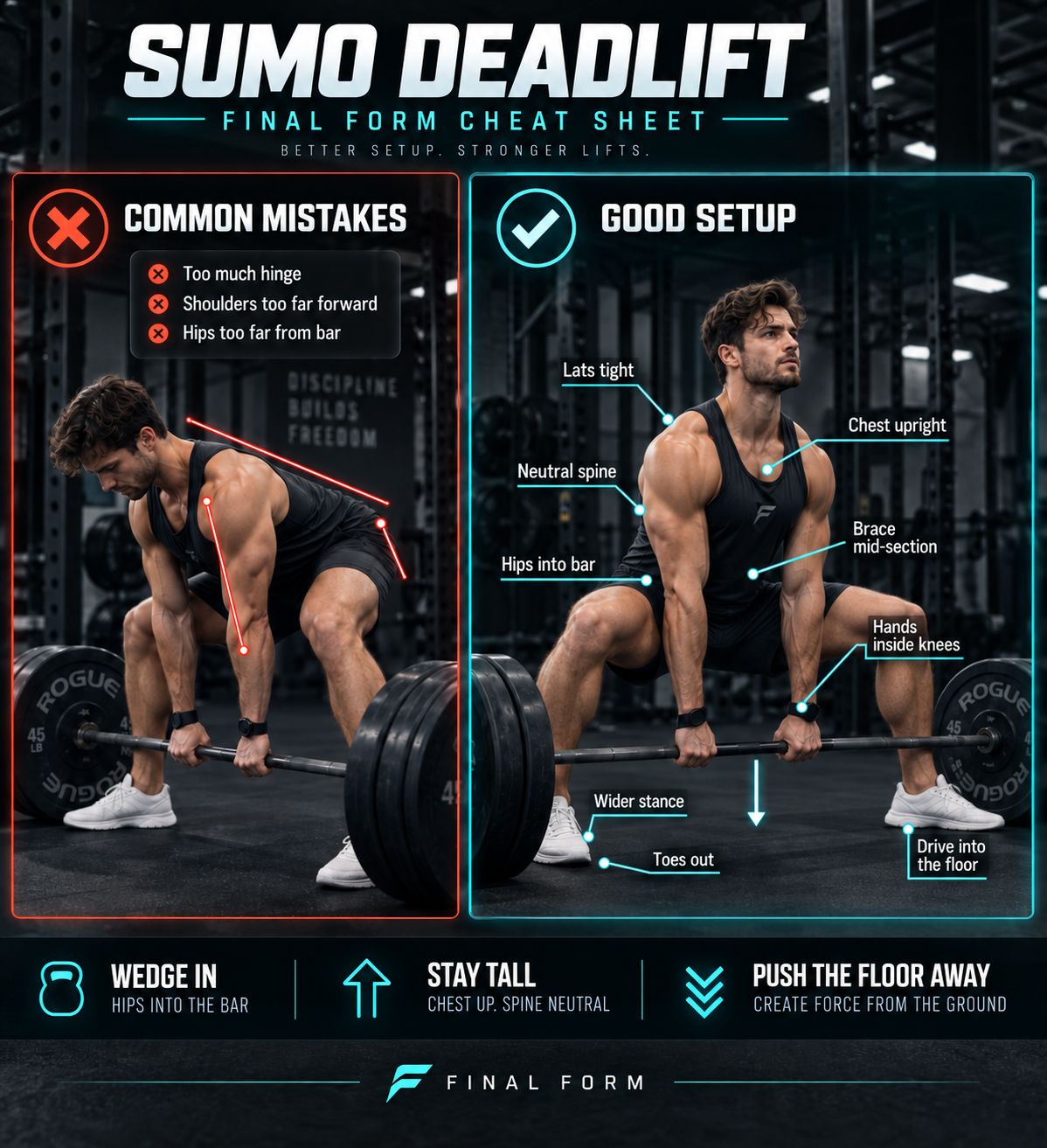
The correct hip height in the deadlift is one of the most misunderstood setup variables. It's also one of the most individual. There is no universal correct hip height because your torso-to-leg-length ratio sets it.
The principle is that the shoulder blades must be directly over the bar at the start of the pull. This is the universal marker. It positions the body so that the initial leg drive can be applied directly, the back angle is set for that particular lifter's proportions, and the bar path can be vertical.
If the hips are too high:
- The shoulder blades shift in front of the bar
- The torso angle becomes too horizontal
- The setup resembles a Romanian deadlift rather than a deadlift
- The bar begins to rise and the back takes a higher relative load because the legs cannot drive efficiently from this position
If the hips are too low:
- The knees come forward, potentially into the bar path
- The setup resembles a squat
- The hips are in a position that cannot extend efficiently. When the pull begins, the hips shoot upward to find the correct hinge angle, abandoning the leg drive before the bar has moved.
The Goldilocks position is specific to your body. A lifter with very long legs and a short torso will have a notably higher hip position at setup than a lifter with short legs and a long torso, because the shoulder-blades-over-bar requirement produces a different hip angle for each.
Finding your correct hip height is a process of observation. Film from the side. Identify where your shoulder blades are relative to the bar at the moment the pull begins. If they're in front of the bar, raise your hips slightly. If they're behind the bar, lower them. Adjust until the position is correct, then repeat it until it's automatic.
Shear vs Compressive Spinal Load: The Key Safety Distinction
This is why the deadlift, performed correctly, is not dangerous to the spine, and why performed incorrectly, it can be.
There are two types of load that act on the spine during lifting:
Compressive load is force directed along the axis of the spine, pressing down from above, as though trying to compress the vertebral column. The vertebral bodies (the cylindrical bone sections that stack to form the spinal column) are dense, strong structures built for exactly this purpose. Under a correctly performed deadlift with a braced, neutral spine, the predominant loading force on the spine is compressive. The spine is strong in compression.
Shear load is force directed perpendicular to the axis of the spine, a sliding force between vertebrae, as though trying to push one vertebra forward relative to the one below it. This is the force type that damages intervertebral discs and the ligaments that hold the vertebral column together. The spine is significantly weaker in shear than in compression.
The deadlift generates shear load primarily through two mechanisms:
- 1Spinal flexion under load. When the lumbar spine rounds (the pelvis tilts posteriorly, the lumbar curve flattens or reverses) the geometry of the vertebral contact changes. What was a compressive arrangement becomes a shear arrangement. The force is now partly directed across the disc rather than through it. Lumbar rounding under load is the primary source of disc injury in the deadlift.
- 1Bar drift. When the bar drifts forward, away from the body, the moment arm at the hip increases. To maintain position, the erectors must resist a greater torque. This greater rotational demand increases the shear component of the load on the lumbar vertebrae. Bar drift compounds the shear load.
The implications are direct. A deadlift with a braced neutral spine and bar kept close to the body generates acceptable compressive load and minimal shear. The spine handles it well. The same weight lifted with a rounded lumbar spine and a bar that has drifted forward generates significant shear load on the lumbar discs. The spine does not handle this well.
Studies measuring lumbar loading during heavy, well-braced deadlifts report compressive forces within the documented tolerance of healthy spinal tissue. Rounding and bar drift change the shear picture. That is the mechanism the technique rules are trying to avoid — not a promise that the lift cannot hurt you.
The Case for Training the Posterior Chain
If the deadlift is so mechanically demanding, why do so many coaches still treat it as a first-line posterior-chain builder rather than a lift to avoid?
The answer is in what the deadlift trains. The posterior chain (hamstrings, glutes, erectors) is chronically undertrained in the general population. Office workers, sedentary lifestyles, and exercise programmes dominated by machines and isolation movements leave these muscles underdeveloped relative to the anterior chain. The consequence is predictable: the posterior chain lacks the strength and endurance to support the spine and hips under the loads of daily life.
Weak hip extensors and limited posterior-chain endurance show up often in people with recurrent low-back pain. Hip-hinge training is one of the usual tools used to rebuild that capacity. It is not a treatment guarantee, and it is not a reason to pull with a rounded back.
The deadlift does this specifically. It develops the posterior chain under the loads and movement patterns that are closest to real-world demand. No machine replicates this. No isolation exercise targets the hamstrings, glutes, and erectors simultaneously in their functional relationship.
A person who can deadlift double their bodyweight with correct technique has built posterior-chain capacity that daily life rarely trains. The lift is still only as good as the positions you hold under it.
The caveat is that the technique must be correct. A poorly executed deadlift (rounded spine, bar drift, jerked off the floor) is a different risk profile entirely. The lift is the vehicle. The technique is the safety system.
Why the Brace Is the Safety System
Everything in the biomechanics section above points to one practical conclusion: the brace is the primary mechanism by which the deadlift becomes safe.
The Valsalva manoeuvre (the 360-degree intra-abdominal pressurisation) converts the flexible, compressible column of the spine into a rigid hydraulic cylinder. The pressurised abdomen acts as an internal splint that prevents spinal flexion under load. It also assists in transferring force from the legs through the torso to the bar.
Increased intra-abdominal pressure reduces the compressive and shear loads on the lumbar spine during lifting. The pressurised abdominal cavity pushes upward on the diaphragm and downward on the pelvic floor, generating an extensor moment at the lumbar spine that partially offloads the erectors. The spine is now supported internally as well as externally by the muscle groups surrounding it.
A brace that's partial (habitual shallow breathing, poor engagement of the obliques or lower back) provides partial protection. A brace that's complete (full 360-degree pressurisation, held for the duration of the rep) provides the maximum available spinal protection. There is no moderate position. Train the complete brace from session one, and never allow it to be a variable that degrades with increasing effort.
Key Takeaways
- The deadlift is a posterior chain movement. Hamstrings and glutes lift the bar; the erectors stabilise the spine against flexion. Confusing these roles leads to technique errors that shift load incorrectly.
- Compressive spinal load in a correctly performed deadlift is within documented spinal tolerance. Shear load from lumbar flexion or bar drift is the actual injury mechanism.
- Sumo places higher demand on adductors and quads; conventional places higher demand on hamstrings and erectors. Neither is more difficult. They're difficult differently.
- Hip height is individual and determined by the principle that shoulder blades must be directly over the bar at the start of the pull. There is no universal number.
- The deadlift develops the posterior-chain musculature that is often undertrained in people who sit all day and then complain of a tired back.
- The brace is the primary safety system in the deadlift. 360-degree intra-abdominal pressure reduces both compressive and shear loads on the lumbar spine and must be complete, not partial.
Put It Into Practice
This week: Before your next deadlift session, practise the hip hinge without the bar. Stand at arm's length from a wall, push your hips back until they touch the wall, spine neutral throughout. This is the hinge pattern. Feel the hamstring pre-tension at the bottom. That sensation should be present in every deadlift setup.
This training block: Add a single Romanian deadlift set after your main deadlift work, three sets of eight at 40–50% of your deadlift max. The Romanian deadlift develops hamstring length and strength specifically in the range of motion that matters most for the conventional pull off the floor. Do this for eight weeks and notice the change in your starting position.
Long term: Study the research, not the myth. The deadlift's reputation is worse than the loading data, and a rounded, drifting pull is not the same lift. A lifter who understands why the technique rules exist is more likely to maintain them under pressure than one who follows them on faith. Know the physics. Respect the positions.
Analysed by FINAL FORM AI. Your form, perfected.
References
- 1Escamilla RF, Francisco AC, Fleisig GS, et al.. 'A three-dimensional biomechanical analysis of sumo and conventional style deadlifts.' Med Sci Sports Exerc. 2000. PMID: 10912892
- 2Escamilla RF, Francisco AC, Kayes AV, et al.. 'An electromyographic analysis of sumo and conventional style deadlifts.' Med Sci Sports Exerc. 2002. PMID: 11932579
- 3Swinton PA, Stewart A, Agouris I, et al.. 'A biomechanical analysis of straight and hexagonal barbell deadlifts using submaximal loads.' J Strength Cond Res. 2011. PMID: 21659894
- 4Hales ME, Johnson BF, Johnson JT. 'Kinematic analysis of the powerlifting style squat and the conventional deadlift during competition: is there a cross-over effect between lifts?' J Strength Cond Res. 2009. PMID: 19910816
- 5Cholewicki J, McGill SM, Norman RW. 'Lumbar spine loads during the lifting of extremely heavy weights.' Med Sci Sports Exerc. 1991. PMID: 1758295
- 6McGill SM, Norman RW. 'Reassessment of the role of intra-abdominal pressure in spinal compression.' Ergonomics. 1987. PMID: 3443085
- 7Hackett DA, Chow CM. 'The Valsalva maneuver: its effect on intra-abdominal pressure and safety issues during resistance exercise.' J Strength Cond Res. 2013. PMID: 23222073
- 8Schellenberg F, Taylor WR, Lorenzetti S. 'Towards evidence based strength training: a comparison of muscle forces during deadlifts, goodmornings and split squats.' BMC Sports Sci Med Rehabil. 2017. PMID: 28725437