Bench Press Biomechanics: The Science Behind the Press
Understanding force vectors, bar path, and leverage to build a bigger bench.
By Dhiren Dunraj MSc
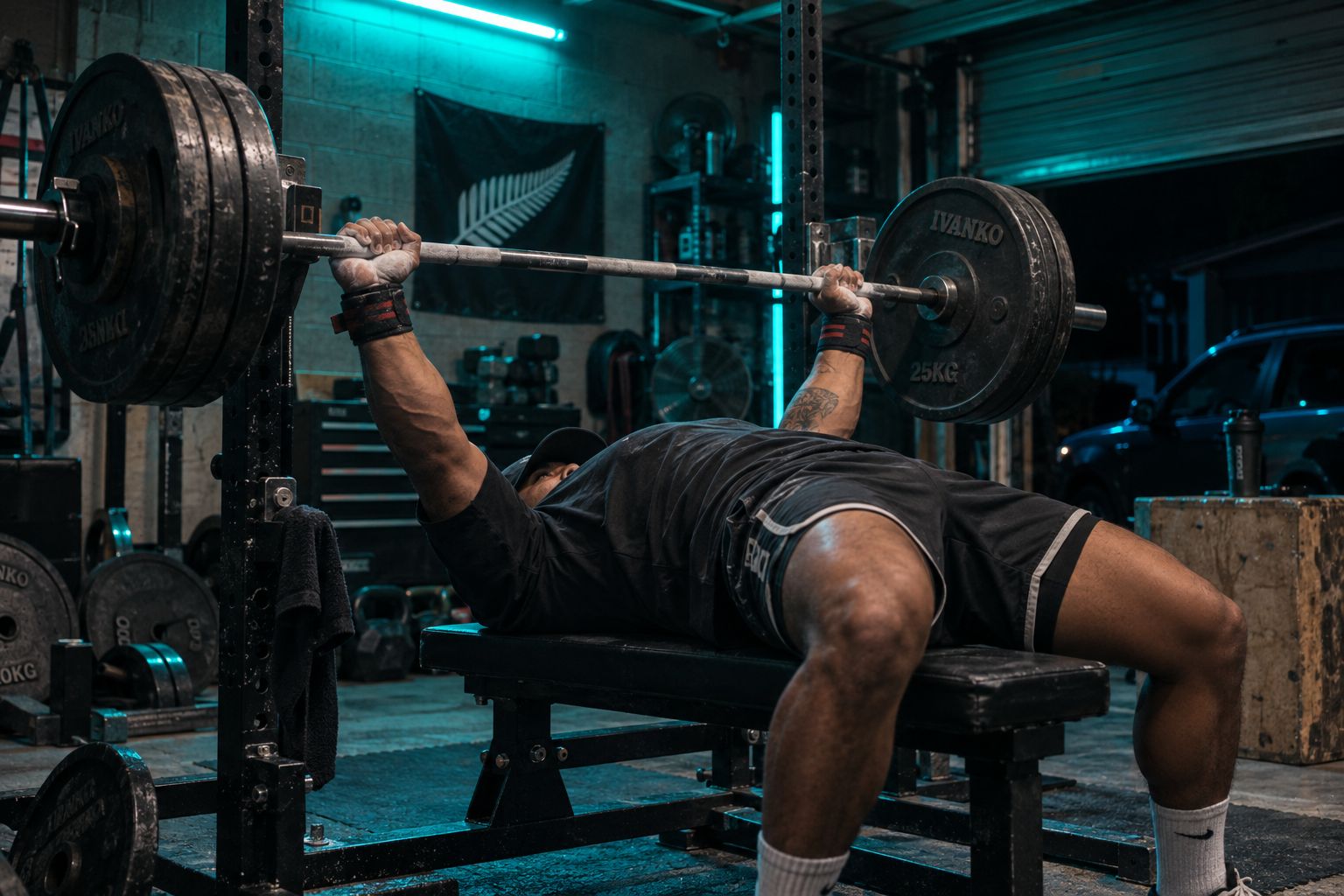
Key Insight
“The bench press has been studied with electrodes, force plates, and high-speed cameras for decades. What the research shows is not what most gym-goers expect.”
The bench press is one of the most studied lifts in sports science. Decades of electromyography, force plate analysis, and kinematic research have mapped exactly what happens inside the lift. Which muscles fire, when they fire, how the forces distribute across the shoulder joint, and what separates a mechanically efficient press from one that accumulates damage over time. Most gym-goers are unaware of what that research shows. This article lays it out.
Understanding the biomechanics changes how you train. When you know why the J-curve is optimal, you stop fighting your natural bar path and start refining it. When you understand which muscle group limits you in which portion of the lift, you stop doing more bench press to fix the problem and start choosing the accessory work that addresses the weakness. When you understand shoulder mechanics, scapular position stops being an optional setup detail and becomes the non-negotiable foundation.
This is the science. Let it inform every rep.
Muscle Contribution Across the Range of Motion
The bench press is a phased movement in which the dominant muscle group changes depending on where the bar is in its path. Electromyography studies consistently show a predictable shift, and understanding this shift is the basis for intelligent programme design.
The bottom half: pectoralis major dominant. From the moment you begin pressing off the chest, the pectoralis major is the primary driver. The pec is maximally loaded at the bottom position, where it's eccentrically stretched across its full length. As the bar travels from chest to approximately the mid-point of the range of motion, the pec contracts forcefully through its optimal length-tension range. This is why the bottom of the bench press is where pec development occurs, and why chest-specific weakness manifests as difficulty initiating the press off the chest.
The transition: both muscles contributing. Around the mid-point of the range of motion, the moment arms at the shoulder and elbow joints begin to shift. The pec's mechanical advantage starts to decline as the shoulder joint closes. The triceps' mechanical advantage starts to increase as the elbow joint approaches the lock-out angle.
The top half: triceps brachii dominant. From mid-range to lockout, the triceps brachii are the primary driver. The lateral and medial heads of the tricep are working hardest through the final range of extension. The sticking point for most intermediate lifters is somewhere in the mid-range to upper third of the press, not at the chest, where the pec is losing its contribution and the triceps have to take over. A stalling bar in this range signals tricep weakness, not chest weakness. A stalling bar right off the chest signals bottom-position weakness: either pec strength out of the stretched position, or insufficient leg drive and arch to load the pec effectively.
The anterior deltoid throughout. The anterior head of the deltoid contributes throughout the entire range of motion, but is maximally stressed at the bottom position, the same position where the pec is maximally stretched. This creates a vulnerability: the bottom of the bench press is simultaneously the most mechanically demanding position for both the pec and the anterior deltoid. For a lifter with anterior shoulder issues, this concentration of load at the bottom is relevant. It's why elbow tuck and scapular control at the bottom are the difference between a lift that trains the shoulder and a lift that damages it.
How Grip Width Shifts the Equation
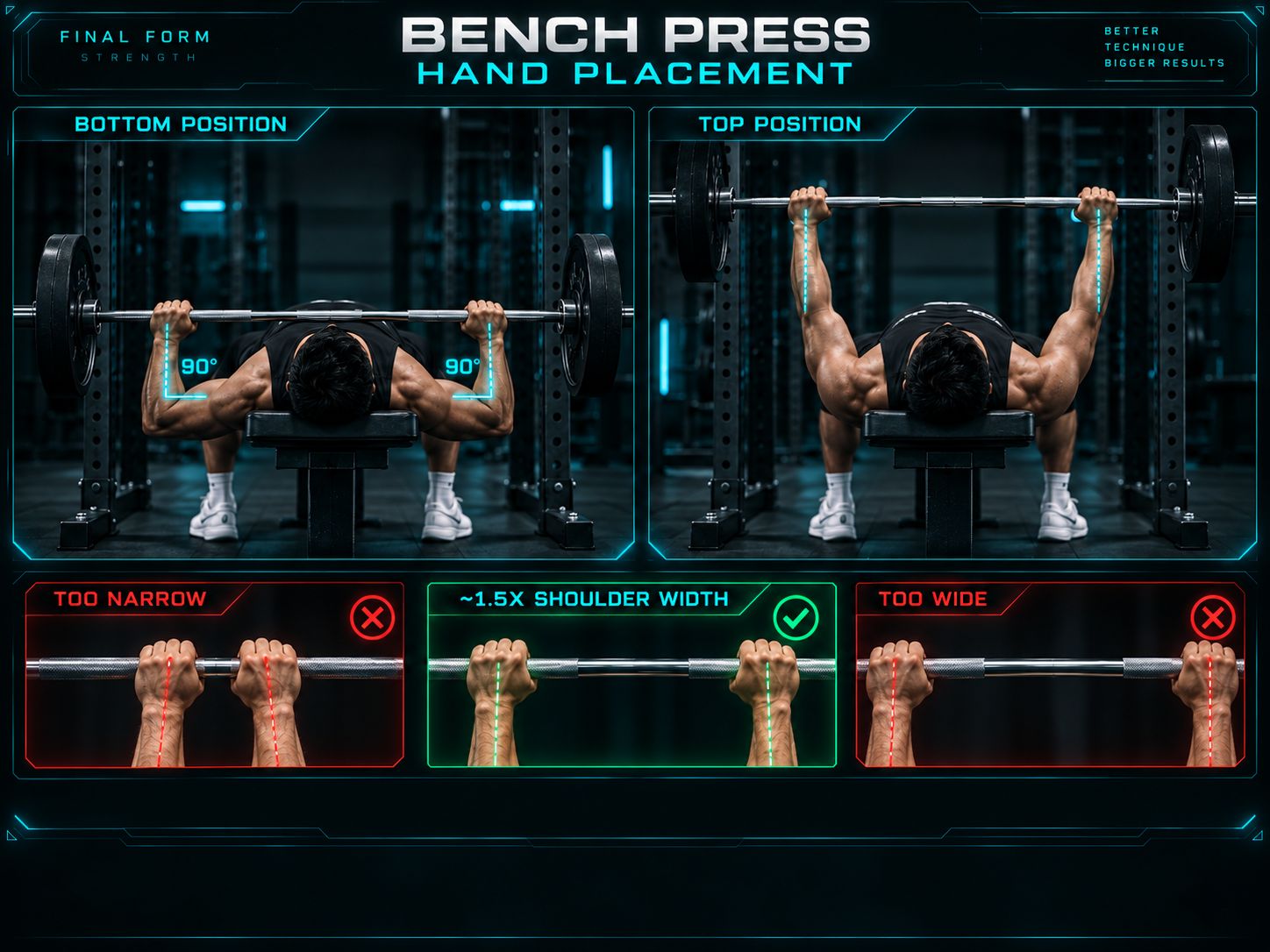
The grip width on the barbell is an input that changes the physics of the lift across three variables: range of motion, muscle activation balance, and shoulder joint stress. Change the grip width and you change all three simultaneously.
Range of motion. A wider grip shortens the range of motion. When the hands are further apart, the bar is closer to the chest at lockout, so there is less distance to cover. A narrower grip increases the range of motion. When the hands are closer together, the arms are more vertical at lockout relative to a wide grip, and the bar must travel further to reach the chest. This is a physical consequence of limb geometry.
Muscle activation. A wider grip increases horizontal adduction at the shoulder, where the shoulder is moving the upper arm across the body, which is the primary action of the pectoralis major. Wider grip, more pec activation. A narrower grip reduces horizontal adduction and increases the elbow extension component, which is the primary action of the tricep. Narrower grip, more tricep activation. EMG studies confirm this relationship.
Shoulder joint stress. A wider grip places the shoulder in greater horizontal abduction at the bottom of the press. The upper arm approaches 90 degrees from the torso and the humeral head is compressed into the glenoid fossa at a less favourable angle. This is the position of maximum impingement risk. A narrower grip reduces this horizontal abduction at the bottom and is systematically easier on the anterior shoulder and AC joint.
The implication is that most intermediate lifters with shoulder discomfort during or after bench press should narrow their grip before any other intervention. The mechanical reduction in joint stress is immediate. The reduction in pec activation is modest. The trade-off is almost always worth making.
Bar Path Physics: The J-Curve Unpacked
A straight bar path, straight down to the chest, straight up to lockout, sounds logical. It's mechanically suboptimal. The reason comes from moment arm analysis.
A moment arm is the perpendicular distance between a joint and the line of force acting on it. Gravity pulls the bar straight down. The moment arm at the shoulder joint is the horizontal distance from the shoulder joint to the bar. The moment arm at the elbow joint is the horizontal distance from the elbow joint to the bar.
At the bottom of the bench press, the bar is over the chest, below and forward of the shoulder joint. The shoulder moment arm is significant. As the bar rises, if it travels straight up, it stays forward of the shoulder joint throughout. The shoulder moment arm remains active all the way to lockout. The shoulder must continue to produce force to hold the bar in position at the top of the press.
Now trace the J-curve. From the chest, the bar travels upward and slightly backward, toward the rack. By lockout, the bar is directly over the shoulder joint. The perpendicular distance from the shoulder joint to the bar is now zero. The moment arm has collapsed. The skeleton (the rigid column of the arm) is holding the bar directly, and the shoulder muscles are no longer required to produce a stabilising force.
On a near-maximal lift, the final few centimetres of the press are where singles are made or missed. A lifter whose bar has drifted past the shoulder joint at lockout, continuing toward the face, reopens the moment arm at the worst possible moment. The shoulder is under load when the system should have become mechanically efficient. The press stalls. The lift fails. The bar path was the fault.
The J-curve is produced naturally when the lats are engaged during the descent. The lat (latissimus dorsi) runs from the upper arm to the lower back and, when contracted, pulls the upper arm toward the hip. This engagement during the bench press descent pulls the elbows slightly inward and downward, guiding the bar toward the lower chest (away from the face) on the way down, and allowing the natural arc back toward the shoulder joint on the way up. Lat engagement is the mechanism. The J-curve is the result.
Why the Arch Reduces ROM, and Why That Matters
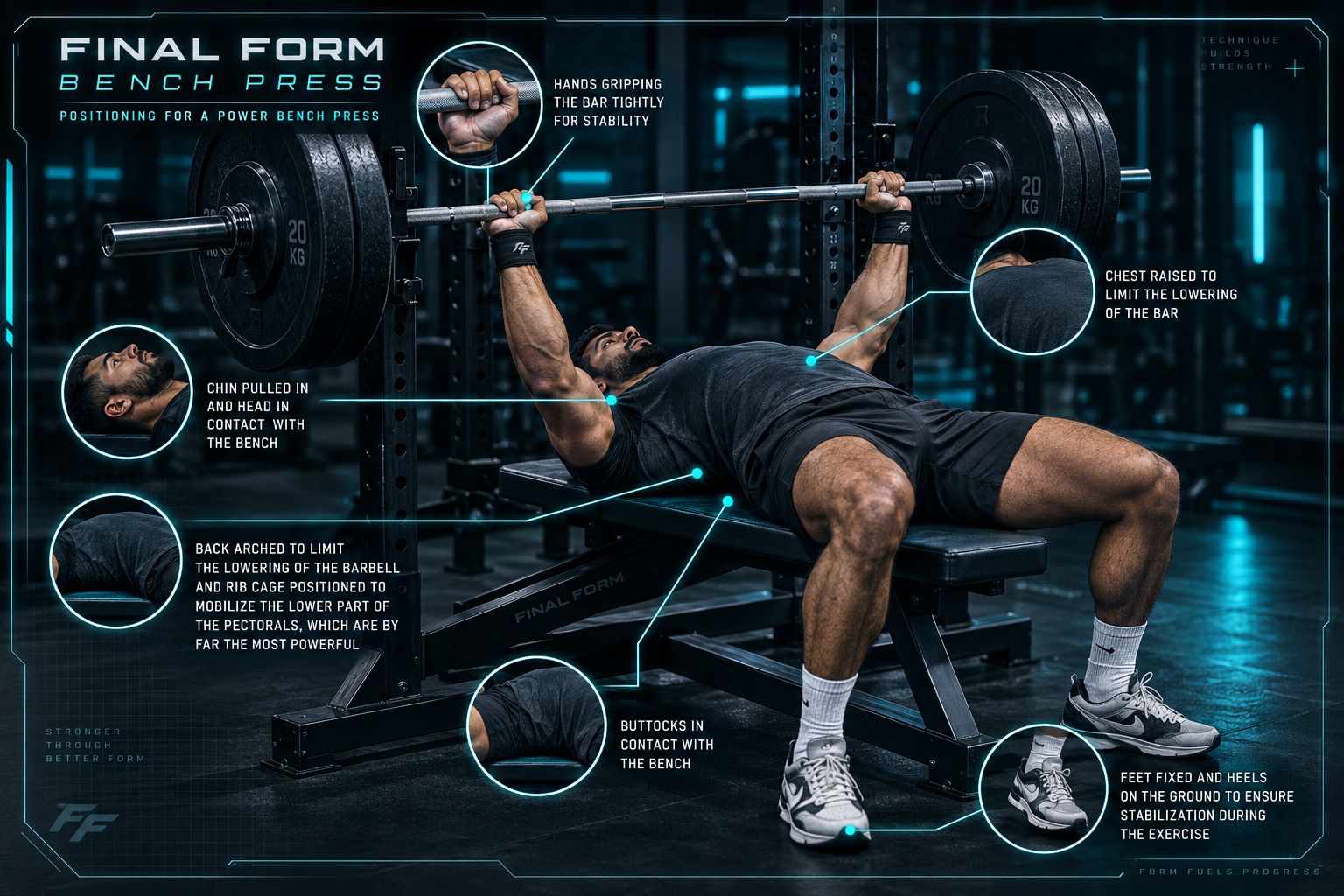
Every centimetre of reduced range of motion under a given load represents less total mechanical work performed. This is a direct application of the work-energy theorem: work equals force multiplied by displacement. Reduce the displacement; reduce the work required.
A lifter benching 150kg over a range of motion reduced by 5 centimetres through an arched setup does measurably less work per rep than the same lifter pressing the same load over a flat-setup range of motion. This energy saving adds up at near-maximal intensities. It translates directly to more force available for the press, and more force available means heavier lifts.
The criticism that this is "cheating" applies the wrong logic. Every mechanical optimisation in strength sport that does not violate the rules of the lift is legitimate technique. The Olympic weightlifter drops under the bar to reduce the height the bar must be pulled. The powerlifter arches to reduce the distance the bar must travel. The principle is identical: optimise the system within the rules.
The arch also changes the geometry of the shoulder joint at the bottom position. When the chest is elevated toward the bar, the shoulder joint is in a less extreme position of horizontal abduction at the point of chest contact. This reduces the impingement load on the AC joint and the eccentric demand on the rotator cuff at the moment of peak load. The arch is both a mechanical efficiency tool and a shoulder protection mechanism.
Shoulder Health: The Anatomy of Risk and Longevity
The shoulder joint is the most mobile joint in the human body. Mobility and stability exist in inverse proportion, so the shoulder sacrifices stability for range of motion. This trade-off creates vulnerability under heavy repeated loads, and the bench press loads the shoulder in a position it does not naturally favour.
The impingement risk. At the bottom of the bench press, the humeral head is compressed toward the acromion (the bony shelf at the top of the shoulder) by the downward force of the bar and the contraction of the muscles around the joint. When the scapula is not correctly positioned, the supraspinatus tendon and the subacromial bursa are caught between the humeral head and the acromion. This is impingement. It produces pain in the anterior and lateral shoulder, typically worst at 60 to 120 degrees of shoulder abduction, exactly the range the bench press operates through.
The fix is scapular control. When the shoulder blade is retracted (pulled toward the spine) and depressed (pulled toward the hip), the acromion rotates slightly upward and backward, creating more subacromial space. The impingement risk reduces dramatically. This is why scapular retraction and depression before every set of bench press is the primary structural modification that keeps the shoulder in a more durable position across years of training.
The rotator cuff. Four muscles comprise the rotator cuff: supraspinatus, infraspinatus, teres minor, and subscapularis. They're the stabilisers, not the prime movers, holding the humeral head centred in the glenoid while the prime movers (pec, tricep, deltoid) produce force. When the rotator cuff is weak or fatigued, the humeral head migrates anteriorly under bench press load and impingement risk increases. For a serious bench presser, rotator cuff work is maintenance, not rehabilitation. External rotation work (band pull-aparts, face pulls, external rotation drills) is standard balance work for the shoulder and belongs in every pressing programme.
Elbow tuck and its protective mechanism. When the elbows are tucked toward the body at approximately 45 to 60 degrees from the torso, two mechanical effects occur. The horizontal abduction angle at the shoulder is reduced, lowering impingement risk. The pectoralis major works through a slightly reduced but still effective range, while the tricep contribution increases slightly. This moderate elbow tuck is the optimal angle for combining force production with shoulder joint longevity.
The 90-degree elbow flare, elbows directly out from the body, maximises horizontal abduction and pec activation in isolation, but creates the highest shoulder load at the point of greatest vulnerability. Over time, that combination loads the anterior shoulder at a poor angle. The elite benchers who have pressed for 20 years without shoulder surgery are not lucky. They tucked their elbows.
Longevity in practice. Three habits protect the bench press shoulder across decades. First: maintain scapular retraction and depression throughout every set, every session. Lose the shoulder blade position and you've lost the primary shoulder protection mechanism. Second: don't ego-load ahead of your technique. The moment the setup breaks to move more weight is the moment the shoulder begins accumulating damage. Third: vary the loading patterns. Touch-and-go, paused, floor press, and close-grip bench each stress the shoulder joint differently. This variety distributes the cumulative load across the joint more evenly than performing exclusively one variation forever.
Training the Weaknesses the Research Reveals
Understanding muscle contribution by ROM phase directly informs accessory selection.
If your bench stalls off the chest, right at the initiation of the press, the fault is in the pec out of the stretched position, or in the setup conditions (insufficient leg drive, insufficient arch, inadequate scapular setting). Accessory work: pause bench at 60 to 70 percent with deliberate emphasis on initiating the press; dumbbell press at full range of motion emphasising the bottom stretch; cable flyes at the bottom range.
If your bench stalls in the mid-range to upper third, the most common sticking point, the fault is tricep strength. The pec has done its job and handed the bar off, but the tricep cannot finish. Accessory work: close-grip bench press; board presses targeting the top half of the movement; overhead tricep extensions for long-head development; tricep pushdowns under load.
If your bench stalls inconsistently, making it some days and failing it others under the same load, the fault is usually neural and setup-related. Inconsistent scapular position, inconsistent bracing, or inconsistent bar path means some reps hit the mechanically efficient path and some don't. The fix is technique standardisation, not more volume.
Key Takeaways
Muscle contribution shifts across the range of motion: pec dominates the bottom half, tricep dominates the top half. Diagnose your sticking point accordingly.
Grip width simultaneously changes range of motion, muscle activation balance, and shoulder joint stress. Shoulder health should inform grip selection before aesthetics do.
The J-curve is mechanically optimal because it collapses the shoulder moment arm to zero at lockout. Lat engagement during descent produces it automatically.
The arch reduces range of motion and improves shoulder positioning. It's a mechanical optimisation and a shoulder protection mechanism simultaneously.
Scapular retraction and depression before every set is the primary structural protection for the shoulder joint. Without it, impingement risk rises every session.
Put It Into Practice
This week: Film your bench press from the foot of the bench. Watch whether your elbows track at 45 to 60 degrees from your torso or flare out toward 90 degrees. If they flare, add the cue "elbows toward your hips" during the descent for one full session and film again.
This training block: Identify your sticking point precisely by filming from the side with bar path traced. Stalls off the chest: add paused bench and bottom-range accessory work. Stalls in the top third: add close-grip bench and tricep-specific work. Attack the actual weakness.
Long term: Add rotator cuff maintenance work to every pressing session, face pulls, band pull-aparts, or external rotation drills. Two to three sets of 15 to 20 reps. This is not optional if you intend to bench heavy for the next 20 years.
Analysed by FINAL FORM AI. Your form, perfected.
References
- 1Elliott BC, Wilson GJ, Kerr GK. 'A biomechanical analysis of the sticking region in the bench press.' Med Sci Sports Exerc. 1989. PMID: 2779404
- 2van den Tillaar R, Ettema G. 'The "sticking period" in a maximum bench press.' J Sports Sci. 2010. PMID: 20373201
- 3van den Tillaar R, Ettema G. 'A comparison of successful and unsuccessful attempts in maximal bench pressing.' Med Sci Sports Exerc. 2009. PMID: 19812510
- 4Gomo O, van den Tillaar R. 'The effects of grip width on sticking region in bench press.' J Sports Sci. 2016. PMID: 26055260
- 5Lehman GJ. 'The influence of grip width and forearm pronation/supination on upper-body myoelectric activity during the flat bench press.' J Strength Cond Res. 2005. PMID: 16095407
- 6Saeterbakken AH, Mo DA, Scott S, et al.. 'The effects of bench press variations in competitive athletes on muscle activity and performance.' J Hum Kinet. 2017. PMID: 28713459
- 7Madsen N, McLaughlin T. 'Kinematic factors influencing performance and injury risk in the bench press exercise.' Med Sci Sports Exerc. 1984. PMID: 6493018
- 8Larsen S, Gomo O, van den Tillaar R. 'A biomechanical analysis of wide, medium, and narrow grip width effects on kinematics, horizontal kinetics, and muscle activity on the sticking region in recreationally trained males during 1-RM bench pressing.' Front Sports Act Living. 2020. PMID: 33554113
- 9Duffey MJ, Challis JH. 'Fatigue effects on bar kinematics during the bench press.' J Strength Cond Res. 2007. PMID: 17530967