How to Track Body Composition for Powerlifting
Practical Methods from AI Scans to DEXA
You step on a BIA scale Monday morning: 18% body fat. Tuesday evening after training and a meal: 14%. Nothing changed except water and glycogen. That's noise, not data. Most lifters are tracking [body composition](/powersthetics-hub/powersthetics-manifesto) with tools that lie to them. Here's how to stop guessing and start measuring.
THE METHODS, RANKED
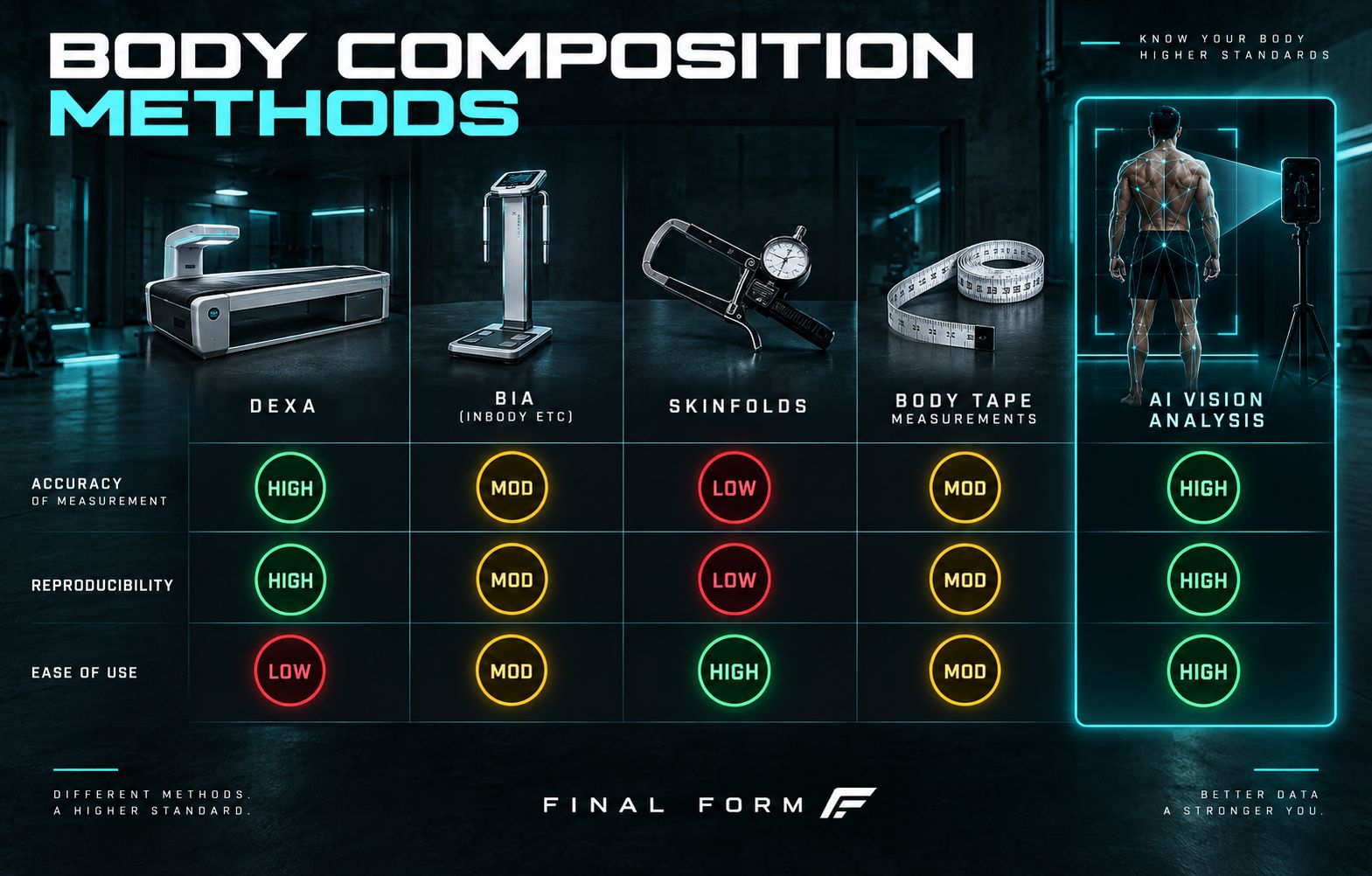
- DEXA Scan: ±1-2% error, $50-150 per scan. The gold standard. X-ray absorptiometry measures bone, lean mass, and fat regionally.
- Hydrostatic Weighing: ±2-3% error, $30-75. Accurate but requires a specialized facility and full submersion.
- The Final Form's Body Scan: free, instant. A photo-based estimate from a single front-facing photo. Use it for high-frequency trend tracking, not as a medical measurement.
- 7-Site Caliper Test: ±3-5% error with a trained technician, ~$20. Cheap and repeatable if technique is consistent.
- Bioelectrical Impedance (BIA Scales): ±4-8% error. Wildly affected by hydration, food intake, and time of day. Not recommended.
- Navy Method (Tape Measure): ±5-10% error. Assumes "normal" proportions. Useless for muscular athletes.
Consistency beats precision. Pick ONE method. Use it at the same time, same conditions, every single week. The trend line is the signal. Individual readings are noise.
HOW TO USE THE BODY SCAN
The body scan uses computer vision to analyse visible muscle definition, vascularity, ab visibility, and body proportions from a single photo. It won't replace a DEXA machine, but it gives you high-frequency data at zero cost, which DEXA can't.
The real value is the weekly delta under the same protocol, not any single reading. A shift that holds across weeks is the signal. A single reading is not.
Scan Protocol
- Same lighting, same location every time (bathroom mirror works)
- Front-facing, relaxed — not flexed, not sucking in
- Same time of day each week (morning, fasted is ideal)
- Same distance from camera (arm's length)
- Minimal clothing (shorts for men, sports bra + shorts for women)
KEY INSIGHT: Use the first scan as a baseline. Repeat the same protocol weekly. The trend line is what you train against, not any one estimate.
CALIPER TESTING: THE DIY OPTION
The 7-site protocol (chest, midaxillary, triceps, subscapular, abdomen, suprailiac, thigh) is the most accurate skinfold method. Calipers cost $15-40. The catch: most people pinch wrong, inflating error to 5-8%.
If you go this route: same sites, same side of body, same person measuring, same time of day. Every time. No exceptions.
DEXA: GROUND TRUTH
DEXA gives you regional lean mass and fat mass, bone density, and visceral fat data. Nothing else comes close for raw accuracy. Use it for:
- Baseline measurement at the start of a training cycle
- Quarterly check-ins during competition prep (every 8-12 weeks)
- Annual health screening (bone density, visceral fat)
- Validating your body scan trend against hard data
WHAT TO AVOID
BIA scales (Tanita, InBody, etc.) are unreliable for athletes. Hydration swings alone move the reading. The Navy Method is equally useless. It assumes average proportions and drastically underestimates body fat in lifters with thick necks and developed cores.
If your tracking method gives you a different body fat percentage depending on whether you drank water that morning, it's not a tracking method. It's a random number generator.
THE PROTOCOL
Combine high-frequency AI scans with periodic ground truth validation:
- Get a DEXA scan for your true baseline
- Run the body scan weekly — same day, same conditions, same protocol
- Calibrate your scan estimate against your DEXA result
- Repeat DEXA every 3-4 months to verify the trend
Weekly feedback from the body scan. Quarterly truth from DEXA. That's the system. The best measurement method is the one you actually use, and with the body scan, there's no excuse not to use it every single week.